Wu Collection, Middle Volume
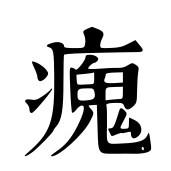
Radical: Sickness (nìng)
Kangxi stroke count: 15
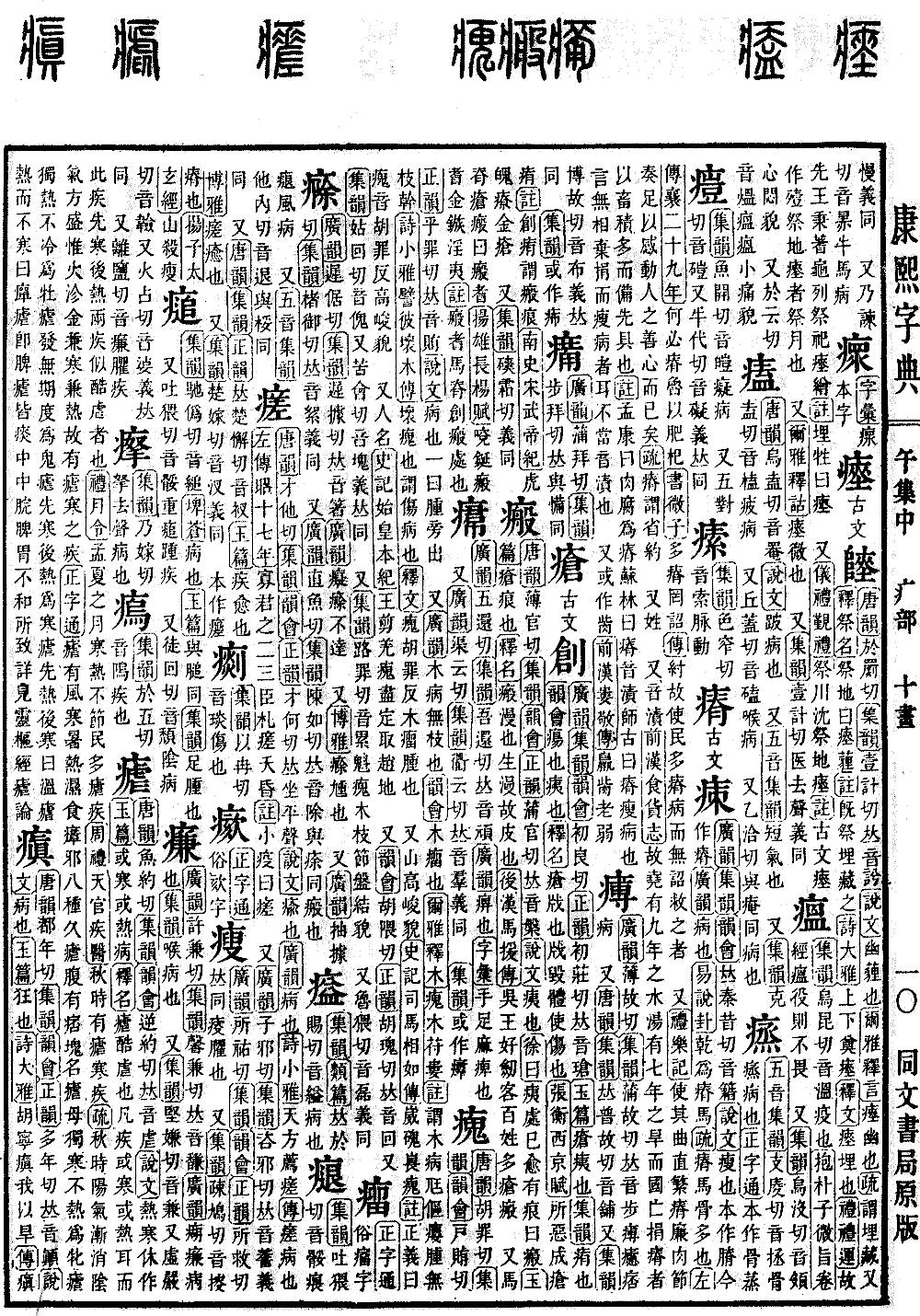
Page 778, Entry 17
Pronounced hui (falling tone).
Shuowen Jiezi (Explanation of Simple and Compound Characters): To be ill. Another meaning is a swelling protruding from the side.
Also, according to Guangyun (Broad Rimes): A tree that is diseased and has no branches.
According to Yunhui (Collection of Rimes): A tree tumor.
Erya (Approaching Nearness), chapter on explaining trees: A hui tree is a fu lou. Commentary: This refers to a diseased tree that is crooked, bent, and has a goiterous swelling with no branches or trunk.
Book of Odes (Shijing), Xiaoya, citation regarding huai wood: Huai means hui. It refers to an injury or illness.
Shiwen (Explanation of Sounds): Hui is pronounced hui (falling tone). It is a tree tumor or swelling.
Also, the appearance of a high and steep mountain.
Records of the Grand Historian (Shiji), Biography of Sima Xiangru: Wai kui wei hui. Commentary: The Zhengzhi (Orthodox Meaning) states: Hui is pronounced hui (falling tone), meaning the appearance of something high and steep.
Also, a name.
Records of the Grand Historian (Shiji), Annals of the First Emperor: Wang Jian and Qiang Hui completely pacified and took the land of Zhao.
Also, pronounced hui (level tone).
Also, pronounced kui (level tone).
Also, pronounced kuai (falling tone). The meaning is the same.
Also, pronounced lei (falling tone). Kui hui: The appearance of a tree with gnarled and twisted branches and joints.
Also, pronounced lei (rising tone). The meaning is the same.