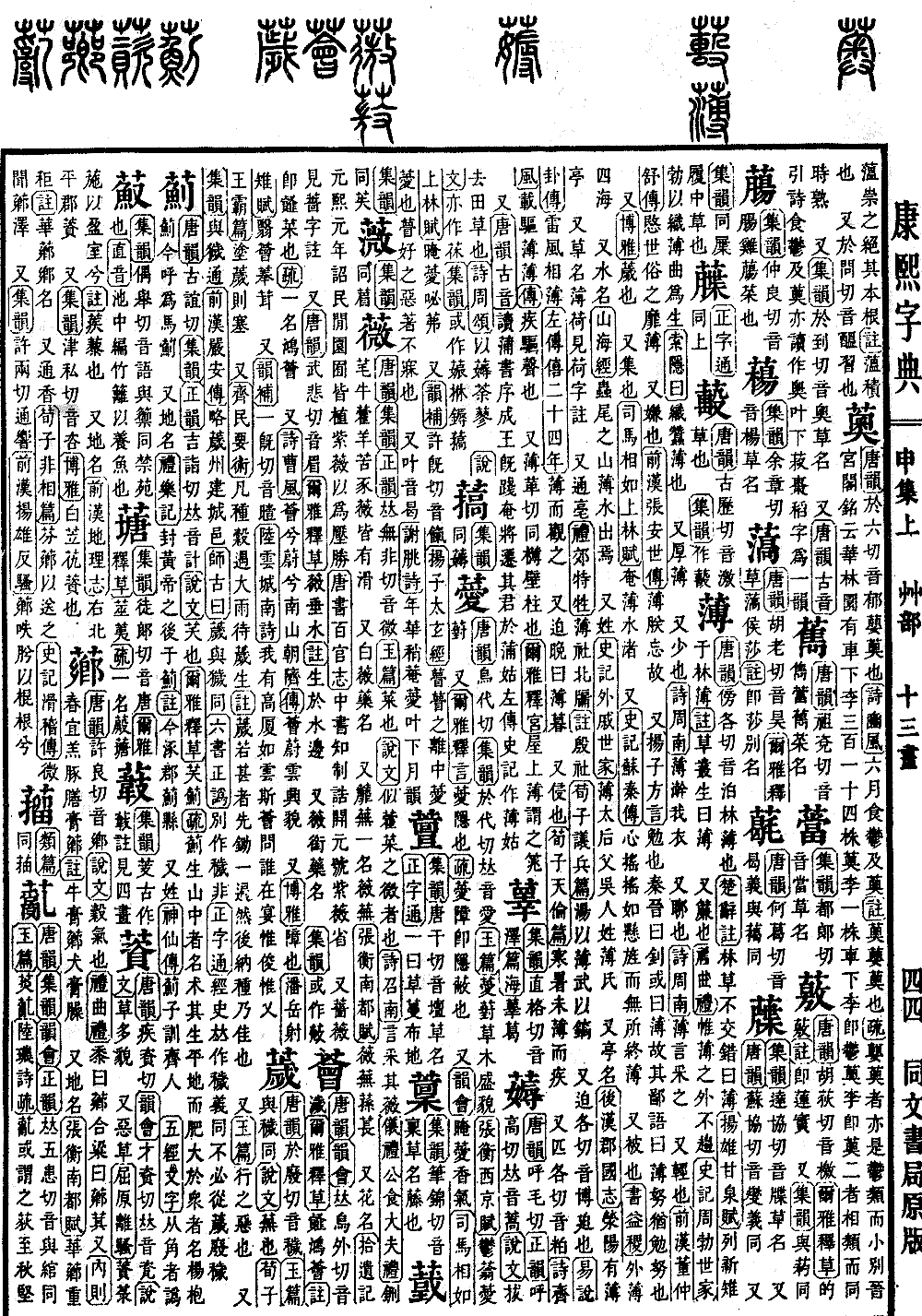
Shen Collection, Upper Volume
Radical: Grass (cǎo)
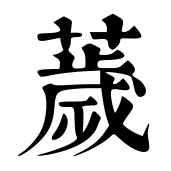
薉
Kangxi Strokes: 19
Page 1060, Entry 23
Tang Rhyme (Tangyun): Pronounced hui (falling tone).
Jade Chapters (Yupian): Same as hui (dirty).
Explaining Graphs and Analyzing Characters (Shuowen): Weeds.
Xunzi, Royal Hegemon Chapter (Wangba pian): If the path is overgrown with weeds, it becomes blocked.
Essential Techniques for the Peasantry (Qimin Yaoshu): Whenever planting grain, if one encounters heavy rain, wait for the weeds to sprout.
Annotation: If the weeds are very dense, first hoe once, then plant the seeds; this is best.
Also, Jade Chapters (Yupian): The evil of conduct.
Also, Collected Rhymes (Jiyun): Interchangeable with hui (the name of an ancient tribe).
History of the Former Han (Qianhan shu), Biography of Yan An: Annexed the Hui region and established cities and towns.
Shigu states: Hui is the same as the character for an ancient tribe.
Six Writings Corrected (Liushu zheng'e): Another form is written as hui (dirty), but this is incorrect.
Correction of Characters (Zhengzitong): Classics and histories use hui (dirty), the meaning is the same. There is no need to follow the form of 薉.