Shen Collection, Upper Volume
Radical: Grass (cǎo)
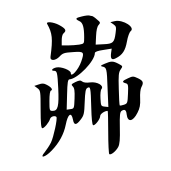
Hui
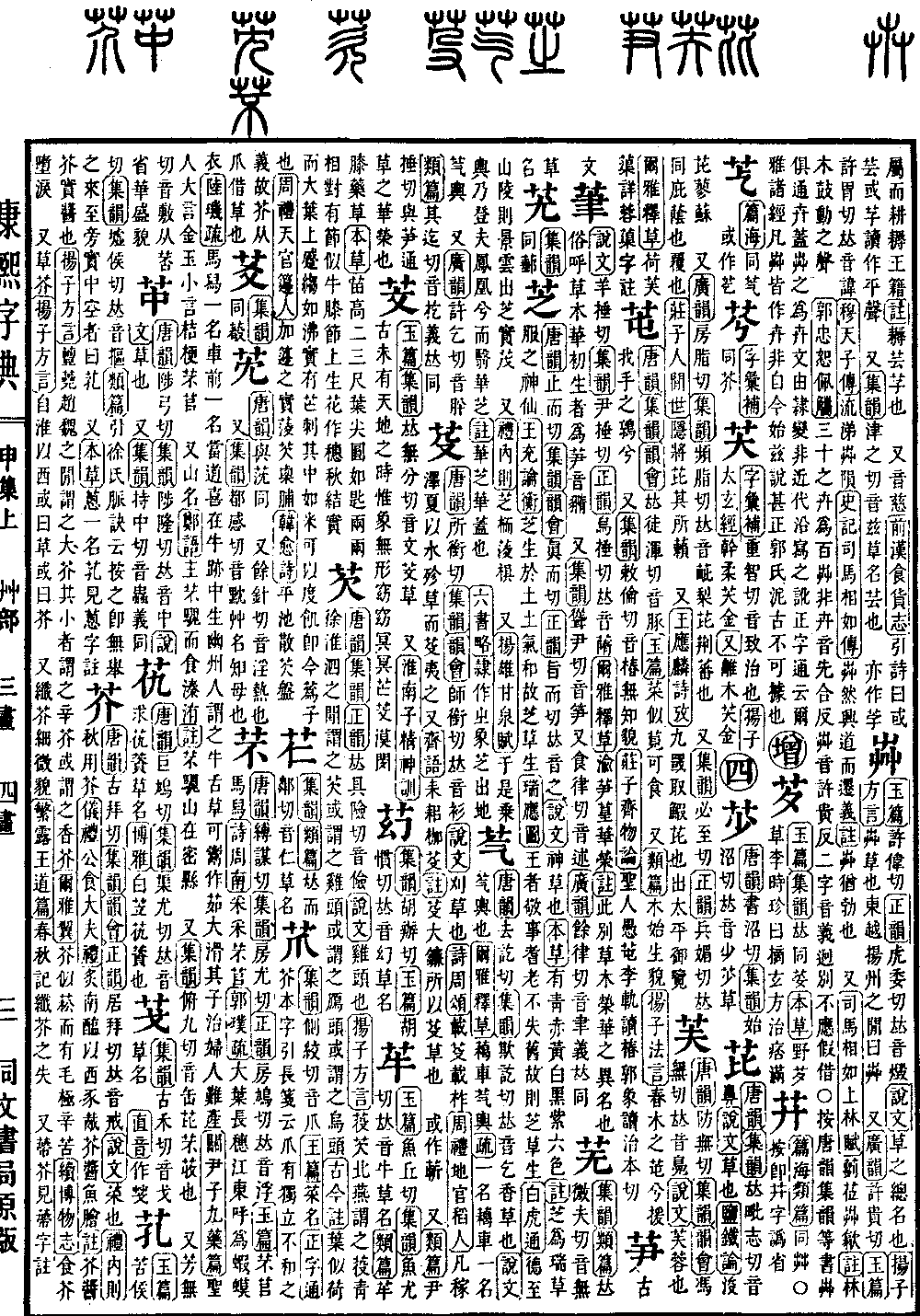
Page 1019, Entry 01
Jade Chapters (Yupian) pronounced hui (rising tone); Correct Rhymes (Zhengyun) pronounced hui (rising tone).
Explaining Graphs and Analyzing Characters (Shuowen): A general term for grass.
Master Yang's Regional Speech (Yangzi Fangyan): Hui refers to grass. In the regions between Eastern Yue and Yangzhou, it is called hui.
Also, in Broad Rhymes (Guangyun) pronounced hui (falling tone); Jade Chapters (Yupian) pronounced hui (falling tone).
Chronicle of the Son of Heaven (Tianzi Zhuan): Shedding tears as they fell.
Records of the Grand Historian (Shiji), Biography of Sima Xiangru: Suddenly rising to follow the path and shift towards righteousness.
Commentary: Hui here means flourishing.
Also, Sima Xiangru, Rhapsody on the Shanglin Park (Shanglin Fu): The rustling sound of the forest trees.
Commentary: The sound of forest trees swaying and moving.
Guo Zhongshu, Carrying the Jade Ring (Peixi): To say that thirty grasses make one hundred hui is incorrect. Hui is pronounced xian he, and hui is pronounced xu gui; the sounds and meanings of the two characters are distinctly different and should not be used interchangeably.
According to the Tang Rhymes (Tangyun), Collected Rhymes (Jiyun), and other books, the two characters are both synonymous with grass. The change from the form hui to the form hui is a result of the evolution from clerical script to modern forms, not a recent scribal error.
The Correct Meaning Guide (Zhengzitong) states: In the Literary Expositor (Erya) and other classics, all instances of this term are written as the variant form, and this has been the case since ancient times; this view is very accurate. Guo Zhongshu's insistence on ancient forms is unreliable.