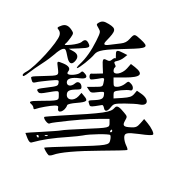
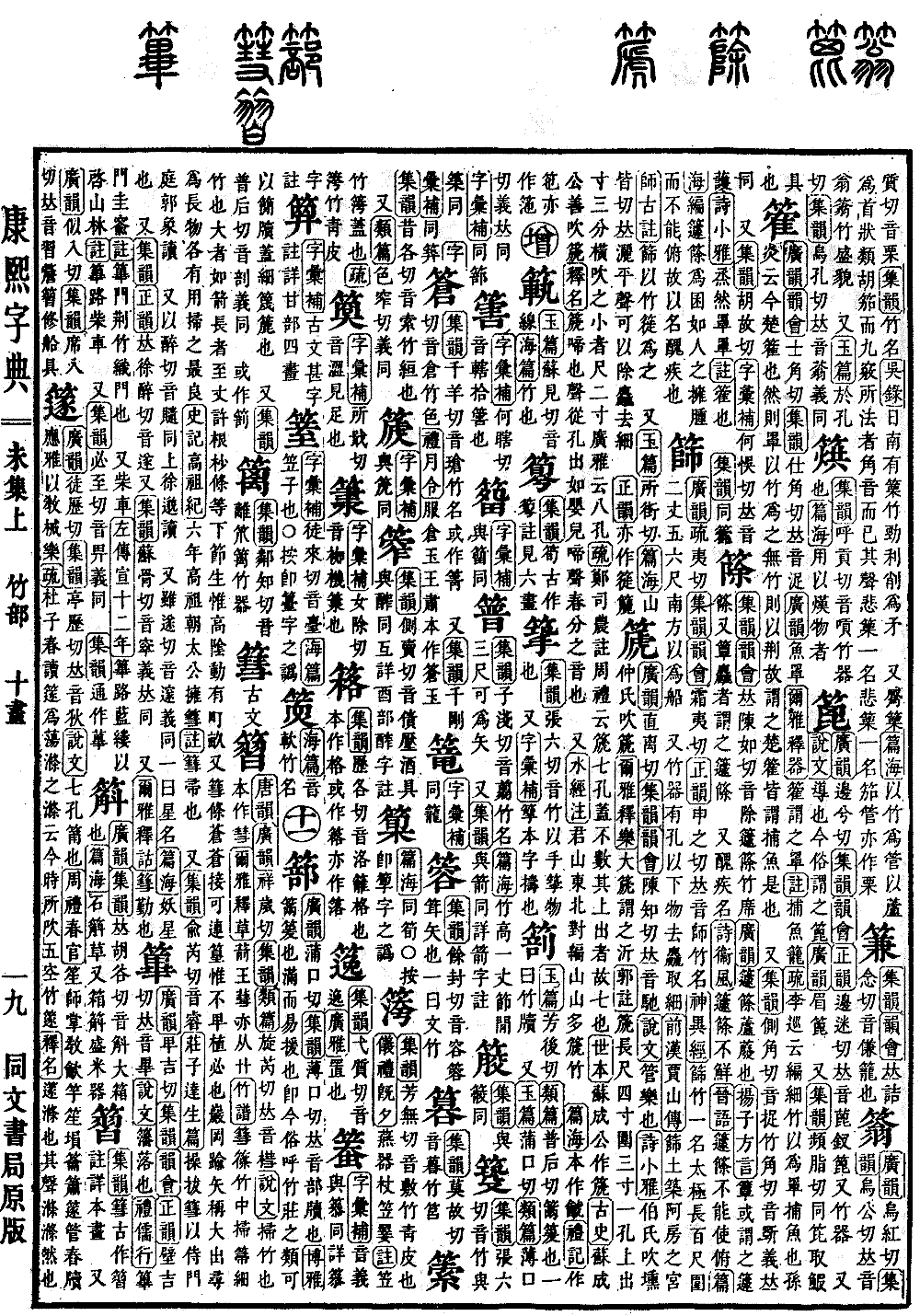
Wei Collection, Upper Volume
Radical: Bamboo (zhú)
Hui
Kangxi strokes: 17
Page 895, Entry 37
Ancient form. Tang Rhymes (Tangyun) and Broad Rhymes (Guangyun) provide the pronunciation sui (rising tone). Collected Rhymes (Jiyun) and Classified Chapters (Leipian) provide the pronunciation rui (falling tone), pronounced hui (falling tone).
Shuowen Jiezi states it is a bamboo broom, originally written as hui.
Erya: Explaining Plants (Erya) states: jian is wanghui. It is also written with the grass radical.
Treatise on Bamboo (Zhupu) states: Hui is a thin bamboo used to make a broom. Larger ones are like arrows, and long ones can reach a zhang (a unit of length). The roots and tips are of equal thickness, with lower joints that sprout. They only grow in shaded, moist areas with borders and fields. Hui branches are verdant and can be joined like bamboo groves. They do not need to be planted, but grow on rocky ridges. Exceeding the length of an arrow is called large, and reaching the length of a xun (a unit of length) is called long. All things have their uses; for sweeping, it is the best.
Records of the Grand Historian (Shiji): Biographies of Emperor Gaozu: In the sixth year, when Emperor Gaozu held audience, the Grand Duke carried a broom. Commentary states: Hui is a broom.
Also, Collected Rhymes (Jiyun) provides the pronunciation rui (falling tone). Zhuangzi: Discourses on Life (Zhuangzi) states: Grasping and pulling a broom to attend the gate and courtyard. Guo Xiang reads it this way.
Also pronounced zui (falling tone). It is the same as the character for fence. Xu Miao reads it this way.
Also pronounced sui (falling tone). The meaning is the same. One source says it is the name of a star.
Ocean of Characters (Pianhai) says it is a baleful star.
Also, Collected Rhymes (Jiyun) and Orthography of Rhymes (Zhengyun) provide the pronunciation sui (falling tone).
Also, Collected Rhymes (Jiyun) provides the pronunciation su (entering tone). The meaning is the same.
Also, Erya: Explaining Words (Erya) states: Hui means diligent.