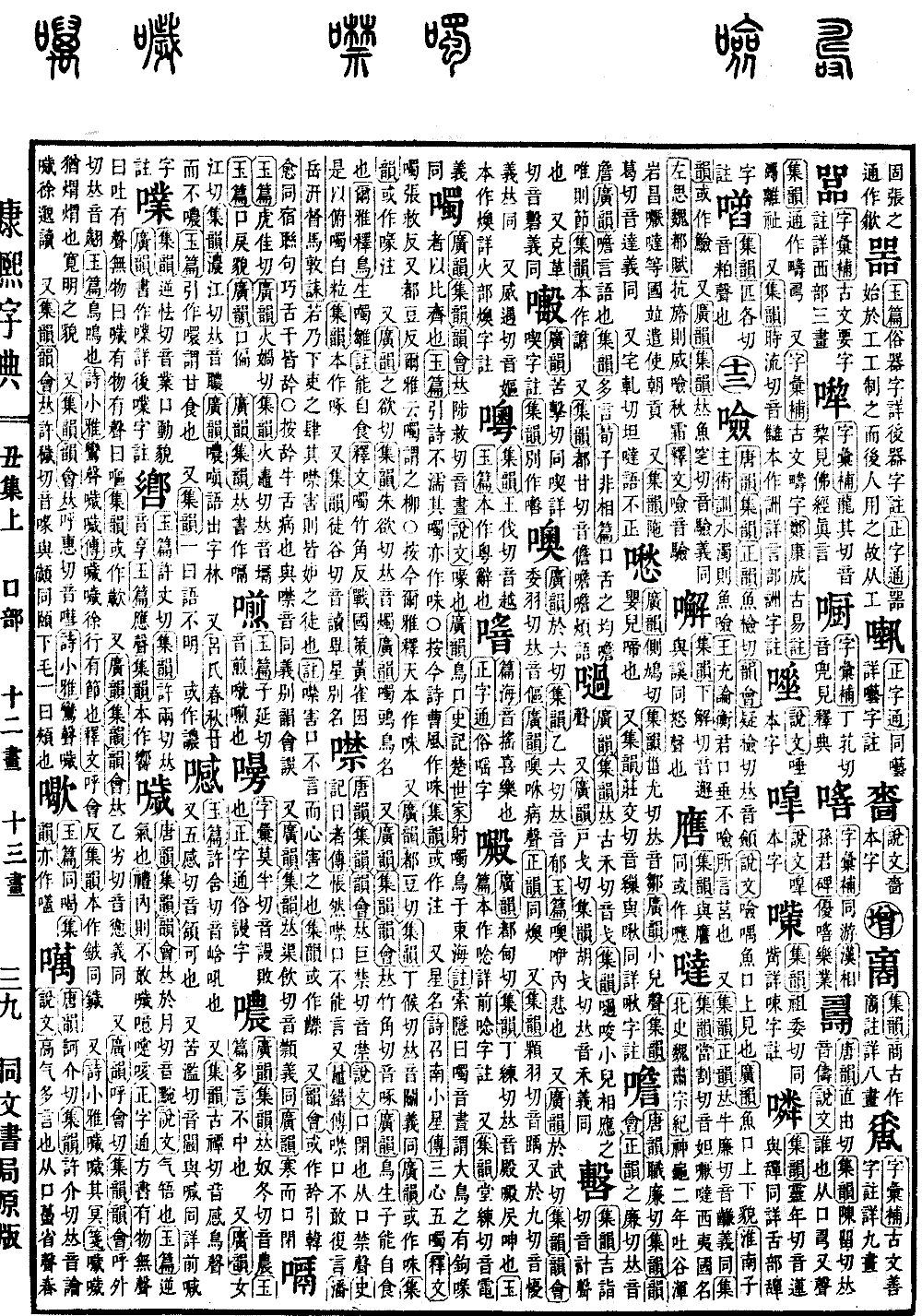
Chou Collection, Upper Volume
Radical: Mouth (kǒu)
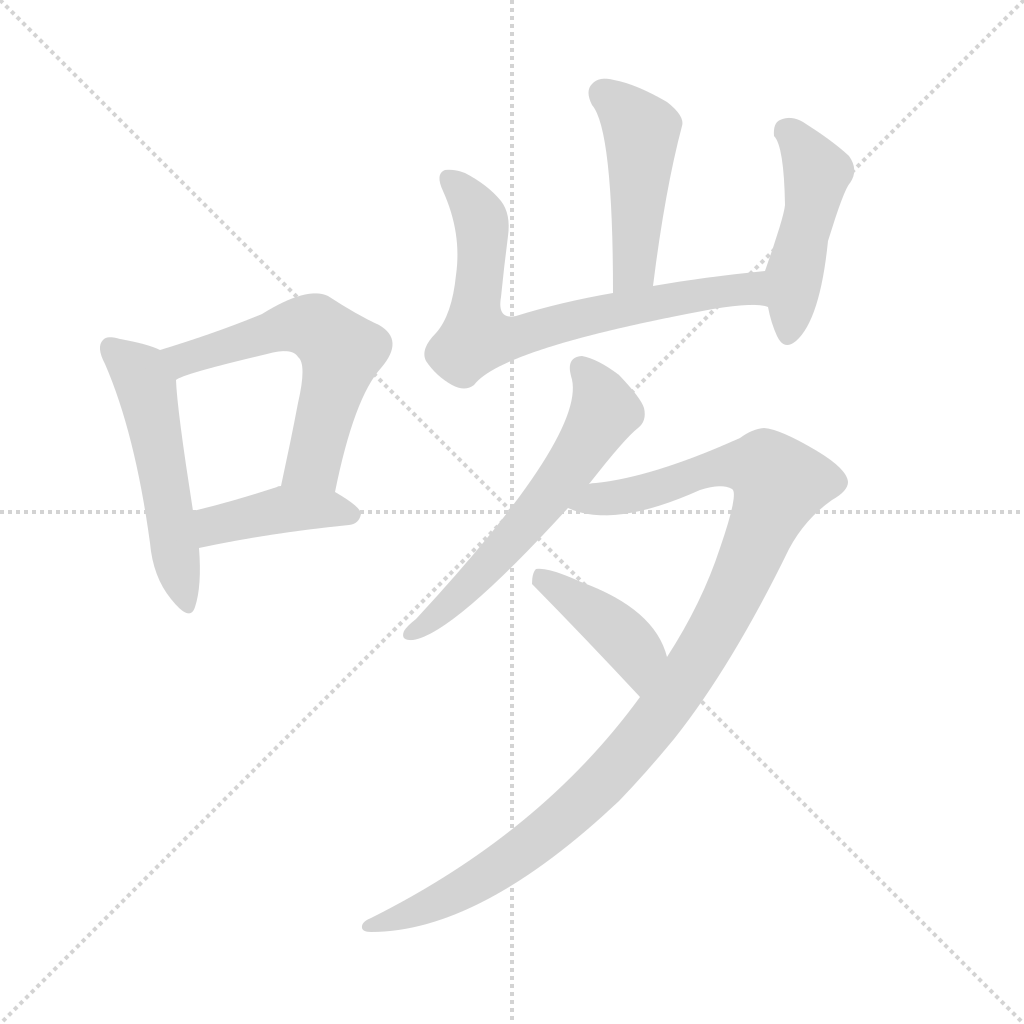
Character: 噦
Kangxi Stroke Count: 16
Page 209, Entry 01
Tang Rhymes (Tangyun), Collected Rhymes (Jiyun), and Rhyme Compendium (Yunhui): pronounced yue (falling tone).
Explanation from Explaining Graphs and Analyzing Characters (Shuowen): The breath is obstructed.
Jade Chapters (Yupian): Rebellious breath.
Book of Rites (Liji), Inner Chapters (Neize): Do not dare to retch, hiccup, sneeze, or cough.
Correct Meaning Thoroughfare (Zhengzitong): In medical texts, having matter without sound is called vomiting; having sound without matter is called retching; having both matter and sound is called heaving.
Collected Rhymes (Jiyun): Sometimes written as a variant.
Also, Broad Rhymes (Guangyun), Collected Rhymes (Jiyun), and Rhyme Compendium (Yunhui): pronounced ye (falling tone). The meaning is the same.
Also, Broad Rhymes (Guangyun): pronounced hui (falling tone); Collected Rhymes (Jiyun) and Rhyme Compendium (Yunhui): pronounced hui (falling tone).
Jade Chapters (Yupian): The sound of birds chirping.
Book of Odes (Shijing), Lesser Odes (Xiao Ya): The bells on the carriage, hwee hwee.
Commentary (Zhuan): Hwee hwee, moving slowly with rhythmic cadence.
Explication of Texts (Shiwen): Pronounced hui (falling tone).
Collected Rhymes (Jiyun): Originally written as a variant, same as another variant.
Also, Book of Odes (Shijing), Lesser Odes (Xiao Ya): Hwee hwee its brightness.
Annotation (Jian): Hwee hwee means bright and radiant, the appearance of being wide and bright.
Also, Collected Rhymes (Jiyun) and Rhyme Compendium (Yunhui): pronounced hui (falling tone).
Book of Odes (Shijing), Lesser Odes (Xiao Ya): The bells on the carriage, hwee hwee.
Xu Miao reading: pronounced hui (falling tone).
Also, Collected Rhymes (Jiyun) and Rhyme Compendium (Yunhui): pronounced hui (falling tone).
Same as a variant. The hair under the jaw. Another meaning is the cheek.