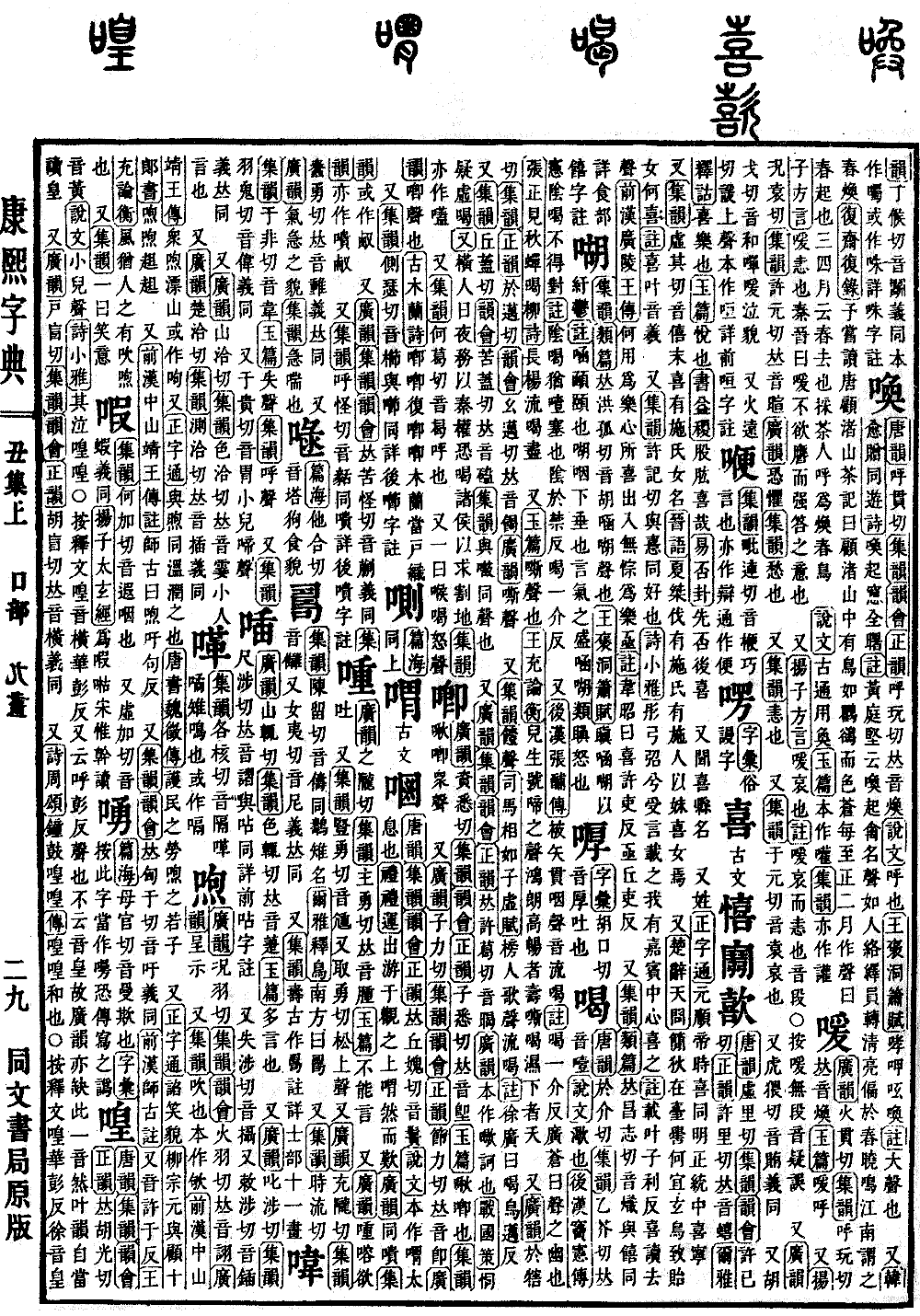
Chou Collection, Upper Volume
Radical: Mouth (kǒu)
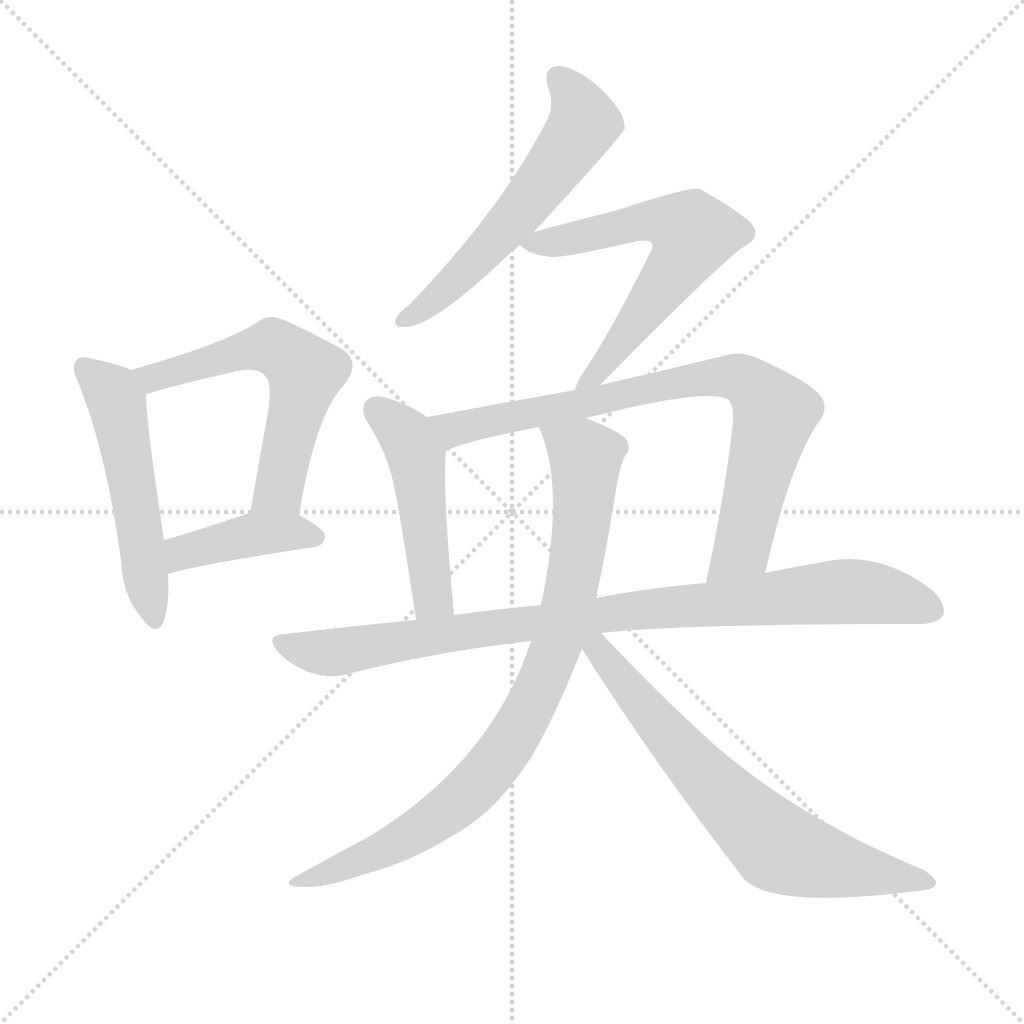
Character: huan
Kangxi stroke count: 12
Page 199, Entry 01
Pronounced huan (falling tone).
Shuowen Jiezi (Shuowen): To call out.
Wang Bao, Rhapsody on the Cave Flute (Dongxiao Fu): A roaring, loud call. Note: Refers to a loud sound.
Han Yu, Poem Presented to My Companions: Calling out until the window is fully bright. Note: Huang Tingjian says: The calling-out bird is a species of bird; its voice sounds like a person, continuous and clear. It specifically sings at the dawn of spring; in the Jiangnan region, it is called the spring-huan.
Fuzhai Fulu (Fuzhai Fulu): I once read the Record of Guzhu Mountain Tea from the Tang dynasty, which states: In Guzhu Mountain, there is a bird, resembling a myna but gray in color. In the first and second lunar months, it makes a sound saying, The spring is rising. In the third and fourth months, it says, The spring is leaving. Tea pickers call it the Spring-Huan bird.
Shuowen Jiezi (Shuowen): In ancient texts, this is used interchangeably with huan.
Yupian (Yupian): Originally written as huan.
Jiyun (Jiyun): Also written as huan.