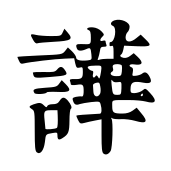
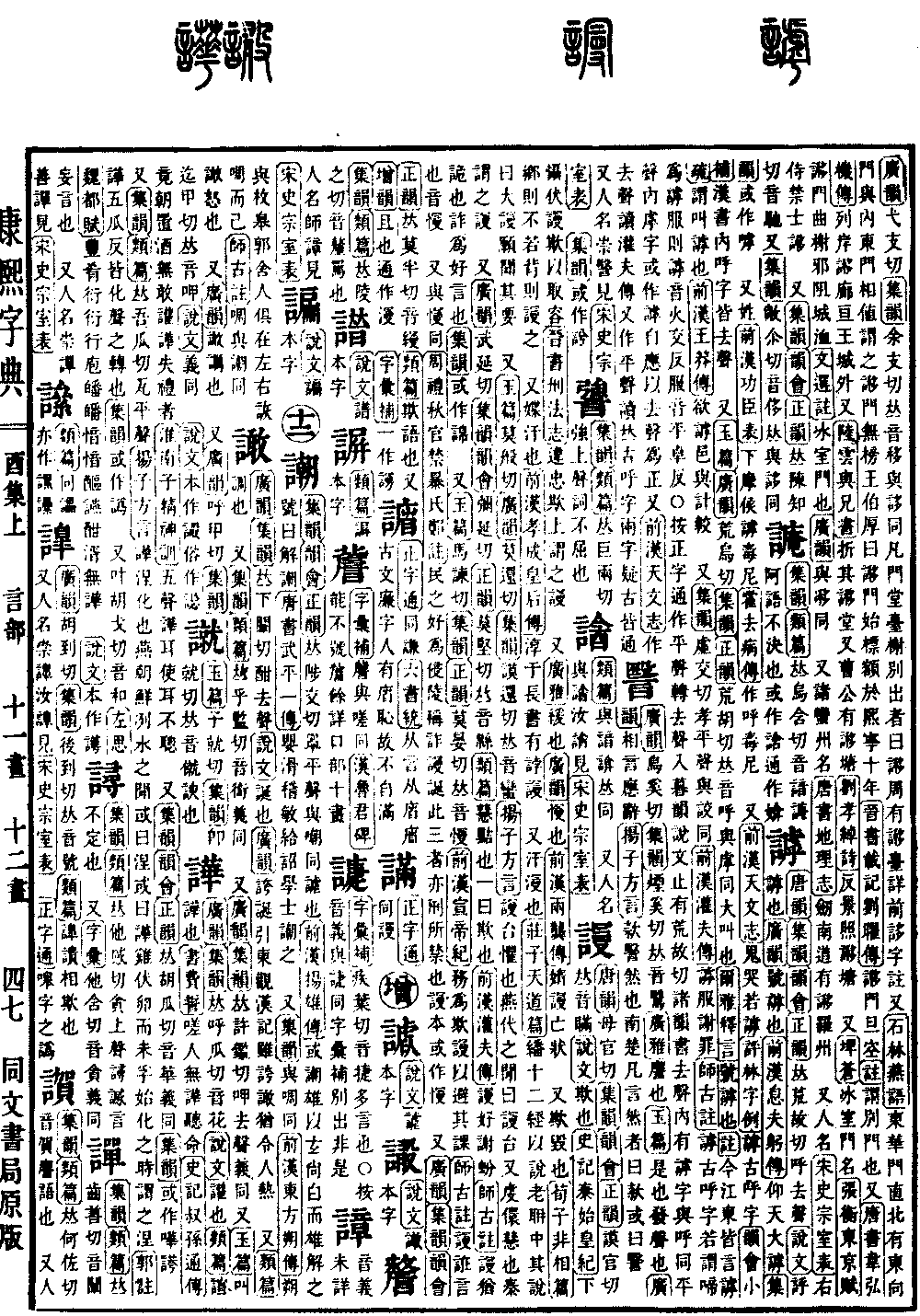
You Collection, Upper Volume
Radical: Speech (yán)
譁; Kangxi brush strokes: 19; Page 1179, Entry 21
Broad Rhymes (Guangyun), Collected Rhymes (Jiyun): Pronounced hua.
Explaining Graphs and Analyzing Characters (Shuowen): The meaning of clamor or noise.
Classified Chapters (Leipian): The meaning of clamorous noise.
Book of Documents (Shujing), Oath at Fei: Hey, everyone do not make noise and listen to the orders.
Records of the Grand Historian (Shiji), Biography of Shusun Tong: Throughout the entire court banquet, no one dared to make noise or be discourteous.
Masters of Huainan (Huainanzi), Teachings on the Spirit: Various sounds clamor in the ear, causing the ear to be unable to hear clearly.
Also, Collected Rhymes (Jiyun), Dictionary of Rhymes (Yunhui), Correct Rhymes (Zhengyun): Pronounced hua. The meaning is the same.
Collected Rhymes (Jiyun): Sometimes also written in a variant form (hua).
Also, Collected Rhymes (Jiyun), Classified Chapters (Leipian): Pronounced wa (level tone).
Yang Xiong's Dialect (Fangyan): Hua and nie refer to the meaning of change. Between the Yan state, Korea, and the Lie River, some say nie and some say hua. When a chicken is incubating an egg and the chick has not yet emerged, the moment it begins to change is called nie.
Guo Commentary: Hua, pronounced with the sound of hua, both are phonetic shifts of the character for change.
Collected Rhymes (Jiyun): Sometimes also written in a variant form (e).
Also, rhyming as he: Pronounced he.
Zuo Si, Rhapsody on the Capital of Wei (Weidu Fu): Abundant dishes are spread out, and the traveling kitchen staff are busy. Peacefully and joyfully they feast, drinking freely and becoming intoxicated without making any noise.
Explaining Graphs and Analyzing Characters (Shuowen): Originally written as the character for hua.