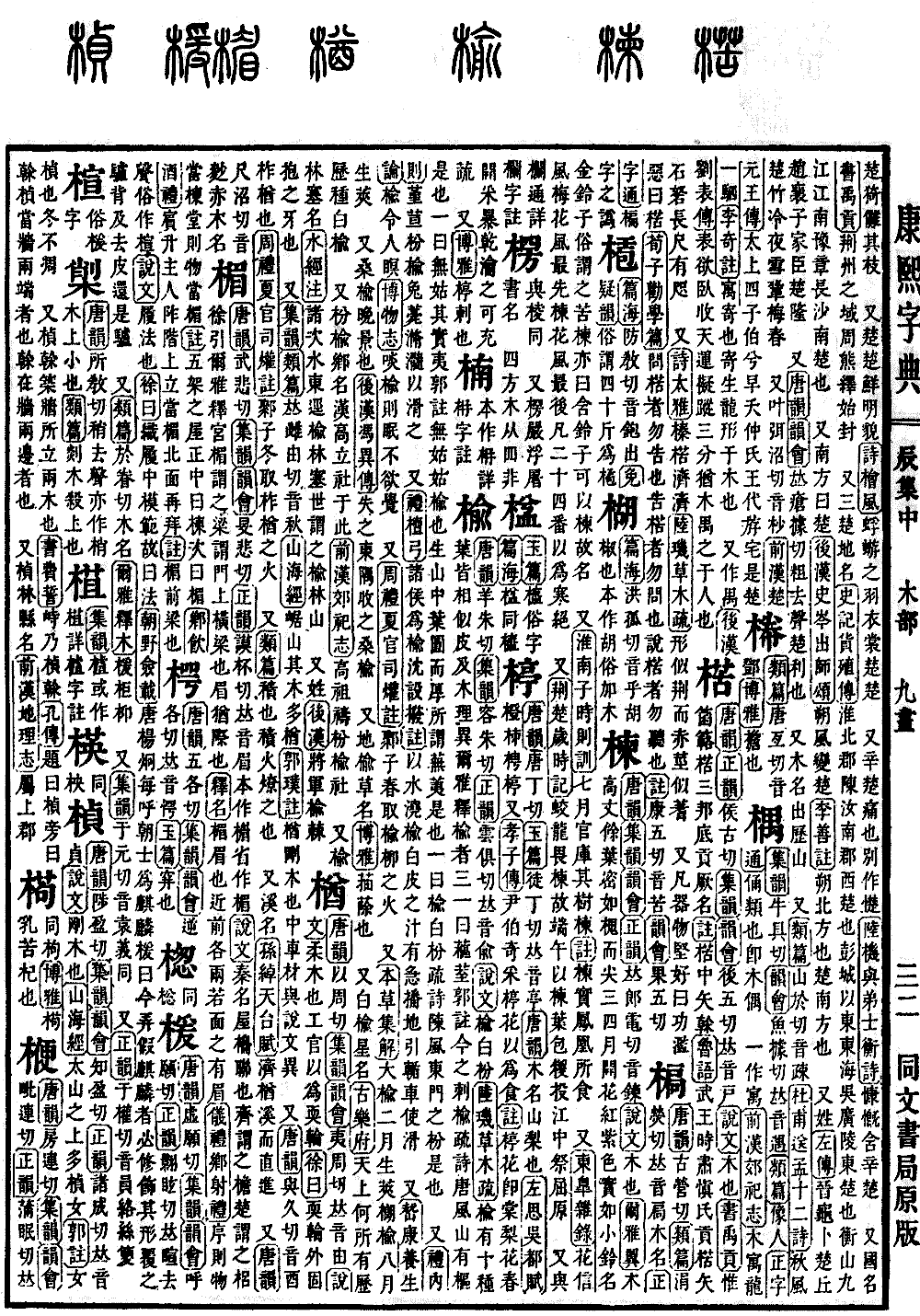
Chen Collection, Middle Volume
Radical: Tree (mù)
Character: Hu
Kangxi Strokes: 13
Page 540, Entry 03
Pronounced hu.
In the Discussion of Script (Shuowen), it is defined as a type of wood.
In the Book of Documents (Shangshu), chapter Tribute of Yu (Yu Gong): The three regions contribute their names, including arrow bamboo, mountain bamboo, and hu wood. The commentary notes that hu is used for arrow shafts.
In the Discourses of the States (Guoyu), chapter Discourses of Lu (Luyu): During the time of King Wu, the Sushen tribe presented arrows made of hu wood and stone arrowheads, measuring one foot and a thumb in length.
In the Book of Odes (Shijing), Great Odes (Daya): Hazel and hu trees grow in abundance.
Lu Ji in his Commentary on Trees and Plants (Caomu Shu) describes the tree as resembling the chaste tree but with red stems, appearing similar to yarrow.
Generally, when tools and objects are durable and fine, they are described as gong (work); when they are inferior or poorly made, they are described as hu.
In the Xunzi, chapter Exhortation to Learning (Quanxue Pian): Do not answer those who ask questions in a clumsy or inferior way, do not ask those who speak in a clumsy way, and do not listen to those who explain things in a clumsy way.
The commentary notes the pronunciation as ku.
Another pronunciation is given as guo.