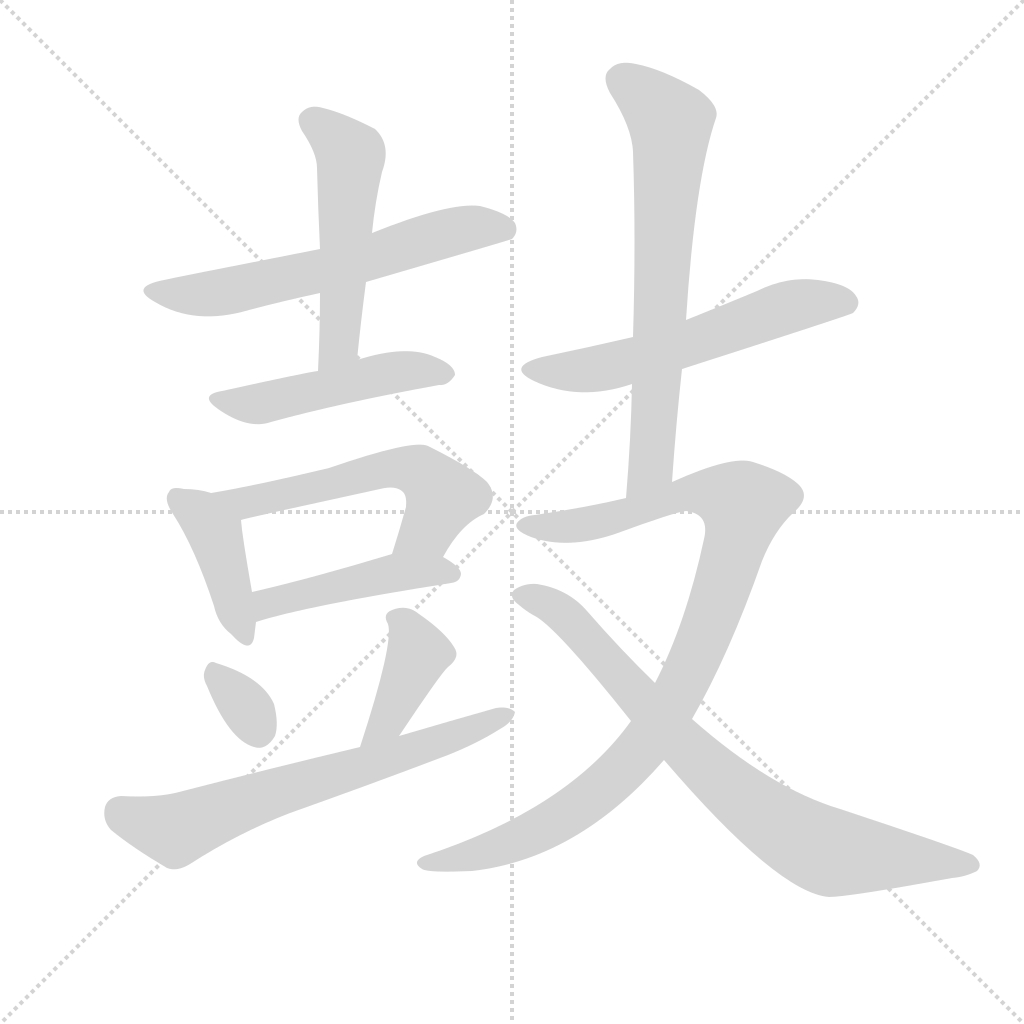
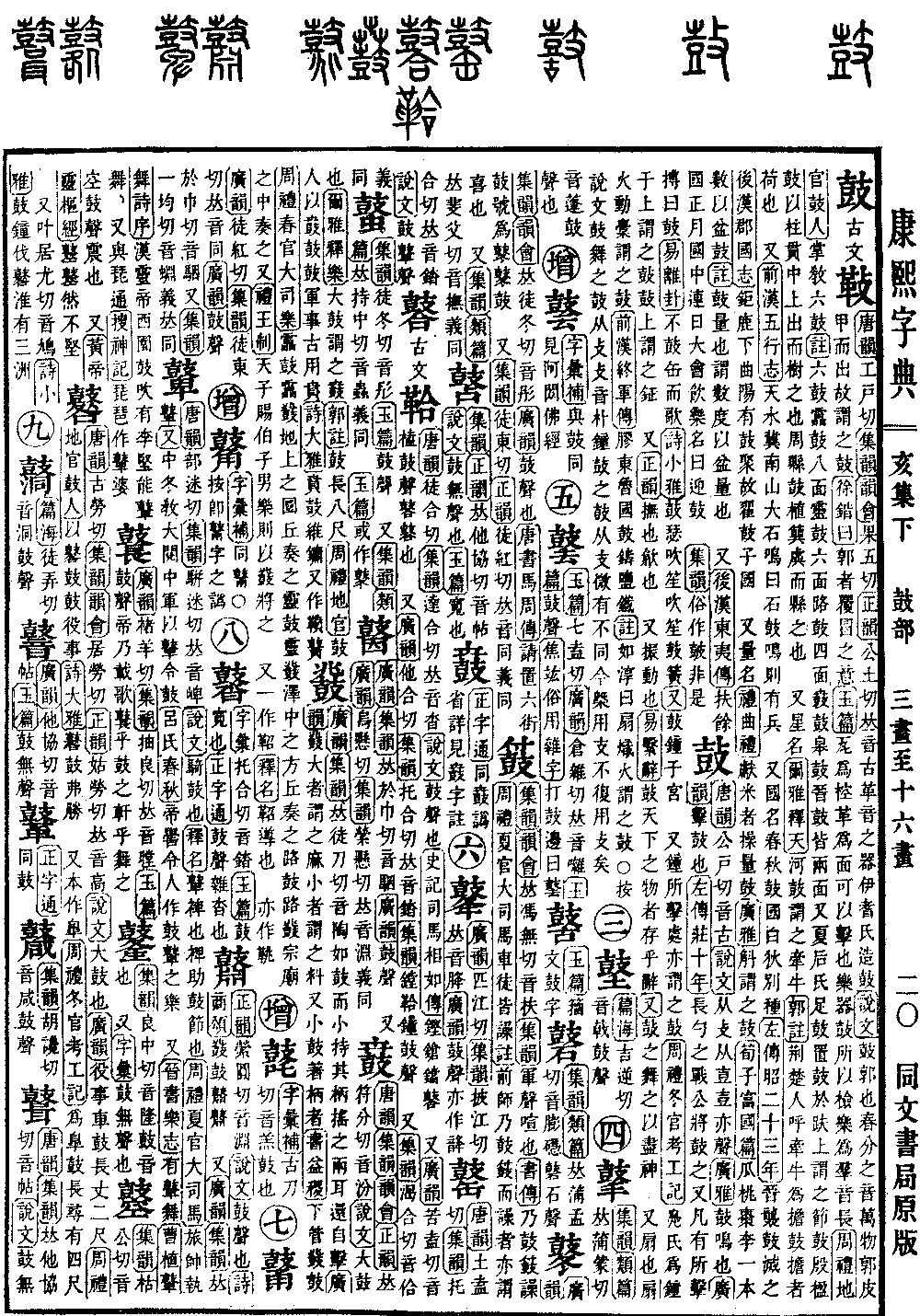
Hai Collection, Lower Volume
Radical: Drum (gǔ)
Kangxi Strokes: 13
Page 1526, Entry 01
According to the Tang Rhyme (Tangyun), the pronunciation is gu. According to the Collected Rhymes (Jiyun) and the Rhyme Assemblage (Yunhui), the pronunciation is gu. According to the Rectified Rhymes (Zhengyun), the pronunciation is gu. It is a musical instrument made of leather that produces sound. Legend has it that the drum was created by the clan of Yi Qi. The Explaining Graphs and Analyzing Characters (Shuowen Jiezi) explains that the drum carries the meaning of an outer casing. It represents the musical rhythm of the spring equinox, when all things break through their shells to sprout, hence the name drum. Xu Kai adds that the term implies a covering or wrapping. The Jade Chapters (Yupian) states: It is made with a clay body and a leather face, which can be struck. Musical texts record that the drum is used to regulate music and is the chief of all musical instruments. The Rites of Zhou (Zhouli), Earth Office, Drummer section, records its duty as teaching the six types of drums. Commentary: The six types are the thunder drum with eight faces, the spirit drum with six faces, the road drum with four faces, and the fen, gao, and jin drums, which each have two faces.
Additionally, during the Xia Dynasty, foot drums were used, where the drum was placed on a base, known as a jie drum. During the Shang Dynasty, column drums were used, with a pillar running through the body of the drum to stand it upright. During the Zhou Dynasty, suspended drums were used, hung on a rack.
It also refers to the name of a star constellation. The Erya, Explanation of Heaven (Shitian), records that the River Drum constellation is also called the Cowherd star. Guo Pu's commentary notes that people in the Jing and Chu regions call the Cowherd star the carrying drum. Carrying means to bear on the back.
Also, the Book of Han (Hanshu), Treatise on the Five Elements, records: A large rock in the southern mountains of Ji in Tianshui produced a sound, known as the stone drum; the ringing of the stone drum was an omen of war.
It is also the name of a feudal state. The State of Gu during the Spring and Autumn period was a branch of the White Di. The Zuo Tradition (Zuozhuan), 23rd Year of Duke Zhao, records: The State of Jin attacked the State of Gu and destroyed it. The Book of the Later Han (Houhanshu), Treatise on Geography, records: The town of Guju in the County of Qu'yang of Julu Commandery is the former State of Guzi.
It is also a unit of volume. The Book of Rites (Liji), Summary of the Rules of Propriety (Quli), records: Those who present rice hold a measuring drum. The Guangya explains: One hu is called one drum. The Xunzi, Wealthy State chapter, records: The yield of fruit trees such as melons, peaches, jujubes, and plums is measured by the pen and the drum. Commentary: The drum is a measuring vessel. This refers to using the pen to determine the quantity.
Also, the Book of the Later Han (Houhanshu), Treatise on the Eastern Barbarians, records: In the Fuyu state, during the first month, the entire nation held grand feasts to drink and make music for several days, calling it welcoming the drum.
The Collected Rhymes (Jiyun) states: The vulgar form is written as gu, which is incorrect.
Verification: Regarding musical instruments, the drum is used to regulate music and is the chief of all musical instruments. Note: This text is not in the Jade Chapters (Yupian); this statement is found in the Music Manual (Yueshu) as cited by the Rhyme Assemblage (Yunhui). Therefore, the original text citing the musical instrument book has been cautiously emended.