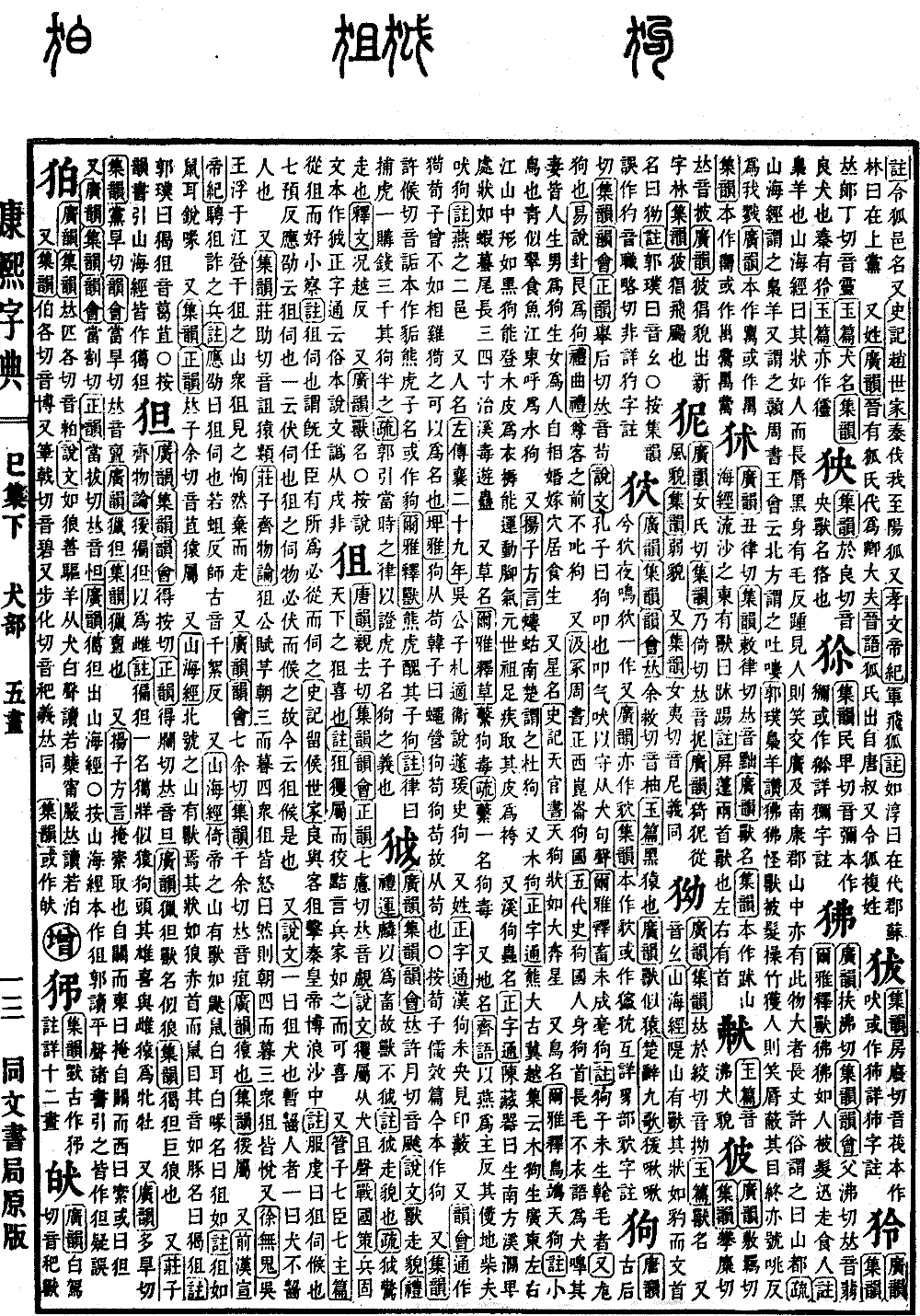
Si Collection, Lower Volume
Radical: Dog (quǎn)
Kangxi Strokes: 9
Page 709, Entry 12
Pronounced gou (rising tone)
Pronounced gou (rising tone)
According to the Shuo Wen Jie Zi: Confucius said that a dog is one that strikes (kou). It strikes the air with its bark to stand guard. The character is formed with the radical for dog and the phonetic component gou.
According to the Erya (Approaching Elegance), Interpretation of Domestic Animals: A young dog that has not yet grown its long hair is called a gou. Commentary: This refers to puppies that have not yet sprouted their hair.
Also: A dog with mixed-colored fur is also called a gou.
According to the Book of Changes (Yijing), Explanation of the Trigrams: The Gen hexagram symbolizes a dog.
According to the Book of Rites (Liji), Songs of Ritual: One should not scold a dog in the presence of an honored guest.
Also, according to the Jizhu Zhoushu (Chronicles of the Zhou Dynasty found in the Jizhong Tomb): In the far west, in the Kunlun Mountains, there is a Dog Kingdom.
According to the History of the Five Dynasties: The people of the Dog Kingdom have the heads of dogs and the bodies of humans. They are covered in hair, do not wear clothing, and their speech sounds like the barking of dogs. Their wives are human; when they give birth to boys, they are dogs, and when they give birth to girls, they are human. They marry within their own group, live in caves, and eat raw food.
Also, the name of a constellation. According to the Records of the Grand Historian (Shiji), Book of the Celestial Offices: The Celestial Dog star has a shape like a giant meteor.
Also, the name of a bird. According to the Erya, Interpretation of Birds: The li bird is also known as the Celestial Dog. Commentary: It is a type of small bird. Its feathers are blue-green like those of a kingfisher, and it eats fish. In the Jiangdong region, it is called the water dog.
Also, according to Yangzi’s Dialects (Fangyan): The mole cricket is called the earth dog in the Southern Chu region.
Also, the wood dog. According to the Zhengzitong: Xiong Dagu’s Jiyue Collection states: The wood dog grows in the mountains around the Zuojiang and Youjiang rivers in Guangdong. It is shaped like a black dog and is capable of climbing trees. Its fur is made into clothing, which can treat rheumatism of the legs and feet. When Yuan Shizu suffered from a leg ailment, he obtained its fur to make trousers.
Also, the stream dog, name of an insect. According to the Zhengzitong: Chen Cangqi states: It grows in the streams of the south. Its shape resembles a toad, and it has a tail three to four inches long. It can treat stream water poisons and migratory gu-toxins.
Also, the name of a plant. According to the Erya, Interpretation of Plants: The mi plant is also called dog poison. Commentary: Mi is another name for dog poison.
Also, a place name. According to the Discourses of Qi (Qiyu): Focusing on the land of Yan, they returned their territory, including the regions of Chaifu and Feigou. Commentary: These are two cities of the Yan state.
Also, a person's name. According to the Zuo Commentary (Zuozhuan), 29th Year of Duke Xiang: Prince Jizha of the state of Wu traveled to the state of Wei and favored Qu Boyu and Shi Gou.
Also, a surname. According to the Zhengzitong: During the Han Dynasty, there was a person named Gou Weiyang. It is found in the Yinsou (Collection of Seals).
Also, according to the Yunhui, it is used interchangeably with the character for gou. Xunzi stated that some animals are not even as good as the chicken, which can be named for its merits. According to the Piya: The character for dog is derived from the component gou. Han Fei stated: To act like a fly or a dog. The term gou-gou is therefore derived from the character gou. Note: Current versions of Xunzi, Chapter on the Efficacy of the Scholars, write the character as dog.
Also, according to the Jiyuji: Pronounced gou (falling tone). The original character is written with the radical for dog and the phonetic gou. It refers to the cubs of bears and tigers. Sometimes written as a variant form (gou). According to the Erya, Interpretation of Beasts: The cubs of fierce beasts such as bears and tigers are called dog. Commentary: The legal code states: Capture one tiger, and the reward is three thousand coins; capture a tiger cub, and the reward is halved. Commentary: Guo Pu cited the legal codes of the time to prove that the meaning of the word for dog includes the cubs of tigers.