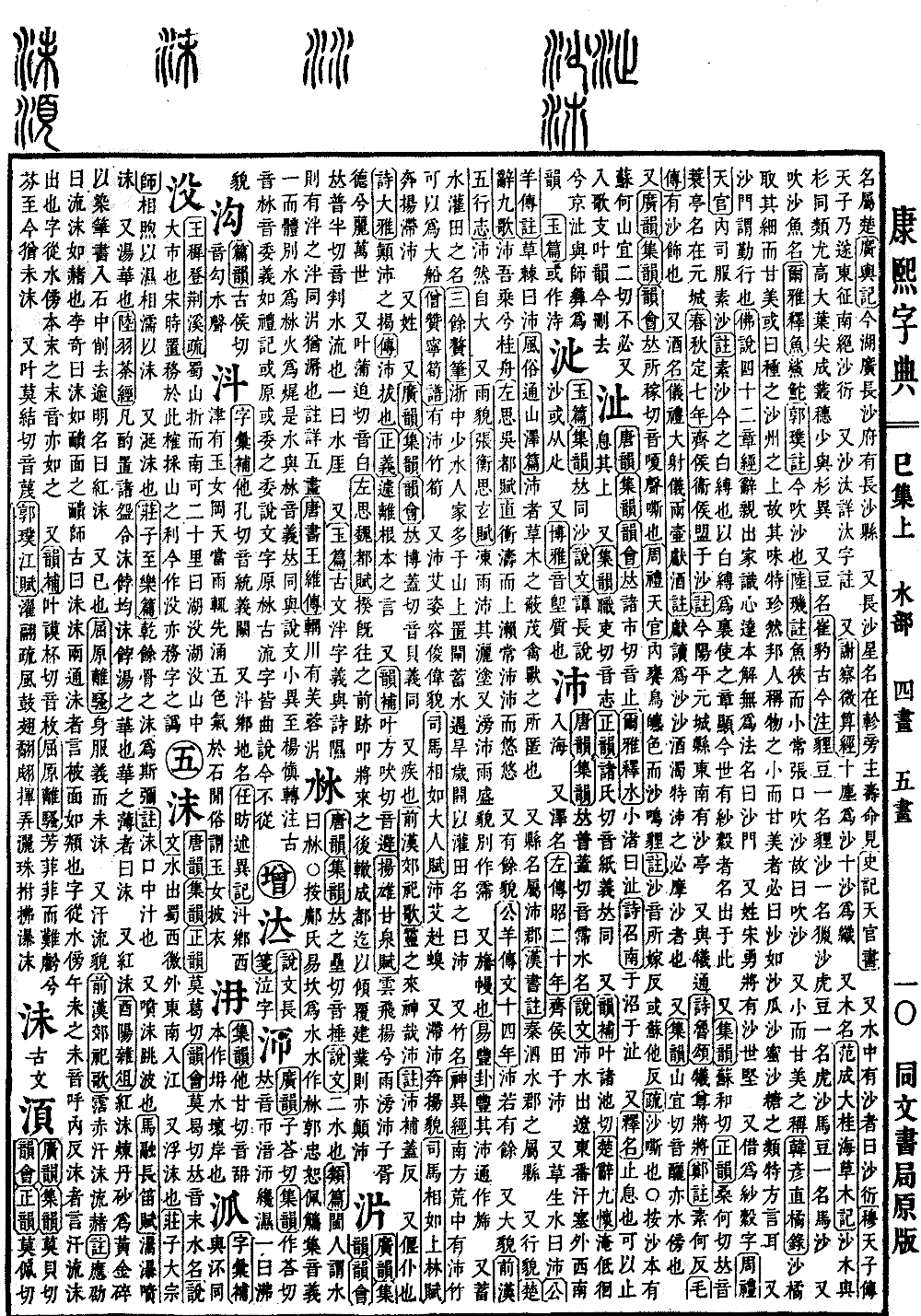
Si Collection, Upper Volume
Radical: Water (shuǐ)
沟
Kangxi Stroke Count: 14
Page 612, Entry 08
According to the Pian Yun and Yun Shu, pronounced gou. It refers to the sound of flowing water.
The entry for gou:
According to the Tang Yun, pronounced gou. According to the Jiyun, Yunhui, and Zhengyun, pronounced gou.
According to the Shuowen Jiezi, it refers to a waterway that is four feet wide and four feet deep.
According to the Shiming, waterways in the fields are called gou. The term implies construction, referring to the crisscrossing pattern of its layout.
According to the Rites of Zhou (Zhouli), ten households share a single drainage ditch.
According to the Erya, Shishui, water flowing into a mountain valley is called gou.
Also, it refers to a moat (gouchi).
According to the Book of Rites (Liji), Liyun, city walls and moats are used to strengthen defenses.
Also, it refers to the han-gou, the depression along a horse's back.
According to the Qimin Yaoshu, when evaluating a horse, a deep han-gou is considered favorable.
According to the Jiyun, pronounced jiang. It shares the same meaning as the character for port (gang). It refers to a branch of a watercourse. See the entry for gang for further details.
According to the Yunbu, rhymed as pronounced ju.
According to the Jiao Shi Yilin, the horse was startled and damaged the carriage, the grandson fell into the ditch, his body perished and his soul departed, leaving his home.