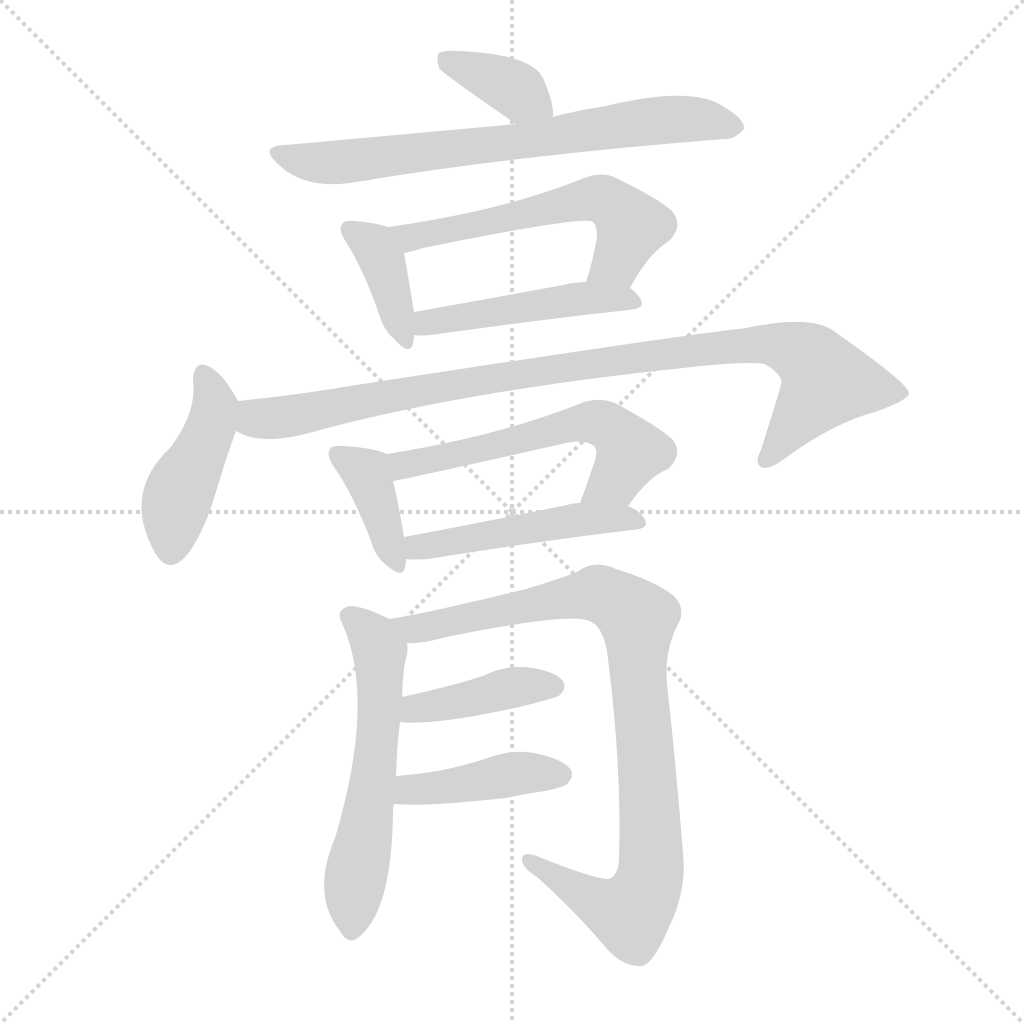
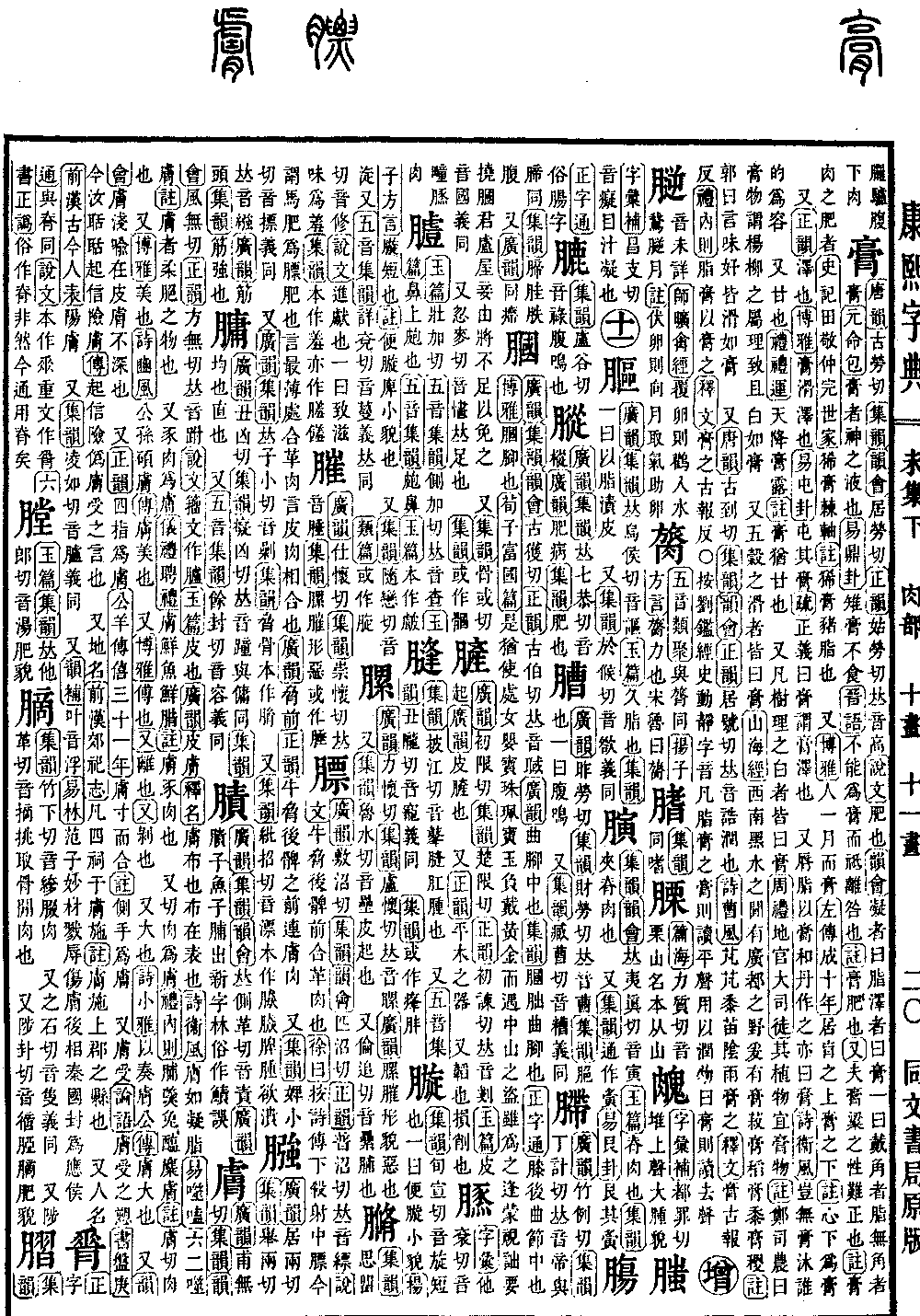
Wei Collection, Lower Volume
Radical: Meat (ròu)
Gao; Kangxi strokes: 16; Page 992, Entry 01
Pronounced gao.
Shuowen Jiezi (Shuowen): Fat.
Yunhui (Compilation of Rhymes): Congealed fat is called zhi; smooth, moist fat is called gao. Another theory states that the fat of horned animals is called zhi, while the fat of hornless animals is called gao.
Yuanming Bao (Records of Destiny): Gao is the fluid of the spirits.
Book of Changes (Yijing), Ding Hexagram: The fat of a pheasant cannot be eaten.
Discourses of the States (Jin Yu): Cannot become rich, moist fat, but instead only invites disaster. Commentary: Gao means rich and beautiful.
Also: The nature of gao is difficult to straighten. Commentary: Gao refers to fat meat.
Records of the Grand Historian (Shiji), Biography of Tian Jingzhong Wan: Using lard to lubricate the axles of a carriage made of thorny wood. Commentary: Xi gao means lard.
Also, Boya (Expanse of Elegance): When a human is one month in the mother's womb, they form into a gao-like state.
Zuo Commentary (Zuo Zhuan), Tenth Year of Duke Cheng: Located above the diaphragm and below the heart. Commentary: The fat at the tip of the heart is called gao.
Also, Zheng Yun (Correct Rhymes): Means to moisten or lubricate.
Boya (Expanse of Elegance): Gao means smooth, moist, and glossy.
Book of Changes (Yijing), Zhun Hexagram: Accumulate its moistening favors. Commentary: The sub-commentary states that gao refers to moistening favors.
Also, lip balm, made by mixing cinnabar with gao, is also called gao.
Book of Odes (Shijing), Odes of Wei: Is there no hair-moistening gao, for whom then should I adorn myself?
Also, means sweet and beautiful.
Book of Rites (Liji), Evolution of Rites (Liyun): Heaven sends down sweet, beautiful dew. Commentary: Gao is like something sweet and beautiful.
Also, any tree with white grain is called gao.
Rites of Zhou (Zhouli), Earth Offices: The plants that grow there are suitable for gao-things. Commentary: Zheng Sinong says: Gao-things refers to plants like the willow, which have fine, white grain resembling gao.
Also, any of the five grains that are smooth and moist are called gao.
Classic of Mountains and Seas (Shanhaijing): Between the Black Waters in the southwest, there are the plains of Guangdu, where there are gao-beans, gao-rice, gao-millet, and gao-broomcorn millet. Commentary: Guo Pu says: This means they are good-tasting and all smooth and moist like gao.
Pronounced gao (falling tone).
Means to moisten or lubricate.
Book of Odes (Shijing), Odes of Cao: The lush millet sprouts, covered by overcast rain that moistens them. Exegesis: Gao is pronounced gu-bao.
Book of Rites (Liji), Inner Chapters (Neize): Use zhi-gao to coat it. Exegesis: Gao-zhi is pronounced gu-bao.
Note: According to Liu Jian's Jing Shi Dong Jing Zi Yin, any gao referring to fat is read with a level tone; when used to moisten things, it is read with a falling tone.
Textual Research: In the Book of Odes (Shijing), Odes of Wei, the phrase is "for whom should I adorn myself" (shui shi wei rong). I have corrected "shui de" to "shui shi" in accordance with the original text.