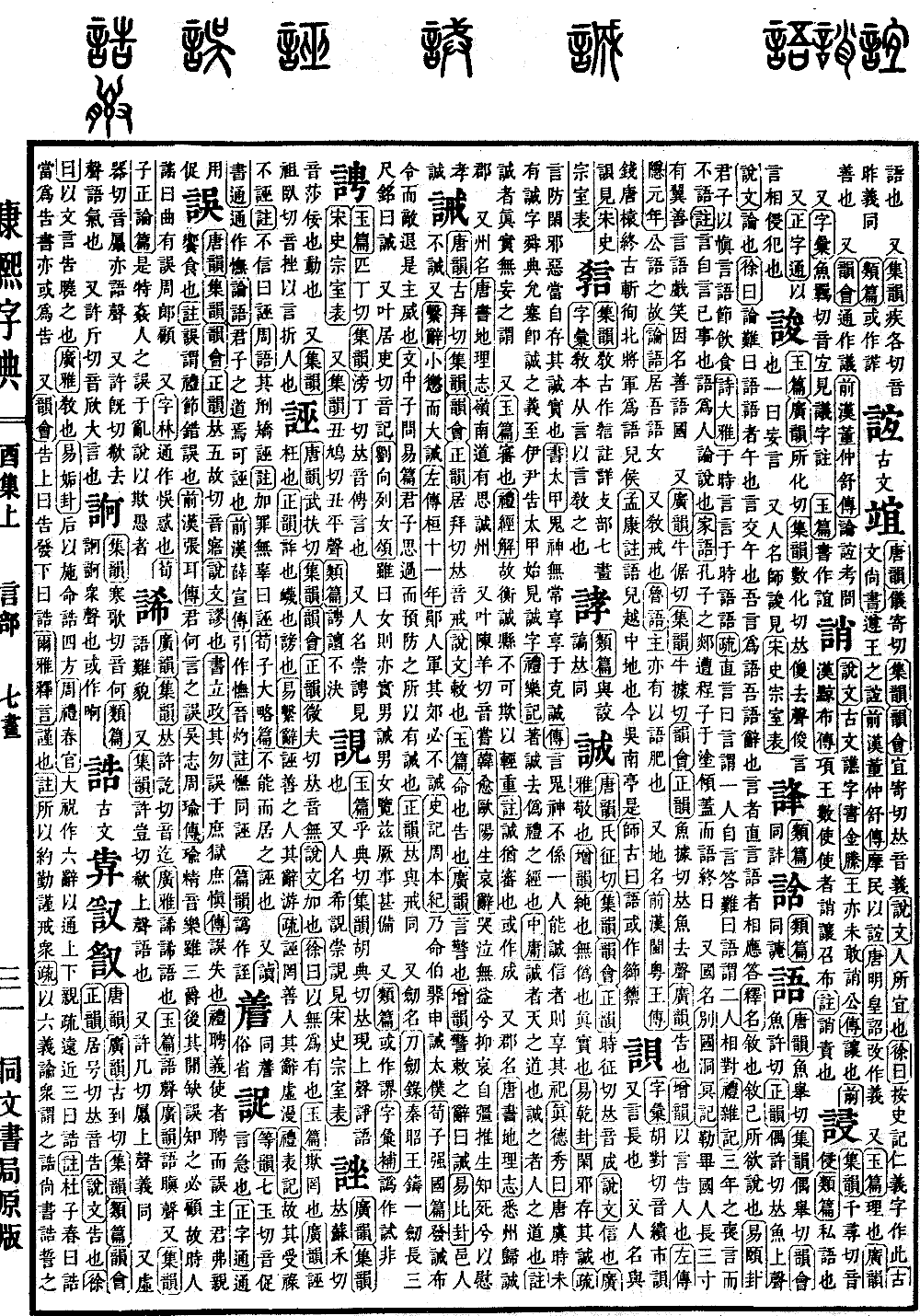
You Collection, Upper Volume
Radical: Speech (yán)
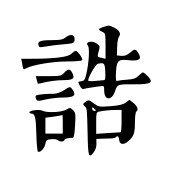
Gao
Kangxi strokes: 14
Page 1163, Entry 23
Ancient script. According to Tang Rhyme (Tangyun) and Broad Rhymes (Guangyun), pronounced gao. According to Collected Rhymes (Jiyun), Classifications (Leipian), Rhyme Compendium (Yunhui), and Correct Rhymes (Zhengyun), pronounced gao.
Shuowen Jiezi states it means to inform. Xu Kai states it is to inform and enlighten someone through written words.
Guangya states it means to teach.
Book of Changes (Yijing), Hexagram Gou: The sovereign issues orders and declares them to the four quarters.
Rites of Zhou (Zhouli), Spring Offices: The Great Invoker creates six types of pronouncements to connect superiors and inferiors, and to reach the close and the distant. The third is called Gao.
Commentary: Du Zichun stated that Gao is equivalent to declaring. In the Book of Documents (Shangshu), it can also signify a declaration.
Rhyme Compendium (Yunhui) states: A declaration to a superior is called gao; an issuance to an inferior is called gao.
Erya, Explanation of Words: Means to be cautious.
Commentary: Used to exhort the masses to be diligent and cautious.
Exegesis: Using the six categories to instruct the masses is called gao; categories such as the declarations and oaths in the Book of Documents are examples of this.
Kong Anguo, Preface to the Book of Documents: The records of the Xia, Shang, and Zhou dynasties, though they differ in their methods of teaching, such as in elegant declarations or profound meanings, all return to the same principle.
Exegesis: Among the teachings of the three kings, there are eight categories including exhortations, declarations, oaths, and mandates. The text mentions only Gao to distinguish it; these eight types are concise, and the term Gao encompasses them all. Because all eight matters involve speech to declare and instruct, they are collectively referred to as Gao.
Guliang Commentary, Year 8 of Duke Yin: Declarations and oaths did not extend to the Five Emperors.
Rites of Zhou (Zhouli), Autumn Offices: The Master of the Law manages the five prohibitions; the second is called Gao, used during assemblies.
Literary Mind and the Carving of Dragons (Wenxin Diaolong): During the three dynasties, matters involved both declarations and oaths; oaths were used to instruct and admonish, while declarations were used to disseminate policy.
Correct Character Guide (Zhengzitong): In ancient times, both superiors and inferiors used Gao; the Qin dynasty abolished the ancient title and used imperial edicts. In the sixth year of the Yuanshou era of Emperor Wu of the Han, the Gao was first used again, though not for appointing officials. The Tang dynasty used imperial decrees rather than Gao. The Song dynasty began to use Gao to grant titles to officials. The Ming dynasty used imperial orders for appointments instead of Gao. After three years of performance reviews, Gao was used to grant praise. In the seventeenth year of the Hongwu era, it was decreed that those with noble titles would be granted a Gao, according to the system for the first rank. In the twenty-sixth year, it was determined that those from the first to the fifth rank would be granted a Gao, and those from the sixth to the seventh rank would be granted an imperial order.
Also a bird name.
Yang Xiong, Dialects (Fangyan): The cuckoo, in the regions between the Guanzhong, Liang, and Chu, is called jiegao.
According to Collected Rhymes (Jiyun), pronounced gu. Also means to inform. Same as the word for inform.