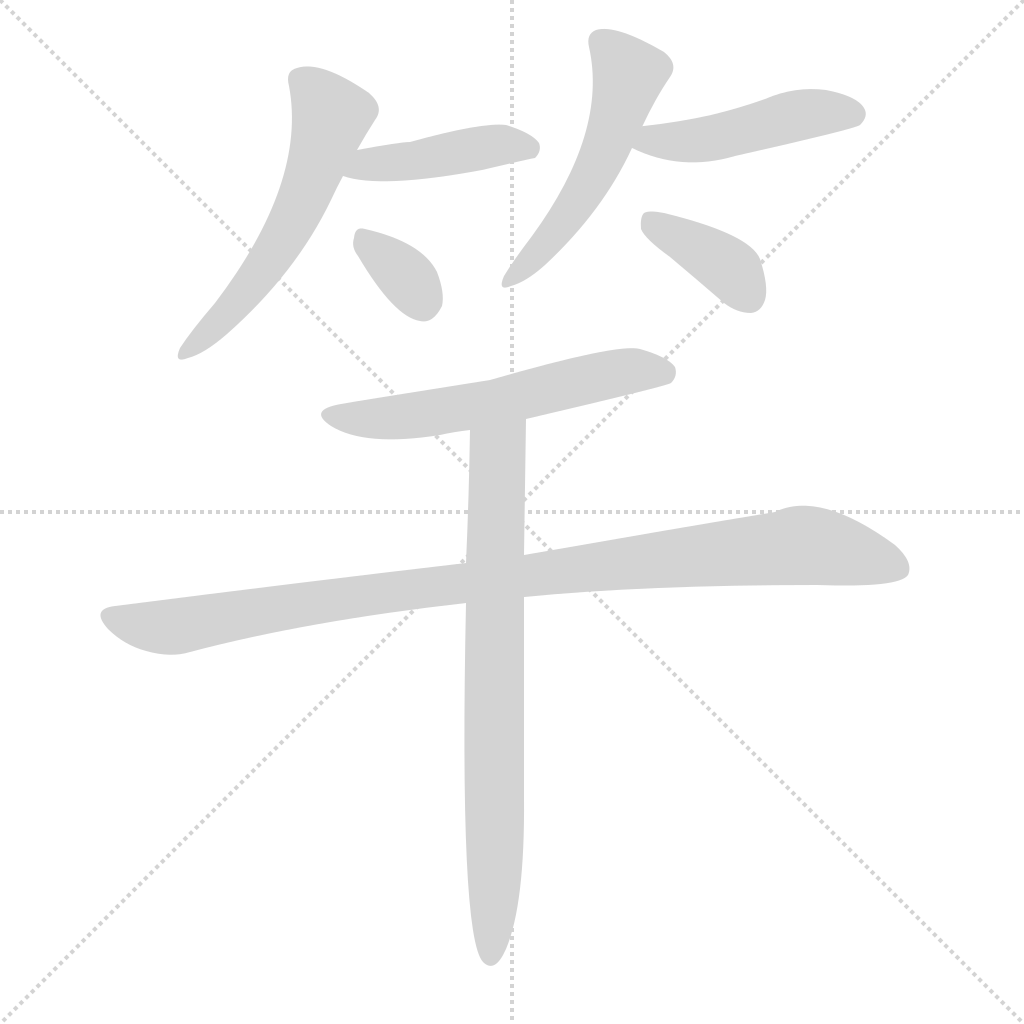
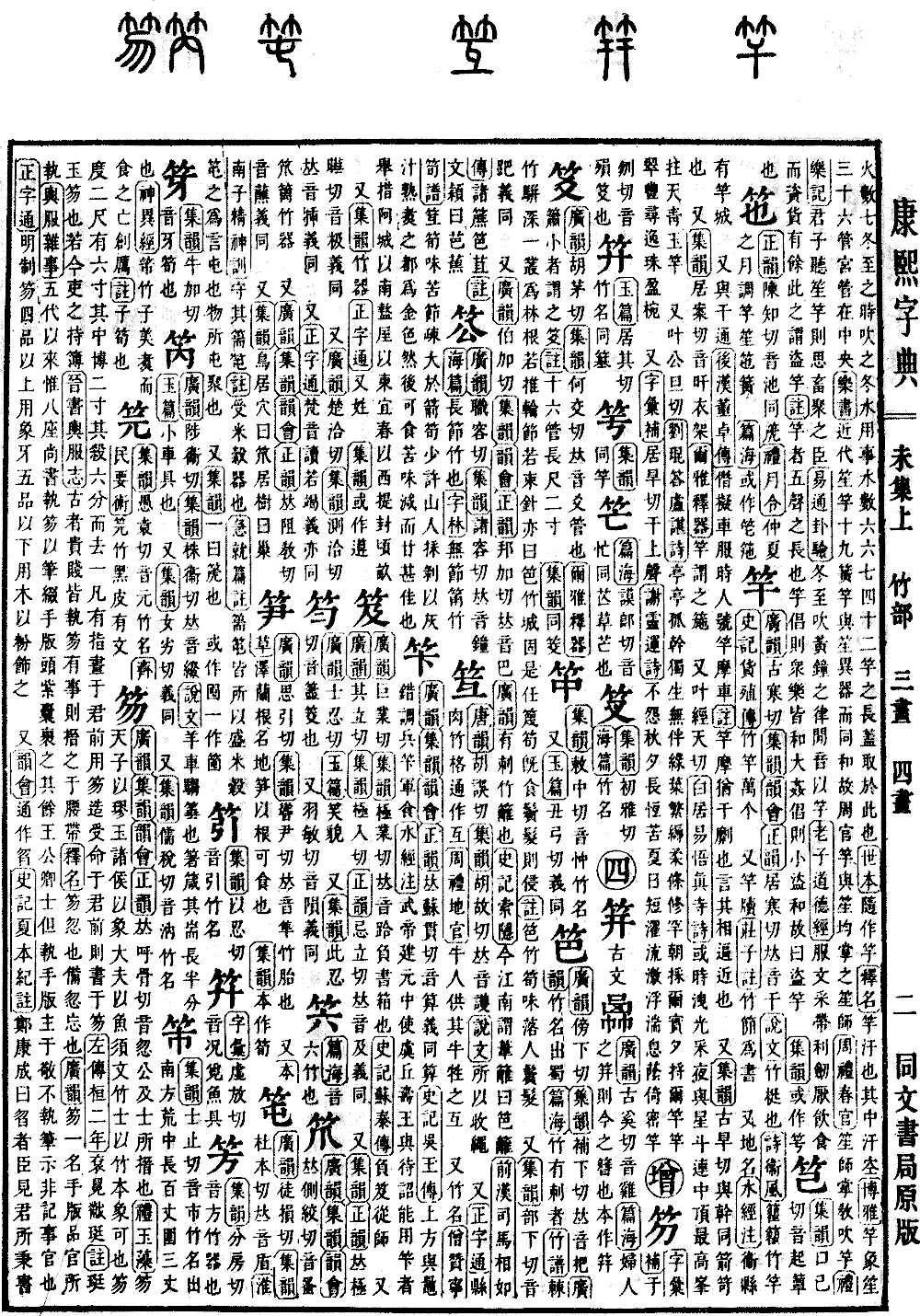
Wei Collection, Upper Volume
Radical: Bamboo (zhú)
Kangxi Strokes: 9
Page 878, Entry 03
Broad Rimes (Guangyun): Pronounced gan. Collected Rimes (Jiyun), Rhyme Meetings (Yunhui), and Correct Rimes (Zhengyun): Pronounced gan.
Explanation of Writing (Shuowen): A bamboo pole.
Book of Odes (Shijing), Odes of Wei: Long, long the bamboo pole.
Records of the Grand Historian (Shiji), Biographies of Money-makers: Ten thousand bamboo poles.
Also, bamboo tablets used for writing, as noted in the Commentary to Zhuangzi.
Also, a place name, as noted in the Commentary on the Classic of Waterways (Shuijing Zhu): There is Pole City in Wei County.
Also, interchangeable with the character meaning to shield or interfere (gan).
History of the Later Han (Houhan Shu), Biography of Dong Zhuo: Arrogantly imitating carriages and clothing, people of the time called it the pole-rubbing carriage. The commentary states: Pole-rubbing is similar to shielding or grinding, referring to their close proximity.
Also, from Collected Rimes (Jiyun): Pronounced gan. Same as the character for a main trunk or a target (gan). An arrow shaft.
Also, from Collected Rimes (Jiyun): Pronounced gan. A clothing rack.
Erya, Explaining Objects: A pole is called a shi.
Also, rhymes with jingtian. Bai Juyi, Poem on Wuzhen Temple: Sometimes revealing radiance, at night connecting with the stars. The center peak is the highest, a green jade pole supporting the heavens.
Also, rhymes with gongdan. Liu Kun, Poem in Response to Lu Chen: Standing tall and solitary, growing alone without a companion. Green leaves are dense and lush, soft branches long and sparse. In the morning I gather your fruit, in the evening I stroke your stalk. The green pole is rich and deep, overflowing with pearls like bowls.
Also, from Supplement to the Collection of Characters (Zihui Bu): Pronounced gan. Same as the character meaning to shield or interfere, in the rising tone. Xie Lingyun's poems: I do not complain that the autumn nights are long, I am always distressed that the summer days are short. Washing in the current to agitate the floating rapids, resting and leaning against the dense bamboo pole.