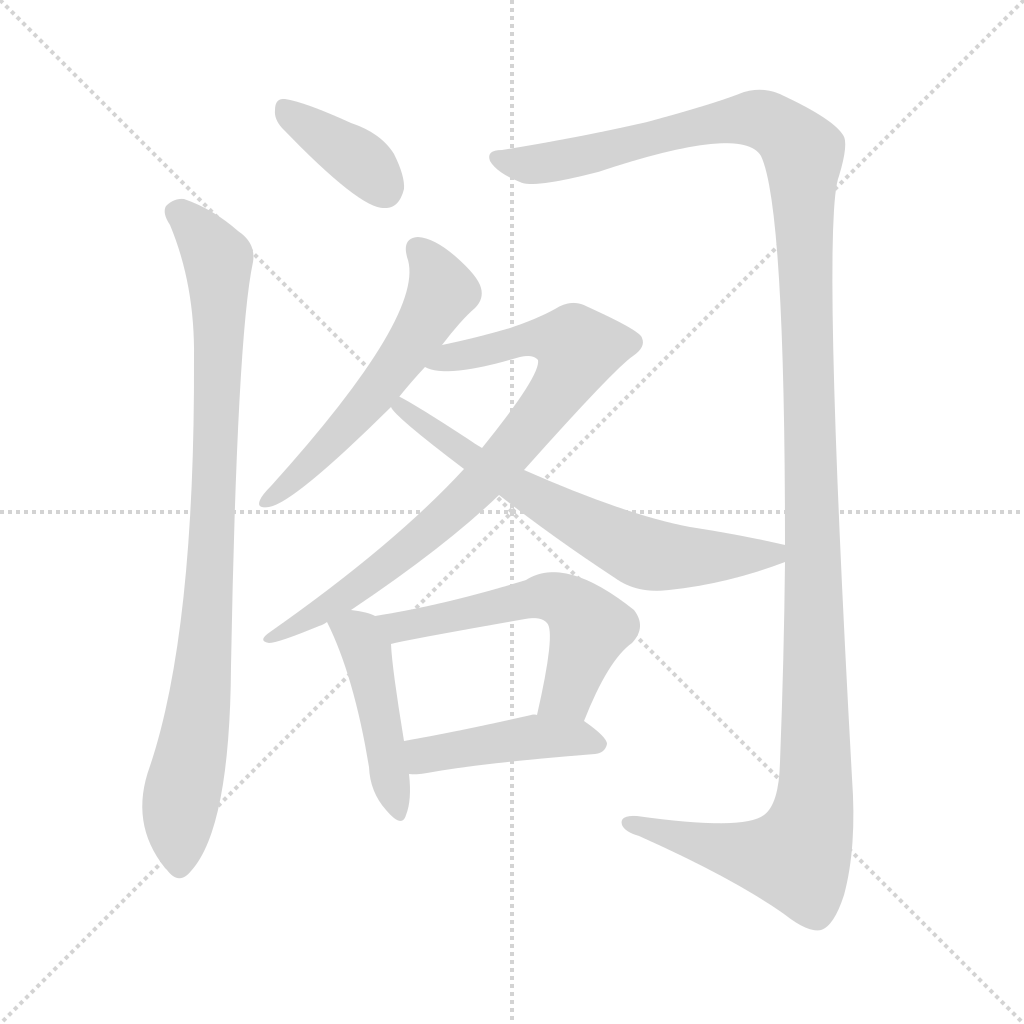
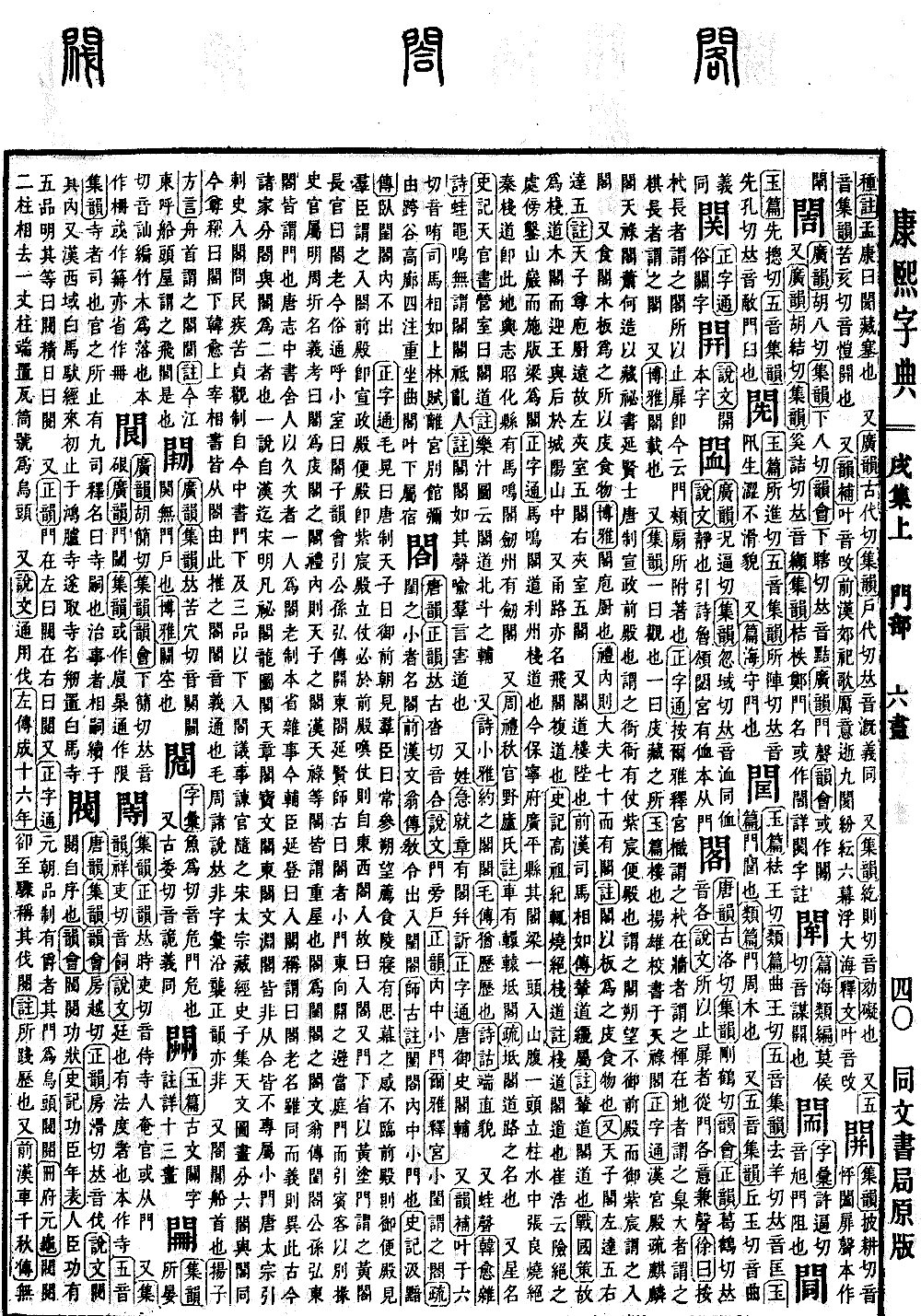
Xu Collection, Upper Volume. Radical: Gate (mén). 14 strokes in the Kangxi Dictionary. Page 1334, Entry 01.
Pronounced ge.
According to the Explaining Graphs and Analyzing Characters (Shuowen jiezi), a device used to wedge a door leaf. It is formed with Gate (mén) and ge, combining both meaning and sound. Xu Xuan notes: A long wooden stake is called a ge, used to stop a door leaf. This is what is currently called a door cheek, the place where the door leaf attaches.
According to the Correct Meaning of Characters (Zhengzitong), citing the Erya section on palaces: A wooden stake is called a yi, a wooden peg on the wall is called a hui, one on the ground is called a nie, a large one is called a gong, and a long one is called a ge.
Also, per the Expanded Erya (Guangya), a ge is a place for storage or support.
Also, according to the Collected Rhymes (Jiyun), one definition is a place for viewing; another is a place for safekeeping.
According to the Jade Chapters (Yupian), it refers to pavilions and high towers. Yang Xiong studied and collated books at the Tianlu Pavilion (Tianlu ge). According to the Correct Meaning of Characters (Zhengzitong), the Han Palace Records note: The Qilin Pavilion (Qilin ge) and Tianlu Pavilion were built by Xiao He to store secret archives and recruit talented scholars. In the Tang dynasty system, the Xuanzheng Hall, the front hall, was called the ya, which housed the ceremonial guards. The Zichen Hall, a private hall, was called the ge. On the first and fifteenth days of the month, when the emperor did not hold court in the front hall but instead visited the Zichen Hall, it was called entering the pavilion (ru ge).
Also, a food pavilion (shi ge) made of wooden planks used to store food. The Expanded Erya (Guangya) states that a ge is a kitchen. According to the Book of Rites (Liji), Inner Teachings (Neize): A minister at age seventy has a ge. The commentary states: A ge is made of wooden planks for storing food. Additionally: The Son of Heaven has ge; five are reached on the left, and five are reached on the right. The commentary states: The Son of Heaven treats the kitchen with respect (keeping it at a distance), so there are five ge in the left side-chamber and five ge in the right side-chamber.
Also, a ge path, referring to stairs and terraces. In the Biography of Sima Xiangru in the Former Han History (Hanshu), it states: The chariot paths connected. The commentary states: A chariot path is a ge path. The Strategies of the Warring States (Zhanguoce) notes: They built plank roads and wooden pavilions to welcome the king and queen into the mountains of Chengyang.
Also, a longitudinal path, also called a flying pavilion, is a covered walkway. In the Records of the Grand Historian (Shiji), Annals of Gaozu, the commentary on burning and cutting off the plank roads states: A plank road is a ge path. Cui Hao says: In steep, precipitous places, one carves into the rock and lays down wooden planks to form a ge path. The Correct Meaning of Characters (Zhengzitong) notes: The Maming ge path is a plank road in Lizhou. In the present Baoning Prefecture, Guangping County, the beams of the ge path extend into the belly of the mountain on one side, with pillars standing in the water on the other. This is the place where Zhang Liang burned the plank roads of the Qin. The Geography Records (Diyuzhi) note that Zhaohua County has a Maming ge and Jianzhou has a Jian Pavilion (Jian ge).
Also, in the Book of Rites of Zhou (Zhouli), Autumn Office, the commentary on the Field Lodging Official (Yelushi) mentions: Vehicles have the huanyuan di ge. The sub-commentary states: Di ge is a name for a road.
Also, a star name. In the Records of the Grand Historian (Shiji), Treatise on the Celestial Offices (Tianguanshu): Six stars cross the Milky Way and reach the Ying-shi mansion, which is called the ge path. The commentary states: The ge path is an auxiliary star of the Big Dipper.
Also, in the Book of Odes (Shijing), Lesser Odes (Xiaoya): Binding them firmly. The Mao commentary states: Meaning clear and distinct. The Exegesis of the Odes (Shigu) defines it as straight and upright.
Also, the sound of frogs. In a poem by Han Yu: Frogs croaking have no meaning; the ge ge sound only causes annoyance. The commentary states: Ge ge mimics their sound. It is used as a metaphor for various forms of speech that harm the righteous path.
Also, a surname. In the Urgent Formulas (Jijiu zhang), there is a Ge Bingxin. The Correct Meaning of Characters (Zhengzitong) mentions that in the Tang dynasty there was an Imperial Censor Ge Fu.
Also, in the Rhyme Supplements (Yunbu), it is rhymed with the sound you. In Sima Xiangru’s Rhapsody on the Upper Forest (Shanglin fu): Detached palaces and separate villas fill the mountains and span the valleys. High galleries circle on all sides, with double-layered seats and winding pavilions. It rhymes with shu and su.