You Collection, Upper Volume
Radical: Speech (yán)
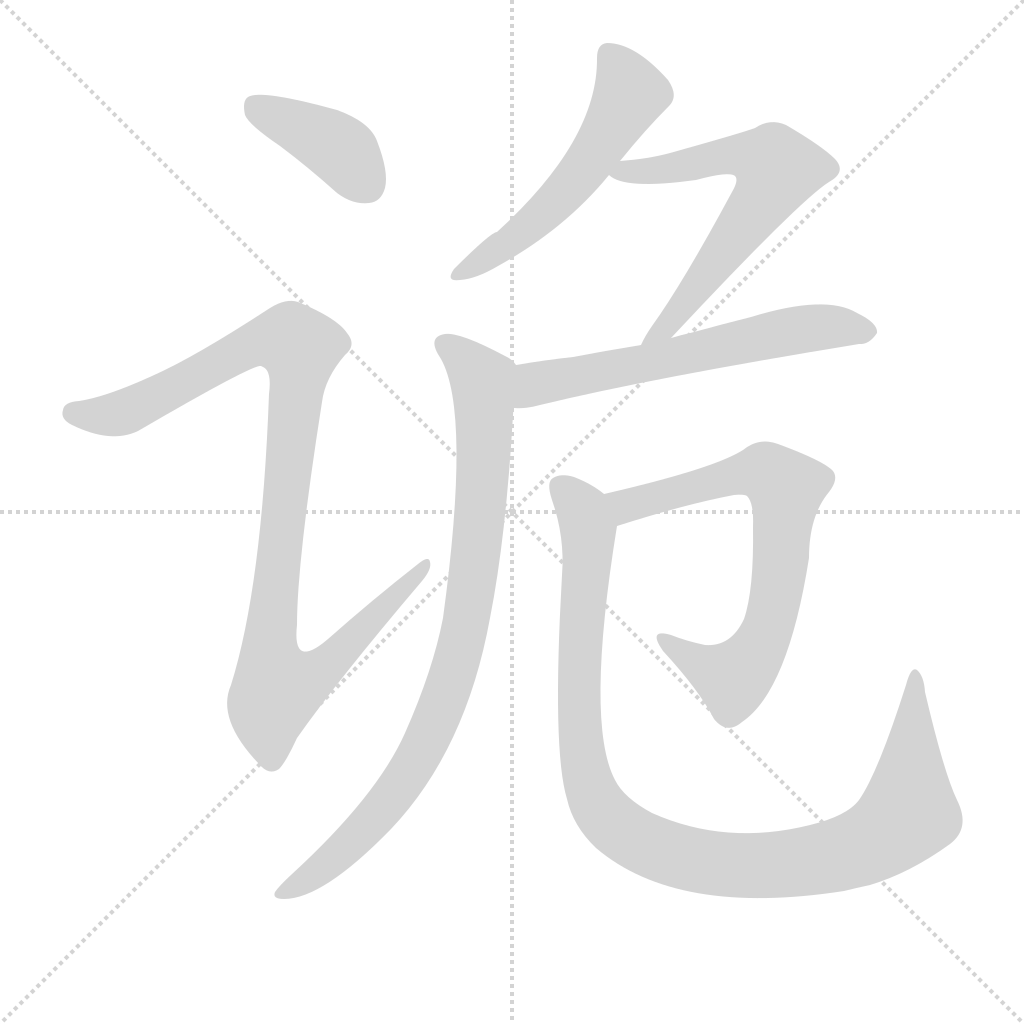
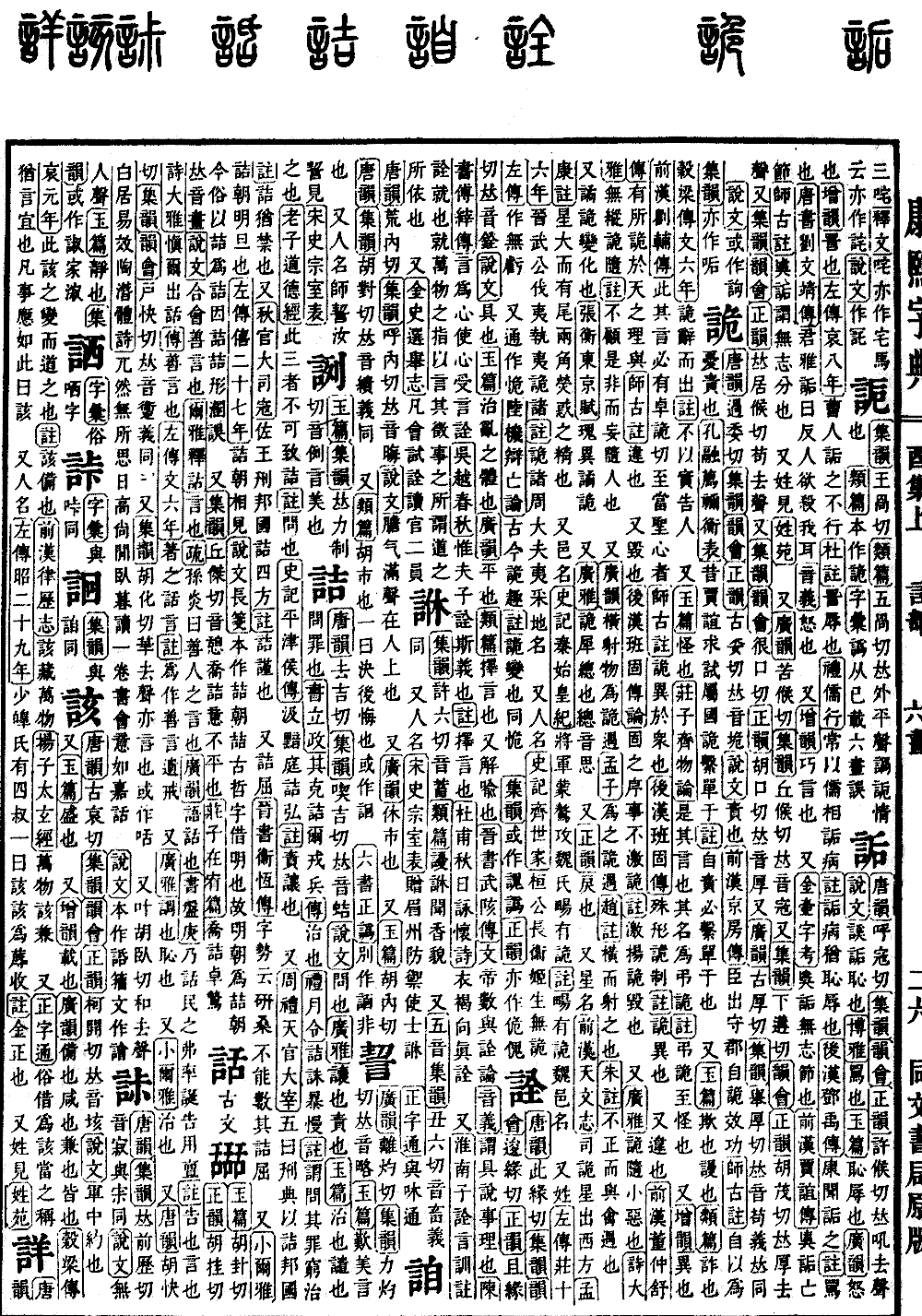
詭
Kangxi strokes: 13
Page 1158, Entry 01
Pronounced gui (falling tone).
In the Discussion of Characters (Shuowen Jiezi), it means to blame or reproach.
In the Biography of Jing Fang from the History of the Former Han (Qianshan Shu), the text states: The minister left to govern the commandery, and personally took on the reproach (gui) of ensuring performance. The commentator Yan Shigu notes: This refers to self-imposed worry and responsibility.
In the Memorial Recommending Mi Heng by Kong Rong, the text states: In the past, Jia Yi requested to be tested in a dependent state, and committed himself to restraining the Xiongnu (Shanyu). The commentary notes: To personally take on the responsibility of binding the Xiongnu.
Also, in the Jade Chapters (Yupian), it means to deceive or to cheat.
In the Categorized Chapters (Leipian), it means to defraud.
In the Guliang Commentary (Guliang Zhuan) on the sixth year of Duke Wen, it states: He spoke with deceptive words and left. The commentary notes: Not telling people the truth.
Also, in the Jade Chapters (Yupian), it means strange or odd.
In the Zhuangzi, under the chapter Discussion on Making All Things Equal (Qiwulun), it states: Such words of his are called strange (diaogui). The commentary notes: Diaogui means extremely strange.
Also, in the Expanded Rhymes (Zengyun), it means different or unusual.
In the Biography of Liu Fu from the History of the Former Han, it states: These words must contain something uniquely unusual (zhuogui) and strike at the heart of the sage. The commentary by Yan Shigu notes: Gui means different from the crowd.
In the Biography of Ban Gu from the History of the Later Han, it states: Unusual forms and strange systems. The commentary notes: Gui means different.
Also, it means to violate or contradict.
In the Biography of Dong Zhongshu from the History of the Former Han, it states: Is there something here that violates (gui) the principles of Heaven? The commentary by Yan Shigu notes: It means to violate or go against.
Also, it means to destroy or defame.
In the Discussion on the Biography of Ban Gu from the History of the Later Han, it states: Gu did not incite destruction (gui) in his arrangement of events. The commentary notes: Ji means to exalt; gui means to destroy or defame.
Also, in the Guangya, it refers to a minor evil known as guisui.
In the Book of Odes (Shijing), under the Greater Odes (Daya), it states: Do not indulge in blind following (guisui). The commentary notes: To follow others blindly without considering right from wrong.
Also, in the Guangyun, to shoot at an object from the side is called a deceptive encounter (guiyu).
In the Mencius, it states: Engaging in a deceptive encounter (guiyu). The Zhao commentary notes: It means to shoot at an angle. The Zhu commentary notes: It means to encounter game in an improper way.
Also, juegui refers to change and transformation.
In the Eastern Capital Rhapsody (Dongjing Fu) by Zhang Heng, it mentions: Extraordinary and changeable (juegui).
Also, in the Guangya, guixi means to gather or summarize. Summarize is pronounced si.
Also, in the Correct Rhymes (Zhengyun), it means perverse or contrary.
Also, it is the name of a star.
In the Treatise on Astronomy from the History of the Former Han, it states: The Master of Deception (Sigui) star appears in the west. The commentary by Meng Kang notes: The star is large with a tail and two horns; it is the essence of Mars.
Also, it is the name of an ancient town.
In the Records of the Grand Historian (Shiji), under the Annals of Qin Shi Huang, it states: General Meng Ao attacked the town of Gui in Wei. The commentary notes: Changyougui is the name of a town in Wei.
Also, it is a surname.
In the Zuo Commentary (Zuo Zhuan), sixteenth year of Duke Zhuang, it states: Duke Wu of Jin attacked Yi and captured Yi Guizhu. The commentary notes: Guizhu was a high official of Zhou; Yi was the name of his fief.
Also, it is a personal name.
In the Records of the Grand Historian, under the Lineage of Qi, it states: Among the children of Duke Huan, the one born to Lady Wei was named Wugui. In the Zuo Commentary, it is written as Wukui.
Also, it is interchangeably used with the character pronounced gui (falling tone), meaning to change.
In the Discourses on the Loss of the South (Bianwang Lun) by Lu Ji, it states: The changing (gui) tendencies of ancient and modern times. The commentary notes: Gui means change. It is identical to the variant form.
In the Rhyme Compilation (Jiyun), it is sometimes written as another character pronounced zhui.
In the Correct Rhymes (Zhengyun), it is also written as characters pronounced gui and kui.