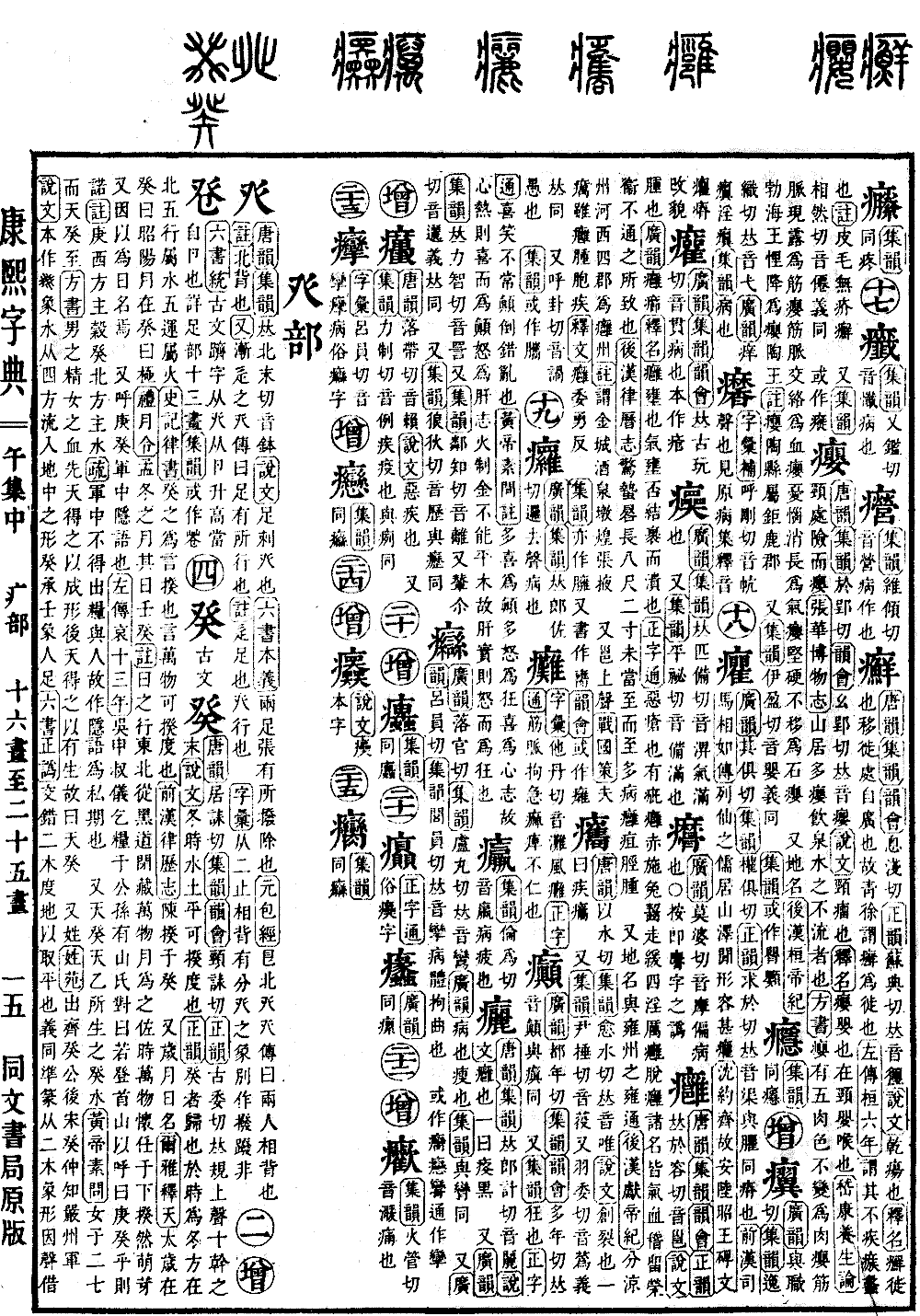
Wu Collection, Middle Volume
Radical: Footsteps (bō)
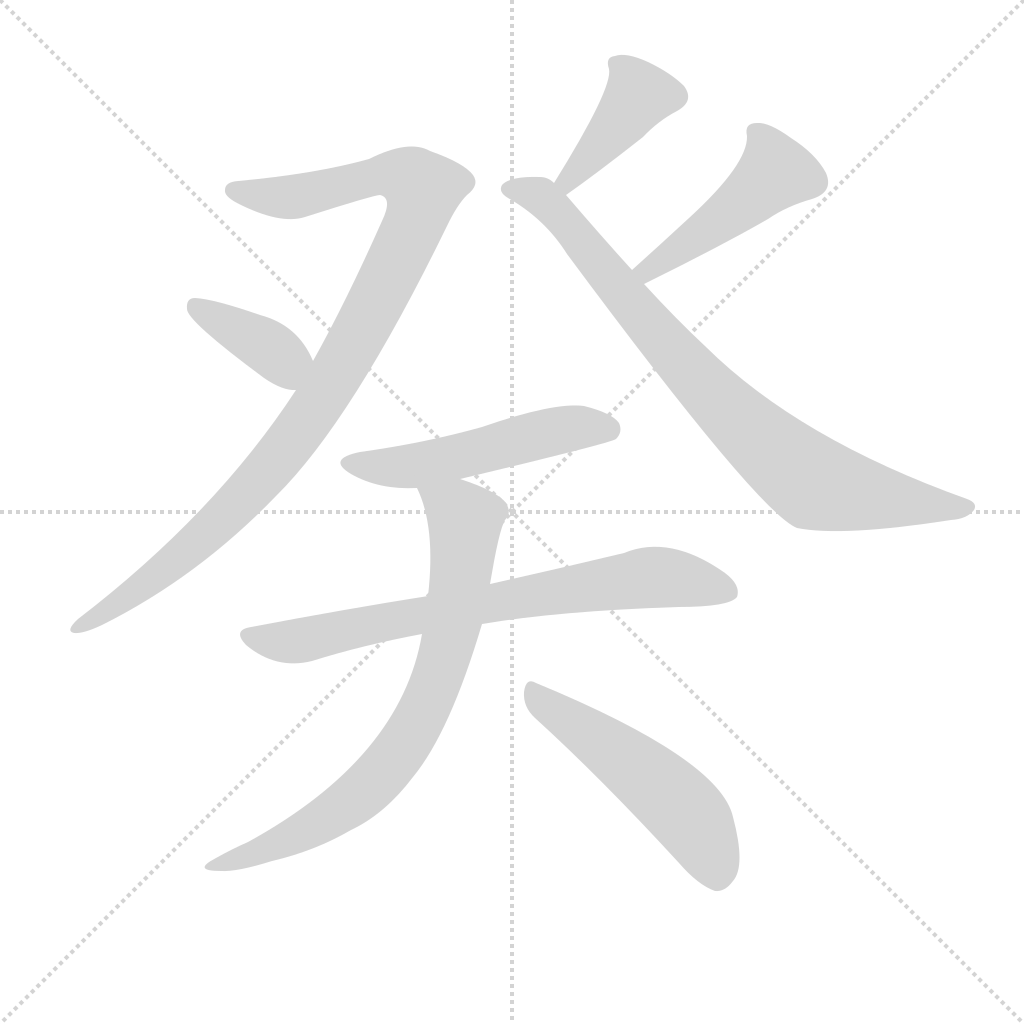
Gui. Kangxi stroke count: 9. Page 783, Entry 32.
Ancient script form.
Pronounced gui (rising tone).
The last of the Ten Heavenly Stems.
Shuowen Jiezi states that in winter, water and earth are level, allowing for measurement and assessment.
Zheng Yun states that gui means to return and be hidden. In the seasons, it represents winter; in orientation, it is the north; in the Five Phases, it belongs to water; in the Five Movements, it belongs to fire.
Records of the Grand Historian (Shiji), Book of the Pitch Pipes states that the meaning of the character gui is to measure and calculate. It signifies that all things can be measured and assessed.
Book of Han (Hanshu), Treatise on Pitch Pipes and the Calendar states to conduct measurement and calculation during the time of gui.
Also used as a name for years, months, and days.
Erya, Interpretation of the Heavens states that a year in the gui cycle is called Zhaoyang. A month in the gui cycle is called Ji.
Book of Rites (Liji), Monthly Ordinances states that in the first month of winter, the day stems are Ren and Gui. The commentary states that the sun moves along the dark path in the northeast, concealing all things, while the moon acts as its assistant; at this time, all things are pregnant below, and sprouts begin to emerge, hence it is used as a name for the day stem.
There is the phrase calling for Geng and Gui, which is secret military slang.
Zuo Tradition (Zuozhuan), Thirteenth Year of Duke Ai states that Shen Shuyi of the state of Wu asked for grain from the Gongsun Youshan clan, who replied: If you ascend Shou Mountain and call out for Geng and Gui, I will agree to provide grain. The commentary states that Geng is in the west and governs grain, while Gui is in the north and governs water. The sub-commentary states that in the military, one does not give grain to others, so secret language was used as a private coded agreement.
There is also Tian Gui, referring to the Gui water (substance related to reproductive development in the human body) produced by Tianyi or the innate essence.
Yellow Emperor's Inner Canon (Huangdi Neijing) states that when a woman is fourteen years old, the Tian Gui arrives.
Medical texts state that a man's essence and a woman's blood are formed by the innate, and they grow by the acquired, which is why it is called Tian Gui.
Also a surname.
Xingyuan states it originates from Duke Gui of the state of Qi; later, Gui Zhong of the Song dynasty served as prefect of Yanzhou.
Shuowen Jiezi states it was originally written as gui, resembling the shape of water flowing from all four directions into the ground. Gui follows Ren, resembling the human foot.
Liushu Zheng'e states it is two pieces of wood placed in a cross, used to measure land for leveling. The meaning is the same as the character for standard. The seal script form uses two wood characters and is a pictograph. Because the pronunciation is similar, it was borrowed for the Gui in Ren and Gui. In clerical script, it is also written as variants (kui) and (kui), all with the same meaning.