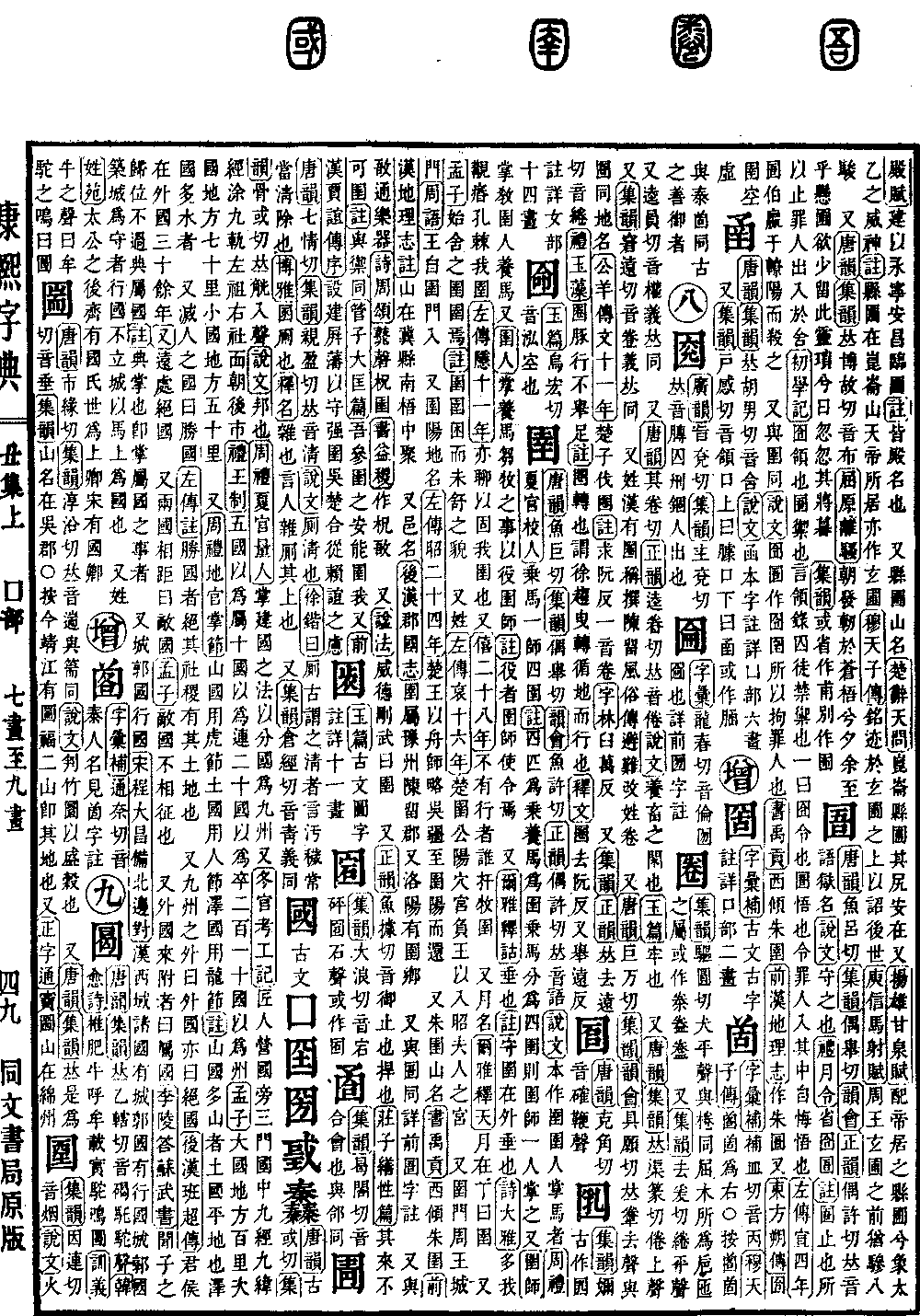
Chou Collection, Upper Volume
Radical: Enclosure (wéi)
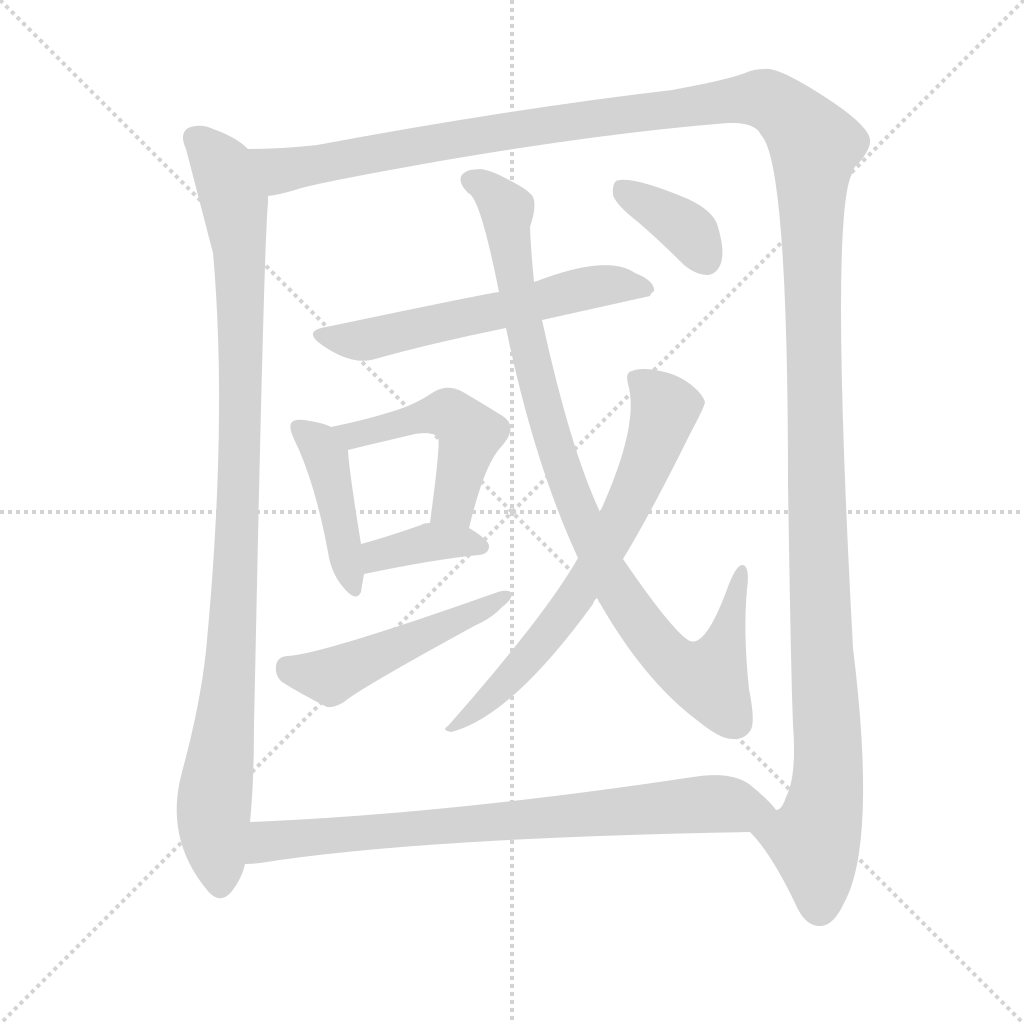
Guo
Kangxi stroke count: 11
Page 219, Entry 16
Ancient forms: Enclosure (wéi), Guo, Guo
Pronounced guo
Shuowen Jiezi: A state or nation.
Rites of Zhou (Zhouli), Summer Offices, Liangren: Oversees the laws for establishing states, dividing the land into the nine provinces.
Winter Offices, Artificers Record (Kaogongji): When the master builder constructs a capital city, there are three gates on each side, nine north-south avenues and nine east-west avenues within the capital, each wide enough for nine carriages to travel side by side; the ancestral temple is on the left, the altars of soil and grain on the right, the imperial court in the front, and the marketplace in the back.
Book of Rites (Liji), Royal Regulations (Wangzhi): Five states form a shu, ten states form a lian, twenty states form a zu, and two hundred and ten states form a zhou.
Mencius: A large state has a territory of one hundred square li; a medium state has a territory of seventy square li; a small state has a territory of fifty square li.
Rites of Zhou (Zhouli), Earth Offices, Zhangjie: Mountainous states use tiger-shaped tallies, flat-land states use human-shaped tallies, and marshy states use dragon-shaped tallies. Commentary: Mountain states refer to those with many mountains, earth states refer to those with much flat land, and marsh states refer to those with much water.
To conquer another state is called sheng-guo (conquered state). Zuo Commentary (Zuozhuan) note: A sheng-guo is a state whose altars of soil and grain have been destroyed and whose land has been seized.
Beyond the nine provinces is called a foreign state. Also called a ju-guo (isolated state). Book of the Later Han (Houhanshu), Biography of Ban Chao: You have been in a foreign state for over thirty years. Also: A distant, isolated state.
States of equal strength are called enemy states. Mencius: States of equal strength do not attack one another.
Foreign states that come to submit are called subordinate states. Li Ling, Letter to Su Wu: I heard that after your return, your position was nothing more than an official in charge of subordinate states. Commentary: Dian means to manage. It refers to an official who manages the affairs of subordinate states.
There are also walled-city states and mobile states. Song Dynasty, Cheng Dachang, Record of Northern Frontier Affairs (Beibian Dui): The states of the Western Regions during the Han dynasty included walled-city states and mobile states. Walled-city states are those that build city walls for defense; mobile states do not build cities and have a national structure based on nomadic life on horseback.
Also used as a surname. Surname Garden (Xingyuan): Descendants of Jiang Ziya. The State of Qi had the Guo family, who served as high ministers for generations; the State of Song had Guo Qing.
Guo: Correct Character Synthesis (Zhengzitong) notes this is a vulgar form of the character guo.
Guo: Same as the character guo; this is a vulgar form used during the Republic of China.