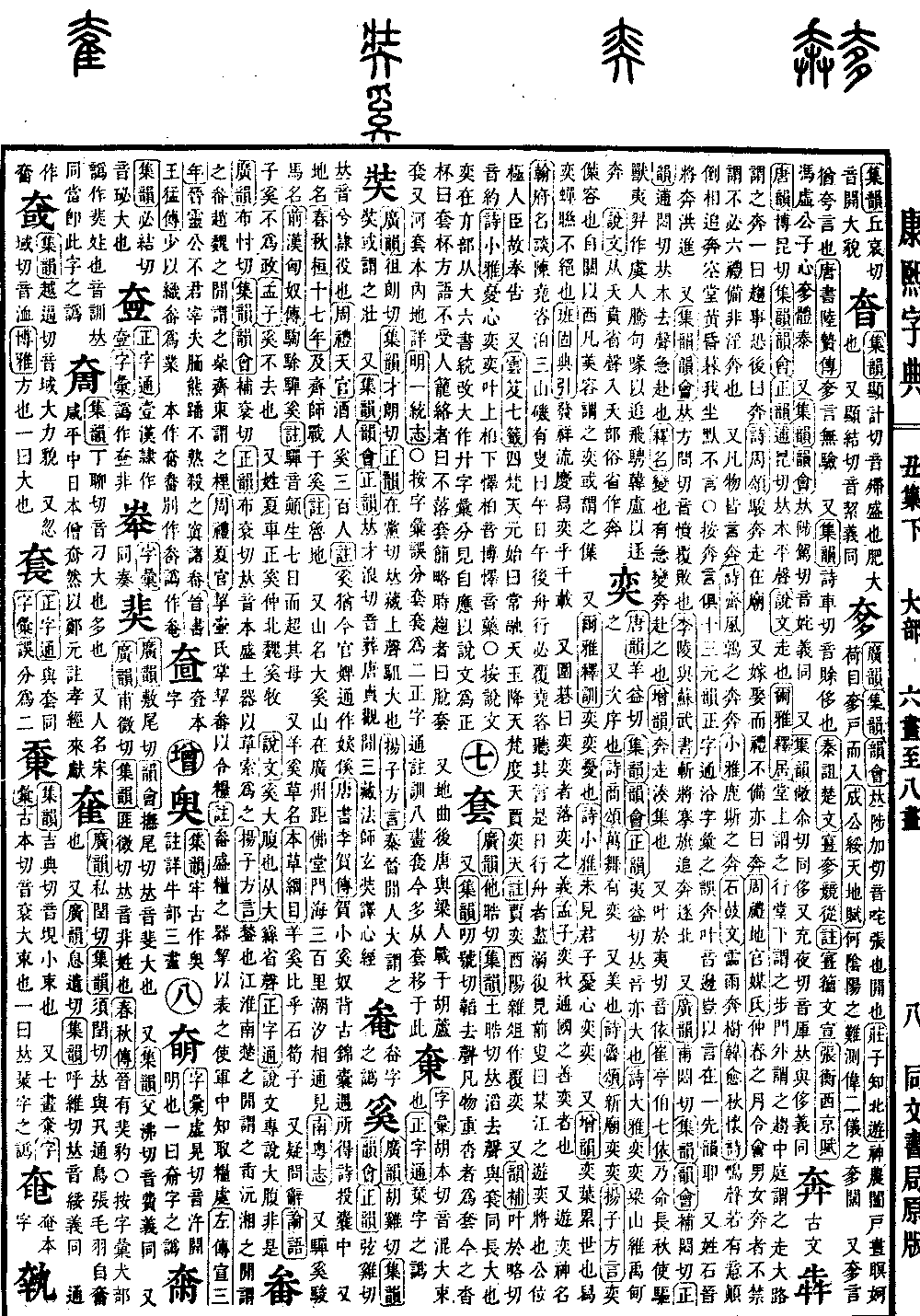
Chou Collection, Lower Volume
Radical: Big (dà)
奔
Kangxi stroke count: 9
Page 252, Entry 03
Ancient character: 犇
Pronounced ben (level tone)
According to the Analytical Dictionary of Characters (Shuowen Jiezi), it means to run. According to the Progress toward Elegance (Erya), in the section on dwellings, movement on a hall is called xing, movement below a hall is called bu, outside a gate is called qu, in a central courtyard is called zou, and on a major road is called ben. Another interpretation is that when people compete to be first in handling affairs, it is called ben. In the Book of Odes (Shijing), in the Zhou Eulogies (Zhou Song), it refers to moving quickly within a temple. It also refers to a marriage or wedding where the rites are not complete. According to the Rites of Zhou (Zhouli), in the Office of Earth, under the Matchmaker, during the second month of spring, when men and women are gathered, those who marry without following all six rites are not prohibited; this does not refer to illicit elopement. Furthermore, all things can be described as ben. In the Book of Odes (Shijing), in the Odes of Yong (Yongfeng), it says the quail is restless. In the Lesser Odes of the Kingdom (Xiaoya), it describes a running deer. In the Stone Drum Inscriptions (Shiguwen), it describes rain rushing against trees. In Han Yu’s Poem of Autumn Thoughts (Qiuhuai Shi), the chirping sound seems to have intent, falling and chasing back and forth. In the empty hall at twilight, I sit in silent meditation. Note: Ben and yan both belong to the thirteen yuan rhyme group. The Treasury of Correct Characters (Zhengzitong) follows the error of the Collection of Characters (Zihui) in rhyming ben as bian, perhaps because yan is placed in the first xian rhyme group. It is also a surname. During the Later Jin dynasty, there was a general named Ben Hongjin.
Pronounced fen (falling tone)
Meaning to overturn or be defeated. In Li Ling’s Letter to Su Wu (Yu Suwu Shu), it refers to beheading generals and capturing flags, chasing the defeated and pursuing the northern enemies.
Pronounced ben (departing tone)
Meaning to hasten toward. According to the Explanation of Names (Shiming), it means to change. It refers to rushing toward something due to an emergency. According to the Augmented Rhymes (Zengyun), to run and gather.
Also rhymes with yi (level tone). In Cui Tingbo’s Seven Admonitions (Qi Yi), he ordered the Longqiu official to drive the beasts, and Yi the Archer served as the game warden. He spurred the hounds to chase the flying birds and unleashed the Han hounds to pursue the running prey.
According to the Analytical Dictionary of Characters (Shuowen Jiezi), it is derived from the radical for yao, with a contracted form of the character ben as the phonetic. It is classified under the radical for yao. The common form is a simplified version of the original character. The character given is the original form.
Textual Research: In the Erya entry on dwellings, it states movement on a hall is called xing. Following the original text, this has been corrected from the entry on dwellings to the entry on palaces. In the Book of Odes (Shijing), in the Odes of Qi, it says the quail is restless. Following the original text, this has been corrected from the Odes of Qi to the Odes of Yong.