You Collection, Upper Volume
Radical: Speech (yán)
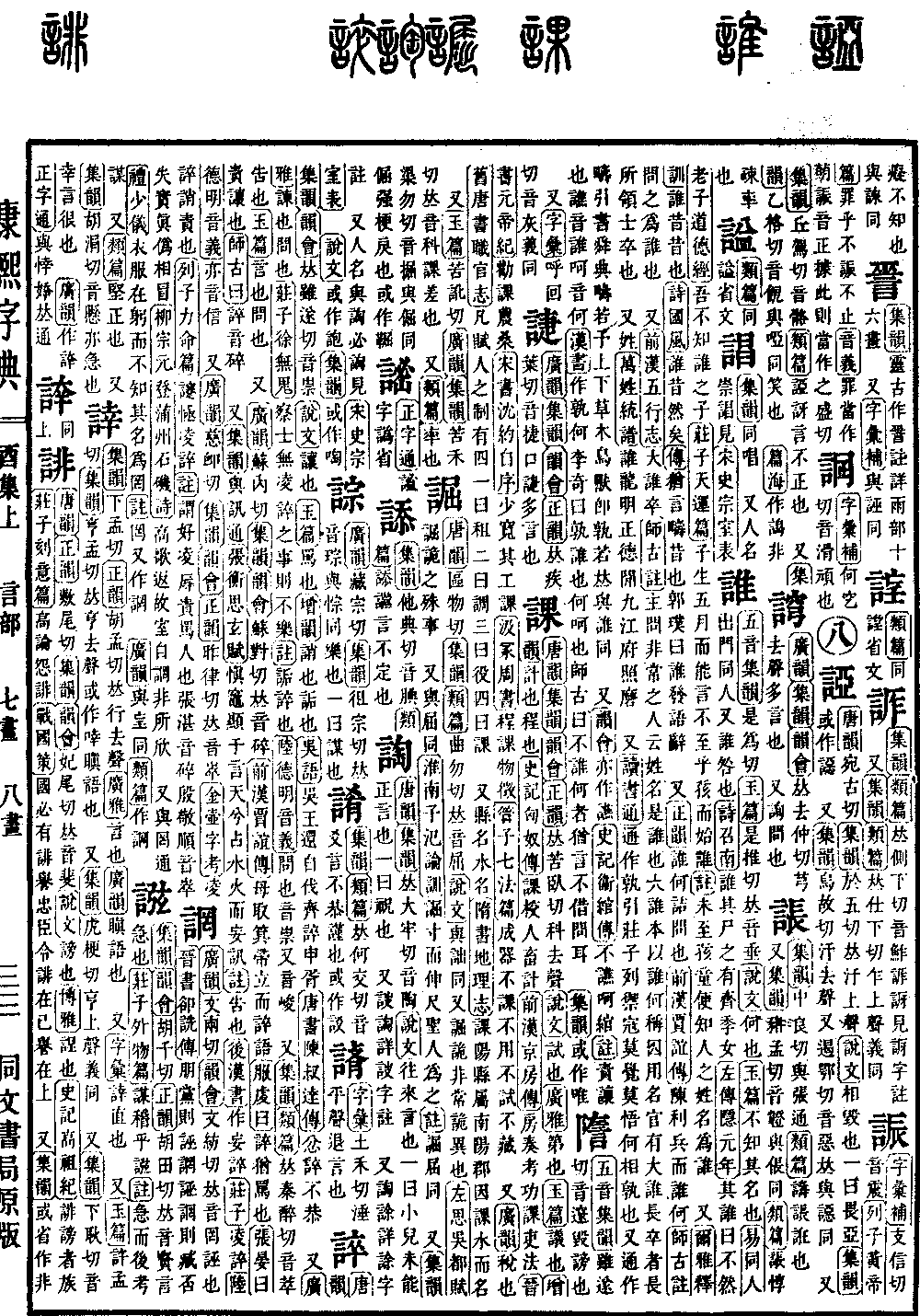
誹
Kangxi stroke count: 15
Page 1165, Entry 27
Pronounced fěi.
Shuowen Jiezi (Shuowen): To slander.
Guangya (Boya): To slander.
Records of the Grand Historian (Shiji), Annals of Emperor Gaozu: Those who slander are executed along with their clans.
Zhuangzi, Ke Yi Chapter: Lofty discourse leads to resentment and slander.
Strategies of the Warring States (Zhanguoce): A state must have slander and praise; a loyal minister lets the slander rest with himself, while the praise rests with the ruler.
Also, in the Jiyun, it is sometimes abbreviated as fēi.
Book of Han (Qianhan), Biography of Chao Cuo: Slander and defamation do not bring about good governance.
Shigu Commentary: The character fēi is read as fěi.
Also, in the Jiyun, pronounced fěi (rising tone). Meaning is the same.
Also, in the Jiyun and Yunhui, pronounced fěi; in the Zhengyun, pronounced fēi. Interchangeable with fēi.
Leipian: Slanderous words.
Zengyun: To criticize or speak ill of.
Records of the Grand Historian (Shiji), Treatise on the Balance of Standards: Zhang Tang reported that Yan Yi, while holding a ministerial position, saw that the imperial decrees were inconvenient, and although he did not speak out, he slandered them in his heart.
Book of Han (Qianhan), Treatise on Food and Money: Written as fēi.
Commentary: The mouth does not speak, but the heart condemns it.
Also, in the Guangyun, pronounced fèi; in the Jiyun, Yunhui, and Zhengyun, pronounced fèi (departing tone). Meaning is the same.
Records of the Grand Historian (Shiji), Annals of Emperor Wen: The wooden post for receiving criticism.
Suoyin: The character fěi is pronounced fēi, and also pronounced fèi. Shizi says: Yao erected a wooden post for receiving criticism. Wei Zhao states: Concerned that there might be flaws in governance, he allowed people to write them on the wood, and later generations adopted this as decoration. The four-column structures found today on palace walls and bridge ends are descendants of this practice.