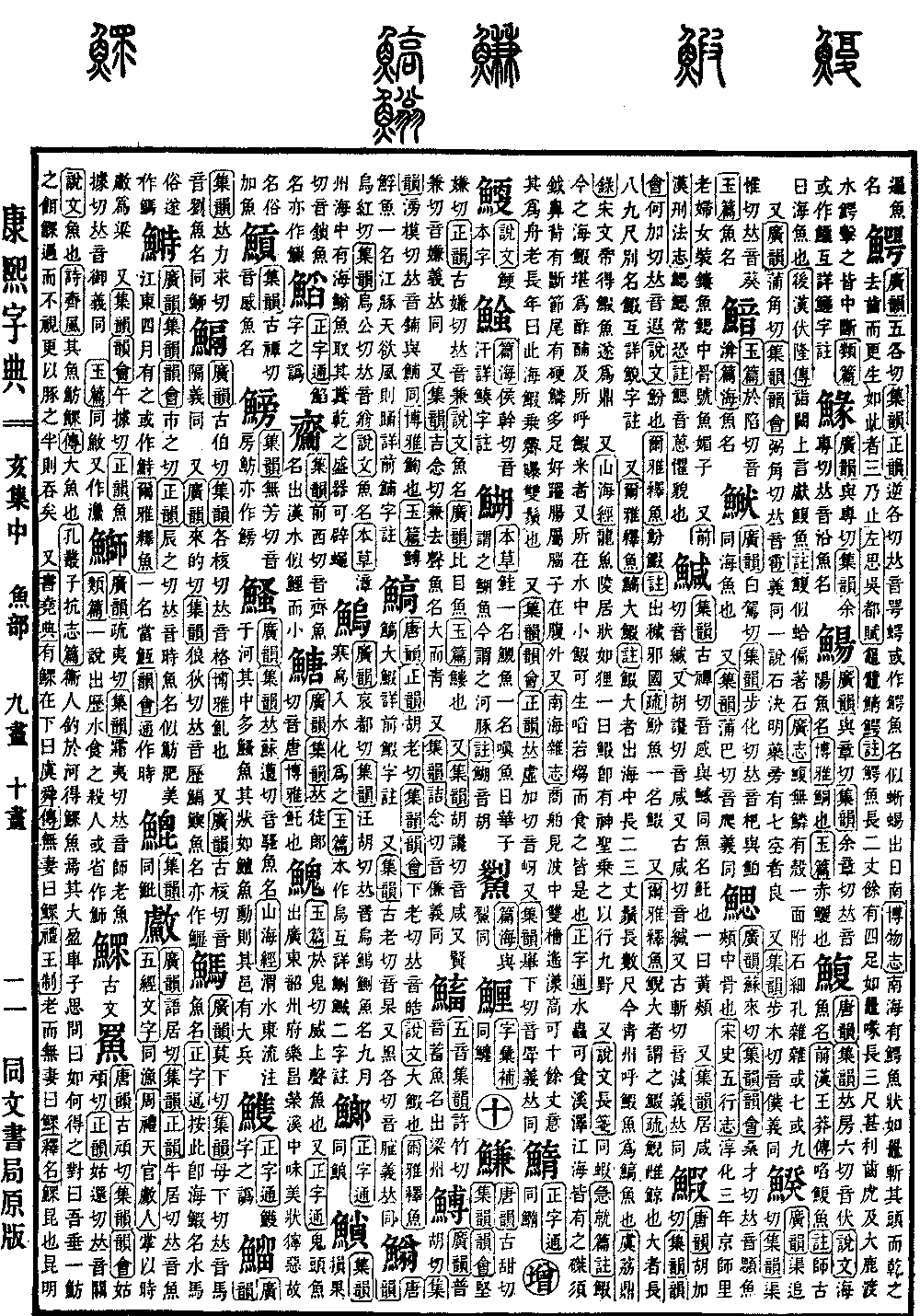
Hai Collection, Lower Volume
Radical: Fish (yú)
Entry: Fú
Kangxi Stroke Count: 20
Page 1475, Entry 03
According to the Tang Rhyme (Tangyun) and the Collected Rhymes (Jiyun), it is pronounced fu.
As stated in the Analytical Dictionary of Characters (Shuowen Jiezi), it is the name of a sea fish.
In the Biography of Wang Mang within the History of the Former Han (Qianhan Shu), it is recorded that he ate this fish. The commentary by Yan Shigu states that it is a sea fish.
In the Biography of Fu Long within the History of the Later Han (Houhan Shu), it is recorded that he went to the imperial court to offer this fish. The commentary states that the fish resembles a clam and attaches itself to rocks.
The Extensive Records (Guangzhi) states that this fish has no scales, possesses a shell, adheres to rocks on one side, and has small, varied apertures, sometimes seven or sometimes nine.
According to the Expanded Rhymes (Guangyun), the Collected Rhymes (Jiyun), and the Rhyme Collection (Yunhui), it is also pronounced bao. The meaning is the same. One source suggests it is the medicinal substance known as shi jue ming (abalone shell). It is considered of high quality when it has seven holes along the side.
According to the Collected Rhymes (Jiyun), it is also pronounced pu. The meaning is the same.