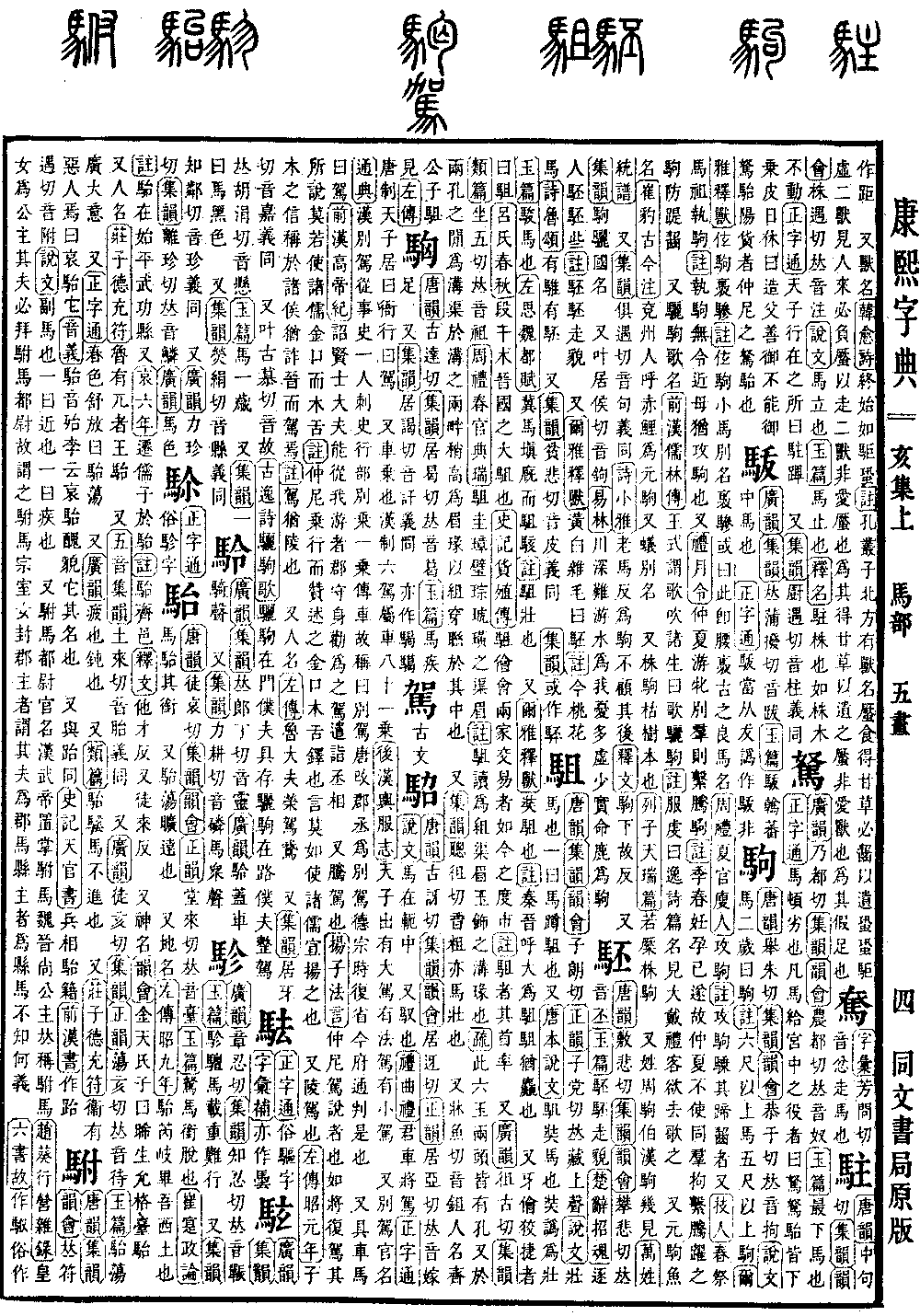
Hai Collection, Upper Volume
Radical: Horse (mǎ)
Kangxi strokes: 15
Page 1436, Entry 17
According to Tang Rhymes (Tangyun), Collected Rhymes (Jiyun), and Rhyme Collection (Yunhui), the pronunciation is fu (falling tone), same as the pronunciation for the character meaning to attach.
Shuowen Jiezi explains the term as a secondary horse. Another interpretation defines it as proximity. Another interpretation defines it as speed.
There is also the official title of Fuma Duwei (Commandant of the Secondary Horses). Emperor Wu of Han established this office to oversee the secondary carriage horses. From the Wei and Jin dynasties onward, those who married princesses were granted the title of Fuma Duwei, and thus came to be known as Fuma.
In Miscellaneous Records of the Military Camp (Xingying Zalu) by Zhao Kui, it is stated that the emperor's daughter is enfeoffed as a princess, and her husband is invariably granted the position of Fuma Duwei, hence the title Fuma. Husbands of women of the imperial lineage enfeoffed as countesses (junzhu) are called junma, and husbands of those enfeoffed as baronesses (xianzhu) are called xianma; the meaning of this is unclear.
In Origins of the Six Writings (Liushu Gu), it is written in a variant form. The common variant is considered incorrect.