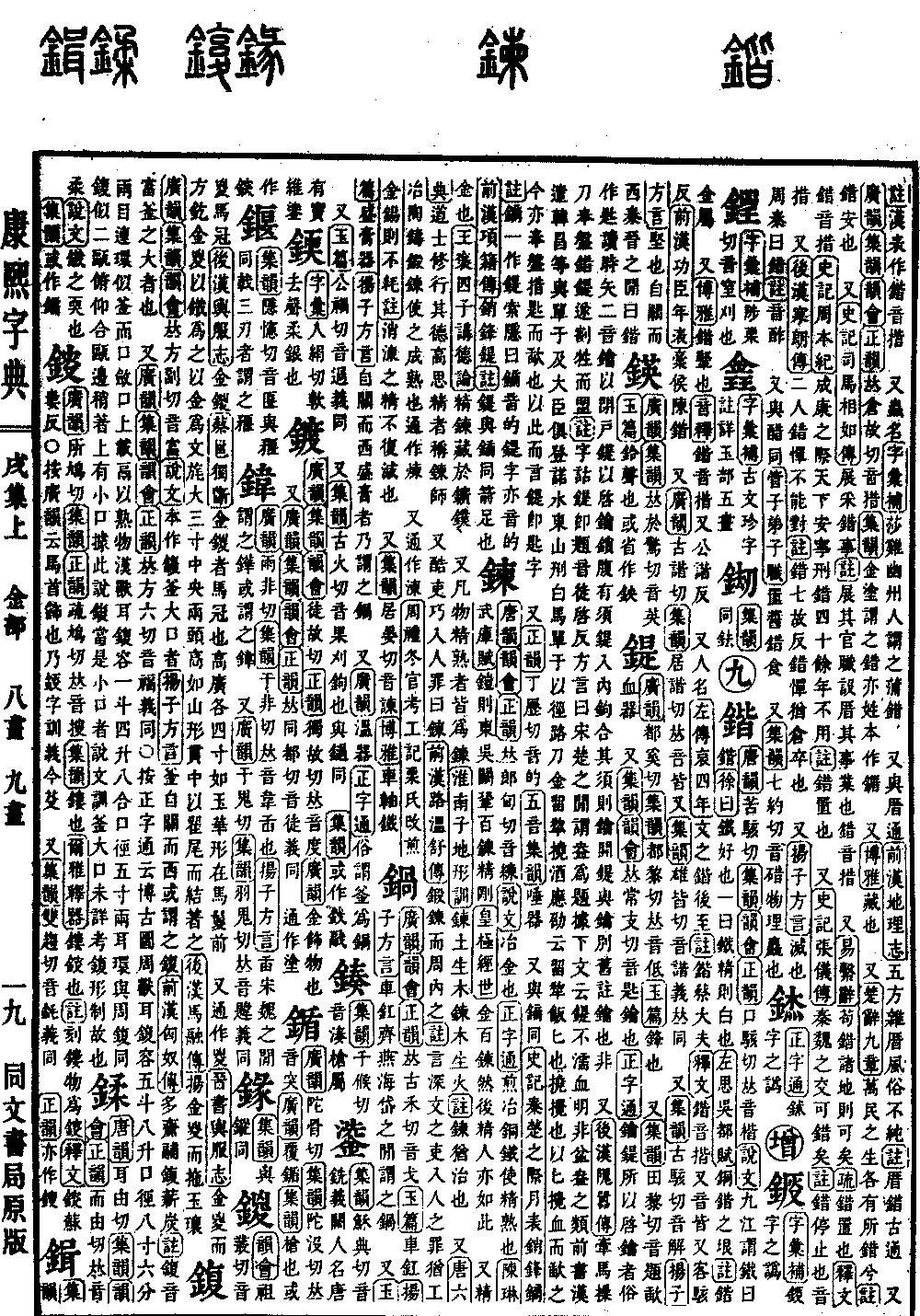
Xu Collection, Upper Volume
Radical: Metal (jīn)
Fu
Kangxi Dictionary strokes: 17
Page 1313, Entry 20
Guangyun (Broad Rhymes), Jiyun (Collected Rhymes), and Yunhui (Collection of Rhymes) state the pronunciation is fu (falling tone).
Shuowen Jiezi (Explanation of Simple and Compound Characters) states: Originally written as such. A pot with a wide opening.
Yangzi Fangyan (Regional Dialects of Yangzi) states: A pot, from the pass to the west, some call it a fu.
Book of Han (Hanshu), Biography of the Xiongnu states: They carried many pots, fu, firewood, and charcoal. The commentary states: Fu is pronounced fu (falling tone). It is a large type of pot.
Also, Guangyun (Broad Rhymes), Jiyun (Collected Rhymes), Yunhui (Collection of Rhymes), and Zhengyun (Correct Rhymes) state the pronunciation is fu (rising tone). The meaning is the same.
The Zhengzitong (Correct Character Dictionary) notes: According to the Bogutu (Illustrated Catalog of Antiquities), the Zhou dynasty animal-eared fu has a capacity of five dou and eight sheng, a mouth diameter of eight cun and six fen, with two linked ring handles. It resembles a pot but with a constricted opening, and a vessel called a li is placed on the opening to cook food. The Han dynasty animal-eared fu has a capacity of one dou, four sheng, and eight he, with a mouth diameter of five cun, with two ring handles similar to the Zhou dynasty fu. The fu resembles two bowls placed facing each other, with the edges slightly attached and a small opening on top. Based on this account, the fu should be a vessel with a small opening. The definition in Shuowen Jiezi describing it as a pot with a wide opening is due to a lack of detailed examination regarding the structure and form of the fu.