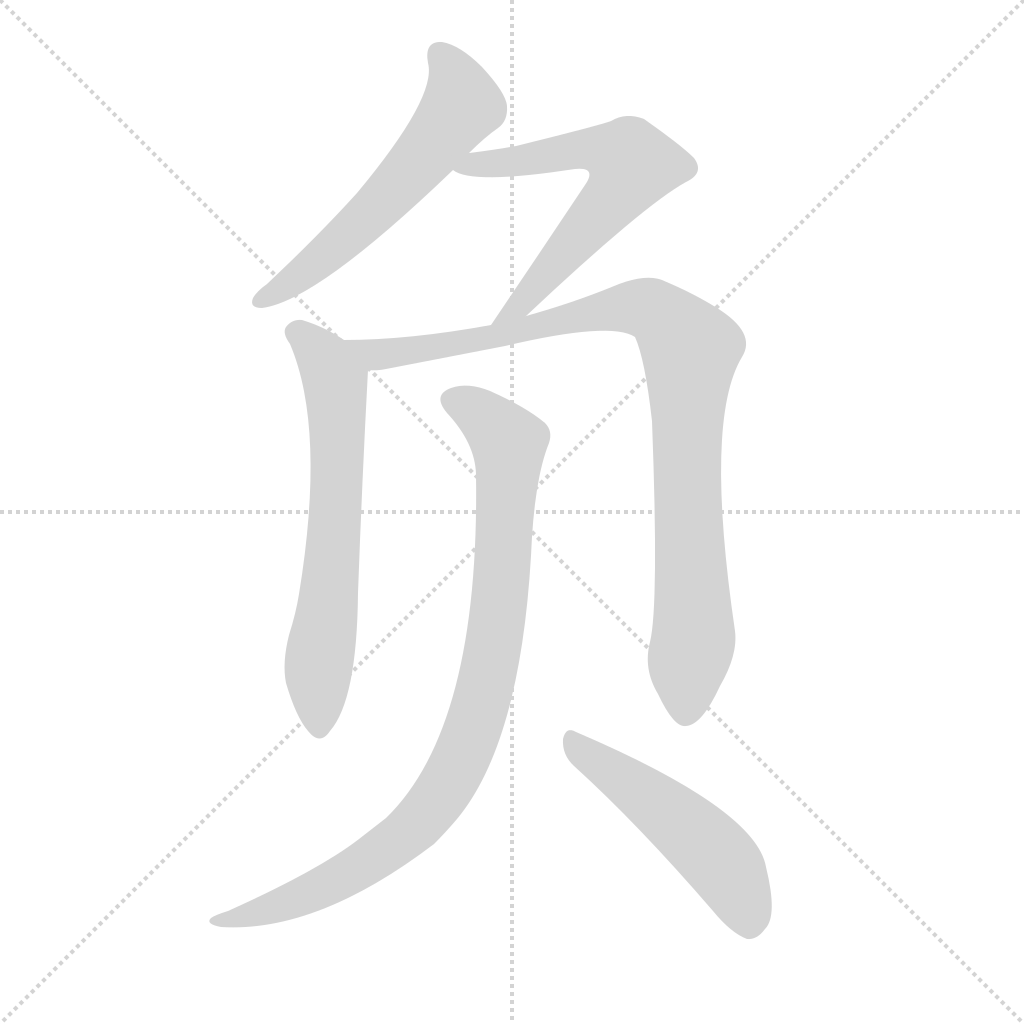
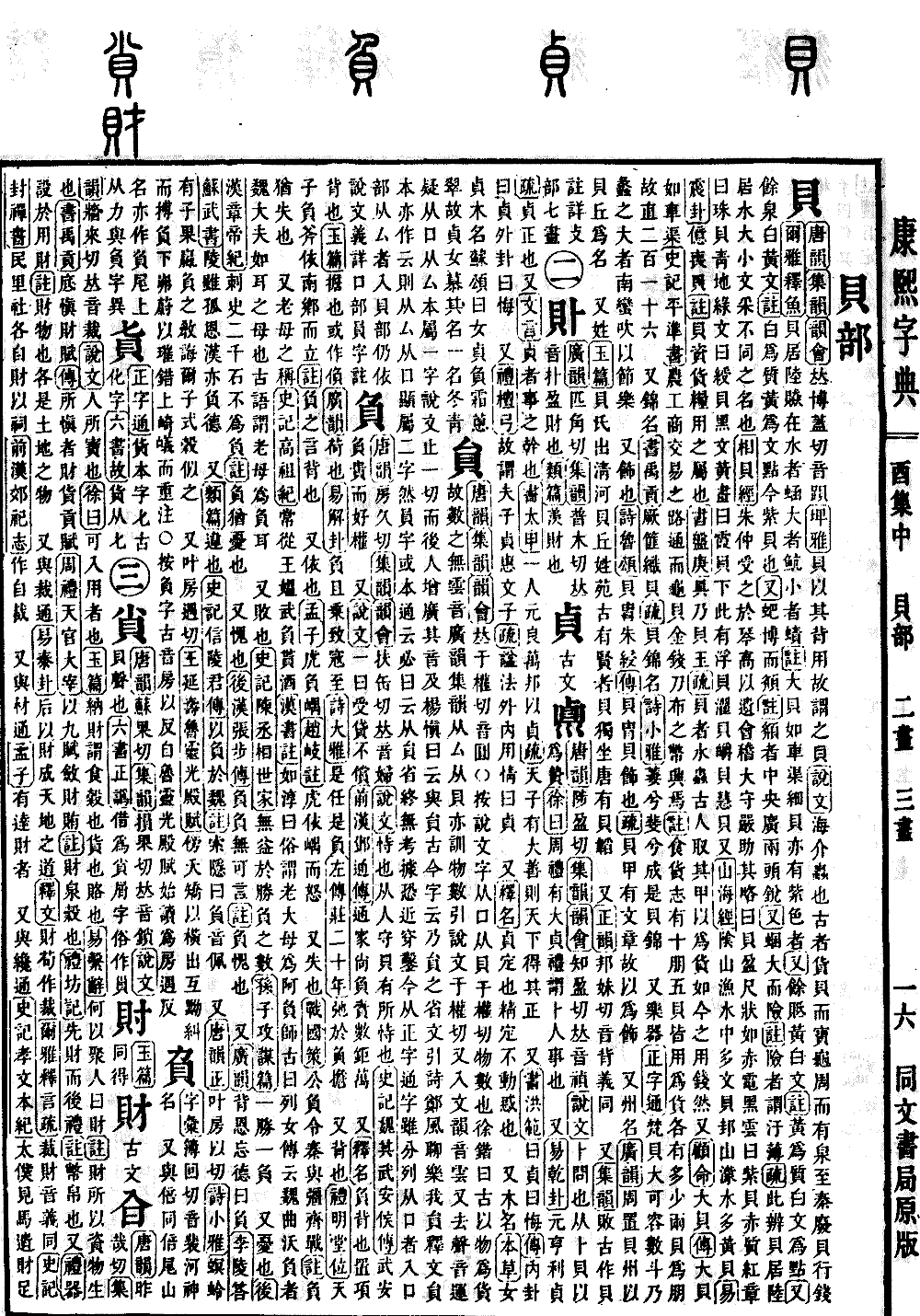
You Collection, Middle Volume
Radical: Cowrie (bèi)
Page 1204, Entry 09
Pronounced fu (falling tone).
According to the Explanations of Graphs and Analysis of Characters (Shuowen Jiezi), it means to rely upon. It is composed of the radical for person and the radical for cowrie, signifying having something to rely upon.
Records of the Grand Historian (Shiji), Biography of Marquis Wu’an: Marquis Wu’an relied on his noble status and favored power.
Also according to the Explanations of Graphs and Analysis of Characters, one meaning is to receive a loan and not repay it.
Book of Han (Hanshu), Biography of Deng Tong: The Tong family still owed debts amounting to tens of millions.
Also, according to Explanations of Names (Shiming), fu means the back. It refers to placing something on the neck or back.
Jade Chapters (Yupian): To carry on the back. Sometimes also written in a variant form (fù).
General Rhymes (Guangyun): To carry.
Book of Changes (Yijing), Xie Hexagram: Carrying something on the back and riding in a carriage leads to the arrival of bandits.
Book of Odes (Shijing), Great Odes: To take on the task and to carry it.
Zuo Tradition (Zuozhuan), 20th Year of Duke Zhuang: Relaxed in carrying burdens.
Also means the back.
Book of Rites (Liji), Mingtang Wei: The Son of Heaven stands with his back to the axe-patterned screen, facing south.
Commentary: The word fu means the back.
Also means to rely on.
Mencius: The tiger relies on the corner of a mountain.
Zhao Qi’s Commentary: The tiger relies on the corner of the mountain while roaring.
Also means to lose.
Strategies of the Warring States (Zhanguoce): You caused the state to lose by letting Qin fight the powerful Qi.
Commentary: Fu here is synonymous with losing.
Also a term for an elderly mother.
Records of the Grand Historian (Shiji), Annals of Gaozu: He often borrowed wine from the elderly Wang and Wu Fu.
Book of Han Commentary: Ru Chun states that in the vernacular, an elderly grandmother is called a Fu. Yan Shigu states that the Biographies of Exemplary Women mentions the Lady of Quwo of Wei, who was the mother of the Wei grandee Ru Er. Ancient language called elderly mothers Fu.
Also means defeat.
Records of the Grand Historian (Shiji), House of the Chancellor: It is of no benefit to the calculation of victory or defeat.
Sun Tzu, Art of War, Strategy of Attack: One victory and one defeat.
Also means to worry.
Book of the Later Han (Houhanshu), Annals of Emperor Zhang: The governors and officials with two thousand piculs of salary did not have worries.
Commentary: Fu here is synonymous with worry.
Also means to be ashamed.
Book of the Later Han (Houhanshu), Biography of Zhang Bu: Feeling deep shame, there is nothing to say.
Commentary: Fu means shame.
Also, according to General Rhymes (Guangyun), to betray favors and forget virtue is called fu.
Li Ling, Letter in Response to Su Wu: Although I have betrayed favors, the Han has also betrayed virtue.
Also, according to the Categorized Dictionary (Leipian), it means to go against.
Records of the Grand Historian (Shiji), Biography of Lord Xinling: Thereby going against the state of Wei.
Commentary: The Suoyin commentary states that fu is pronounced pei.
Also, according to the Corrected Tang Rhymes (Tang Yun Zheng), rhymes with fu (rising tone).
Book of Odes (Shijing), Lesser Odes: The solitary wasp has young, and the caterpillar carries them away. Teach and instruct your children, and they will be virtuous like them.
Also rhymes with fu (falling tone).
Wang Yanshou, Rhapsody on the Lingguang Hall of Lu: Obliquely twisting to emerge horizontally, mutually dark and winding while clutching and bearing. Below, dense and lush with intricate colors; above, steep and craggy with heavy streams.
Note: As for the character fu, the ancient pronunciation was fu (rising tone). It began to be read as fu (falling tone) starting with the Rhapsody on the Lingguang Hall of Lu.