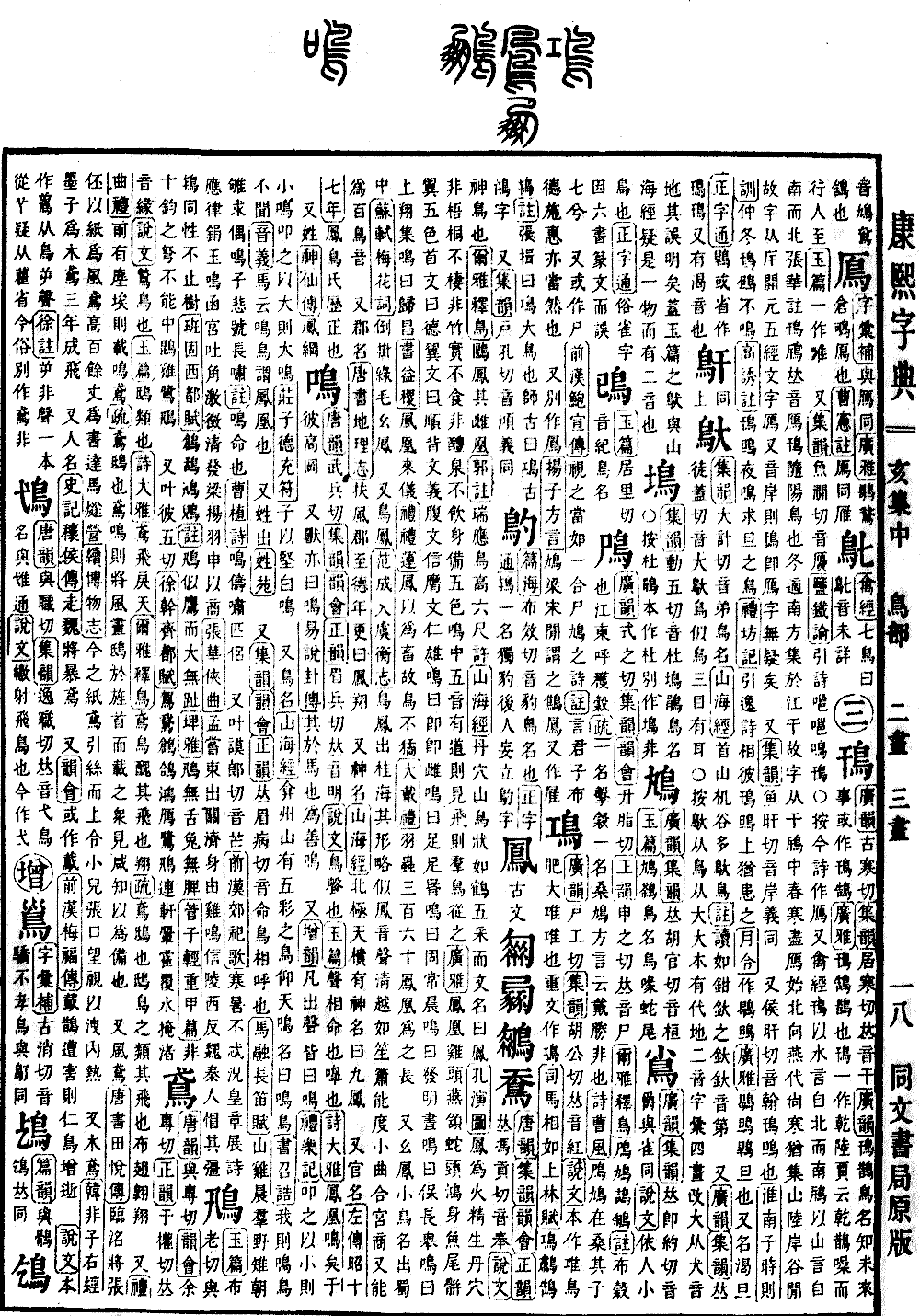
Hai Collection, Lower Volume
Radical: Bird (niǎo)
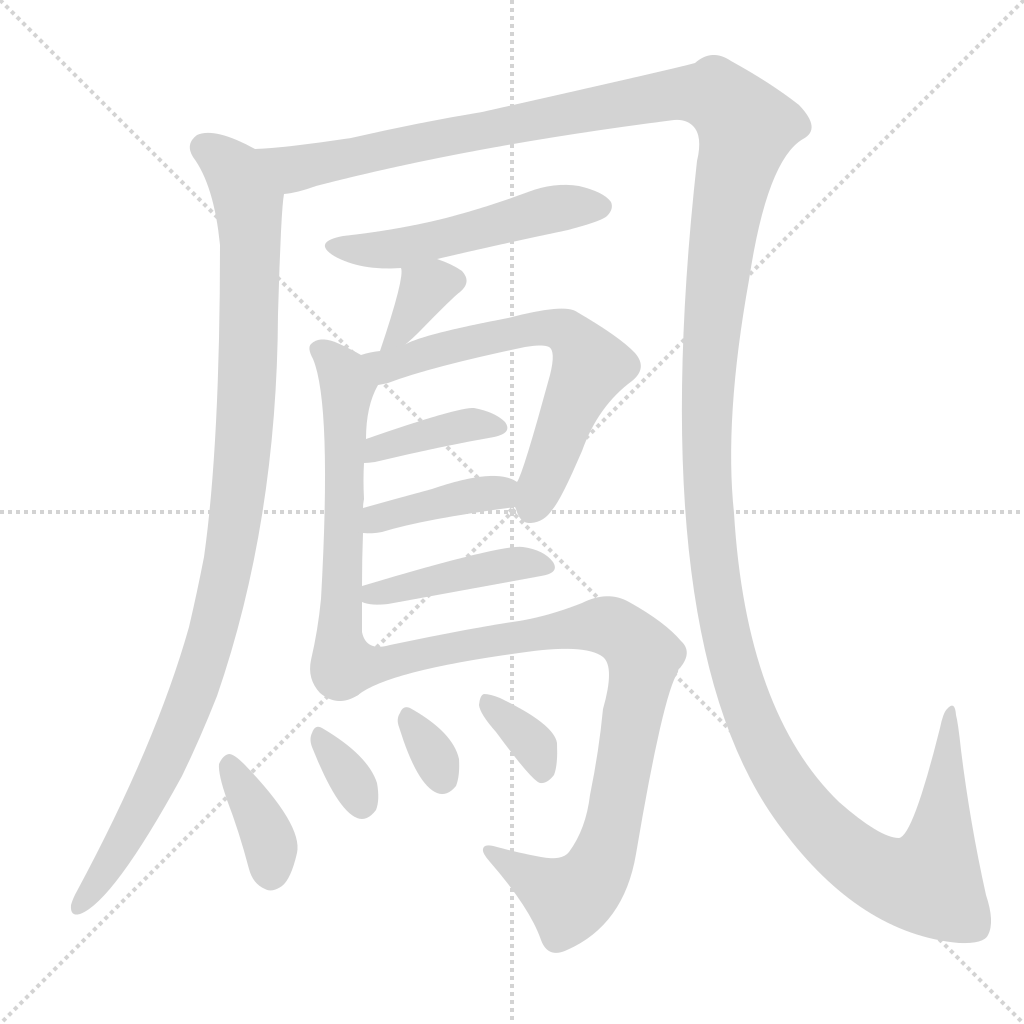
Feng
Kangxi strokes: 14
Page 1482, Entry 13
An ancient form is written as Feng (fèng).
Tang Rhymes (Tangyun), Collection Rhymes (Jiyun), Dictionary of Rhymes (Yunhui), and Orthodox Rhymes (Zhengyun) all provide the pronunciation as feng (falling tone), read the same as the word for "tribute" or "to offer" (fèng).
Explaining Graphs and Analyzing Characters (Shuowen Jiezi) defines it as a divine bird.
Er Ya: Interpretations of Birds (Er Ya - Shiniao) records: The Yan (yān) is the Feng, and the female is called the Huang (huáng).
Guo Commentary (Guo Zhu) states: It is an auspicious bird, approximately six feet tall.
Classic of Mountains and Seas (Shanhaijing) records: There is a bird on Mount Danxue, shaped like a crane, with multicolored feathers and patterns; it is called the Feng.
Kong Yan Tu says: The Feng is the spirit of fire, born on Mount Danxue. It does not perch on anything but the paulownia tree, does not eat anything but the fruit of the bamboo, and does not drink anything but sweet spring water. Its body possesses five colors, and its cry matches the five musical notes. It appears when the world follows the Way (Dao), and when it flies, flocks of birds follow it.
Broadening Refinements (Guangya) describes: The Fenghuang has a head like a chicken, a chin like a swallow, a neck like a snake, a body like a wild goose, a tail like a fish, and folded wings. It has five colors: the patterns on its head are called Virtue, the patterns on its wings are called Compliance, the patterns on its back are called Righteousness, the patterns on its abdomen are called Trust, and the patterns on its breast are called Benevolence. The male cries "ji-ji," the female cries "zu-zu," the cry at dusk is "guchang," the cry at dawn is "faming," the cry during the day is "baochang," the cry when taking flight is "shangxiang," and the cry when settling to roost is "guichang."
Book of Documents (Shangshu - Yiji) records: The Fenghuang arrives and dances, its appearance is extraordinary.
Book of Rites (Liji - Liyun) records: When the Fenghuang is kept as a domestic animal, the other birds do not fly off in startled flocks.
Dai's Record of Rites (Da Dai Liji) records: There are three hundred and sixty types of feathered creatures, and the Fenghuang is their leader.
There is also the Yao-feng, which is the name of a small bird found in the Shu region.
Su Shi's Plum Blossom Poem (Meihua Ci) contains the line, "hanging upside down is the green-feathered Yao-feng."
There is also the Niao-feng.
Fan Chengda's Records of the Southern Regions (Yuheng Zhi) records: The Niao-feng is produced in the Gui Sea region; its shape is generally like a Feng, its voice is clear and resonant like a reed pipe, it can perform short melodies that conform to musical temperament, and it can imitate the calls of various birds.
It is also a commandery name.
Old Book of Tang (Tangshu - Dilizhi) records: Fufeng Commandery was renamed Fengxiang during the Zhide era.
It is also the name of a deity.
Classic of Mountains and Seas (Shanhaijing) records: There is a deity on Mount Tiangui in the North Pole, named Nine-Feng.
It is also an official title.
Zuo Tradition (Zuo Zhuan - Zhao Gong Year 17) records: The Feng-bird Official was the official in charge of the calendar.
It is also a surname.
Biographies of Immortals (Shenxian Zhuan) mentions a person named Feng Gang.