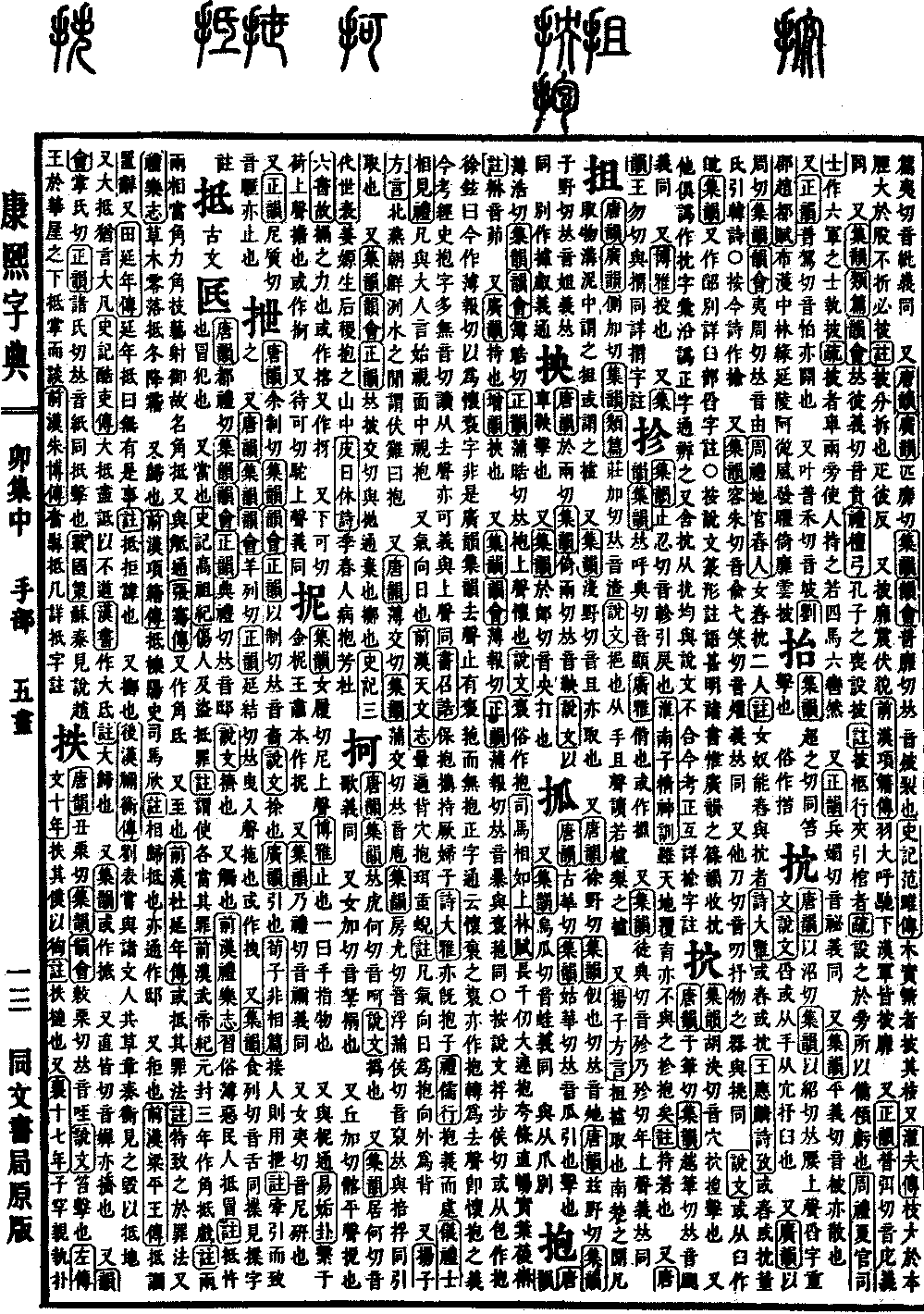
Mao Collection, Middle Volume. Radical: Hand (shǒu). Kangxi stroke count: 9. Page 423, Entry 12.
According to the Tang Rhymes (Tangyun), pronounced di (falling tone). According to the Collection of Rhymes (Jiyun), the Rhyme Anthology (Yunhui), and the Correct Rhymes (Zhengyun), pronounced di (falling tone). The pronunciation is the same as di. The Explaining Graphs and Analyzing Characters (Shuowen Jiezi) defines it as to squeeze. It also carries the meaning of to offend. The History of the Former Han (Qian Hanshu), Records of Rites and Music (Liyue Zhi) states: The customs were shallow and base; the common people often offended and defied. Annotation: di means to be contrary or to offend. It also means to correspond or to match. The Records of the Grand Historian (Shiji), Annals of Gaozu (Gaozu Benji) states: For harming others or theft, one must compensate or be punished according to the crime. Annotation: This means making each party bear the corresponding responsibility for their actions. The History of the Former Han (Qian Hanshu), Annals of Emperor Wu (Wudi Ji) states: In the third year of Yuanfeng, a horn-locking performance was held. Annotation: This refers to two people matched against each other, testing strength, skill, archery, or charioteering; hence it is called horn-locking. It is also interchangeable with the character di. In the Biography of Zhang Qian (Zhangqian Zhuan), it is written as di. It also means to reach or to arrive at. The History of the Former Han (Qian Hanshu), Biography of Du Yannian (Du Yannian Zhuan) states: Some were applied to the laws governing their crimes. Annotation: Specifically making them subject to the penal code. Also, in the Records of Rites and Music (Liyue Zhi), it states: Trees and grasses wither and fall, and when it reaches winter, frost descends. It also means to turn towards or to flee to. The History of the Former Han (Qian Hanshu), Biography of Xiang Ji (Xiangji Zhuan) states: Fleeing to Sima Xin, the prison official of Yueyang County. Annotation: This refers to going to submit or seek refuge. It is also used interchangeably with the character di. It also means to resist. The History of the Former Han (Qian Hanshu), Biography of Prince Liang Ping (Liangping Wang Zhuan) states: To resist and deny, fabricating language. Also, in the Biography of Tian Yannian (Tian Yannian Zhuan), it states: Tian Yannian resisted, saying: There is no such thing. Annotation: di means to refuse to admit. It also means to throw. The History of the Later Han (Hou Hanshu), Biography of Mi Heng (Miheng Zhuan) states: Liu Biao once drafted a memorial with several scholars; Mi Heng saw it, tore it up, and threw it on the ground. It also appears in the compound dadi, meaning generally or on the whole. The Records of the Grand Historian (Shiji), Biographies of Harsh Officials (Kuli Zhuan) states: Generally, they all used the charge of being unprincipled to slander. In the History of the Han (Hanshu), it is written as dadi. Annotation: This means the main summary. Also, according to the Collection of Rhymes (Jiyun), it is sometimes written as di. Another pronunciation is zhi (level tone). It also means to squeeze. Also, according to the Rhyme Anthology (Yunhui), pronounced zhi (falling tone). According to the Correct Rhymes (Zhengyun), pronounced zhi (falling tone). The pronunciation is the same as zhi. It is the same as the character zhi. It means to strike. Strategies of the Warring States (Zhanguo Ce) states: Su Qin lobbied the King of Zhao beneath a magnificent hall, striking his palms while speaking. The History of the Former Han (Qian Hanshu), Biography of Zhu Bo (Zhu Bo Zhuan) states: Shaking his beard and striking the desk. See the detailed entry for the character zhi.