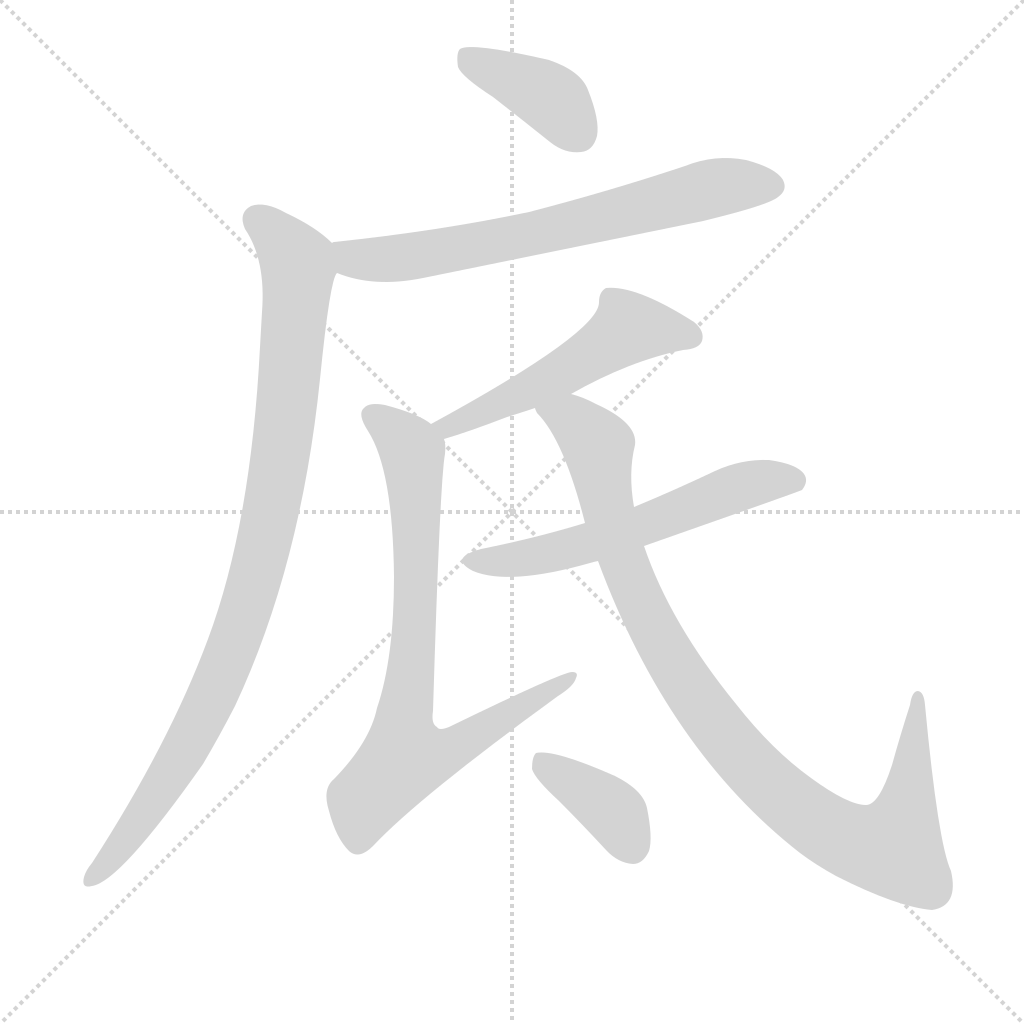
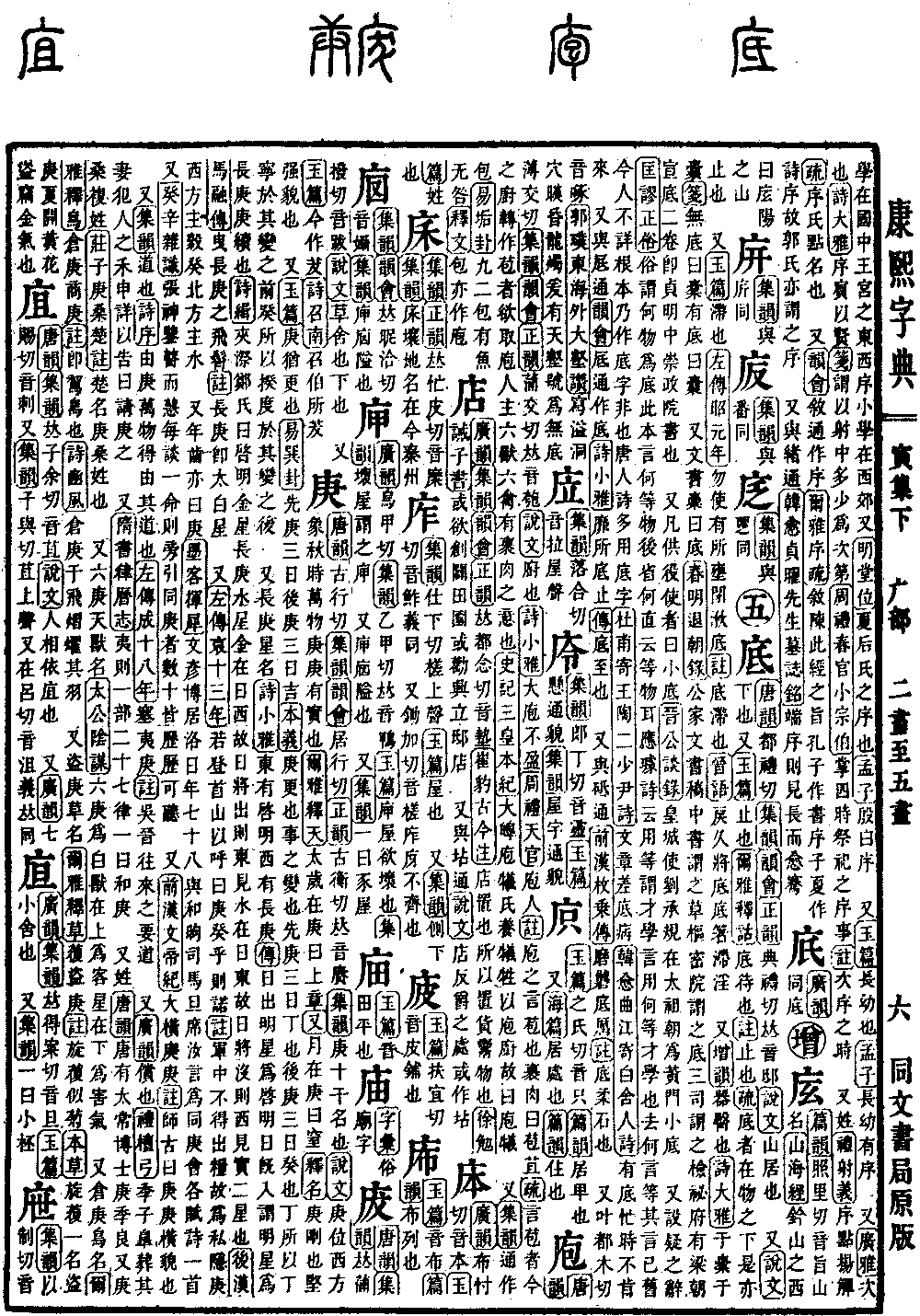
Yin Collection, Lower Volume
Radical: Wide (guǎng)
Kangxi Strokes: 8
Page 344, Entry 06
Pronounced di (rising tone).
According to the Shuo Wen Jie Zi (Explaining Graphs and Analyzing Characters), it refers to a dwelling in the mountains.
It also means the bottom.
According to the Yu Pian (Jade Chapters), it means to stop.
According to the Erya (Approaching Elegance), in the chapter interpreting ancient terms, it states that di means to wait. The commentary adds that it means to stop. The sub-commentary states that di denotes something at the base of an object, which also implies a stop.
According to the Yu Pian, it also means to stagnate.
In the Zuo Zhuan (Chronicle of Zuo), regarding the first year of Duke Zhao: Do not allow things to become blocked, stagnant, or obstructed. The commentary states that di means to stagnate. In the Jin Yu (Discourses of Jin): If perversity persists, it will stagnate; stagnation leads to excessive indulgence.
According to the Zeng Yun (Expanded Rhymes), it refers to the bottom of a container.
In the Book of Odes (Shijing): In the sack or in the bag. The commentary notes that a container without a bottom is called a tuo, while one with a bottom is called a nang.
Drafts of documents are called di. According to the Chunming Tuichao Lu (Record of Retiring from Court at Chunming): Official document drafts are called cao in the Secretariat, di in the Bureau of Military Affairs, and jian in the Three Financial Commissions. The Imperial Archives contain two volumes of Liang Dynasty Xuan Di, which are records from the Chongzheng Academy during the Zhenming period.
Those who provide service are also called xiao di. According to the Jin Gong Tan Lu (Records of Conversations of Duke Jin): Imperial Palace Commissioner Liu Chengkui served as a yellow-gate xiao di during the reign of the founding emperor of the Song Dynasty.
It is also a word used to pose a question. According to the Kuang Miu Zheng Su (Correcting Errors and Standardizing Customs): Popular speech uses what thing as di. Originally, this meant what sort of thing; later, the what was omitted, leaving only sort of thing. The poet Ying Ju wrote: Using deng refers to talent and learning, meaning what sort of talent and learning. Omitting what and using deng has a long history. People today do not understand the origin and instead create the character di, which is incorrect. Tang Dynasty poets frequently used the character di. In Du Fu's poem Sent to the Two Junior Administrators Wang and Tao: How is the ailment of the writing? In Han Yu's poem Sent to Bai Sheren from Qujiang: What sort of business prevents you from coming?
It is also interchangeable with the character di. According to the Yun Hui (Collection of Rhymes): Di is often written as the variant form di. In the Book of Odes (Shijing): There is nowhere to reach. The commentary states: Di means to arrive.
It is also interchangeable with the character zhi. In the Former Han Dynasty biography of Mei Cheng: Grinding and honing. The commentary notes: Di refers to a soft whetstone.
It also rhymes with zhu (entering tone). In Guo Pu's Praise of the Great Chasm East of the Sea: Pouring and overflowing into the cave, illuminating the darkness like a dragon candle. There exists a heavenly chasm, known as bottomless.