Wu Collection, Upper Volume
Radical: Field (tián)
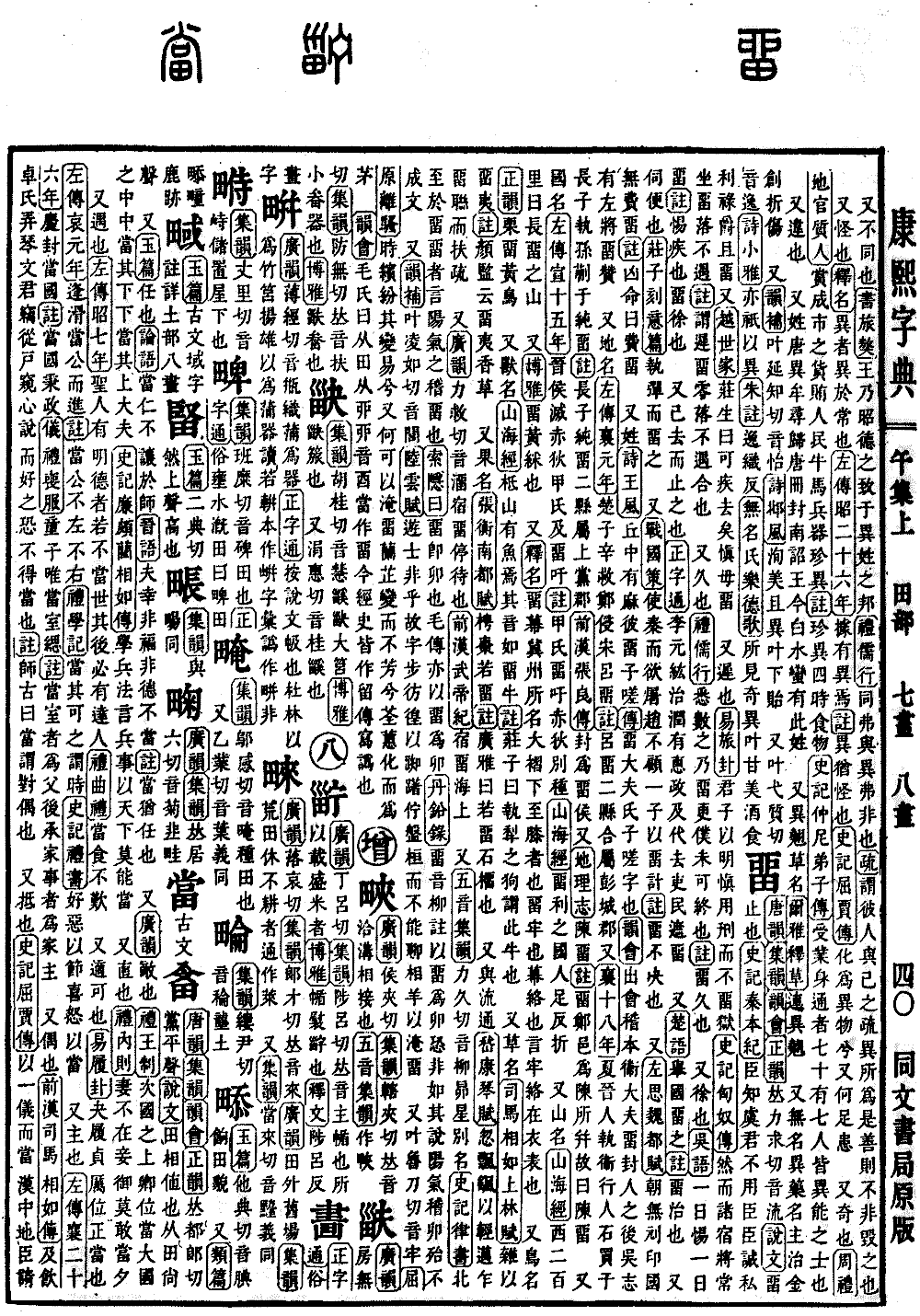
Page 764, Entry 02
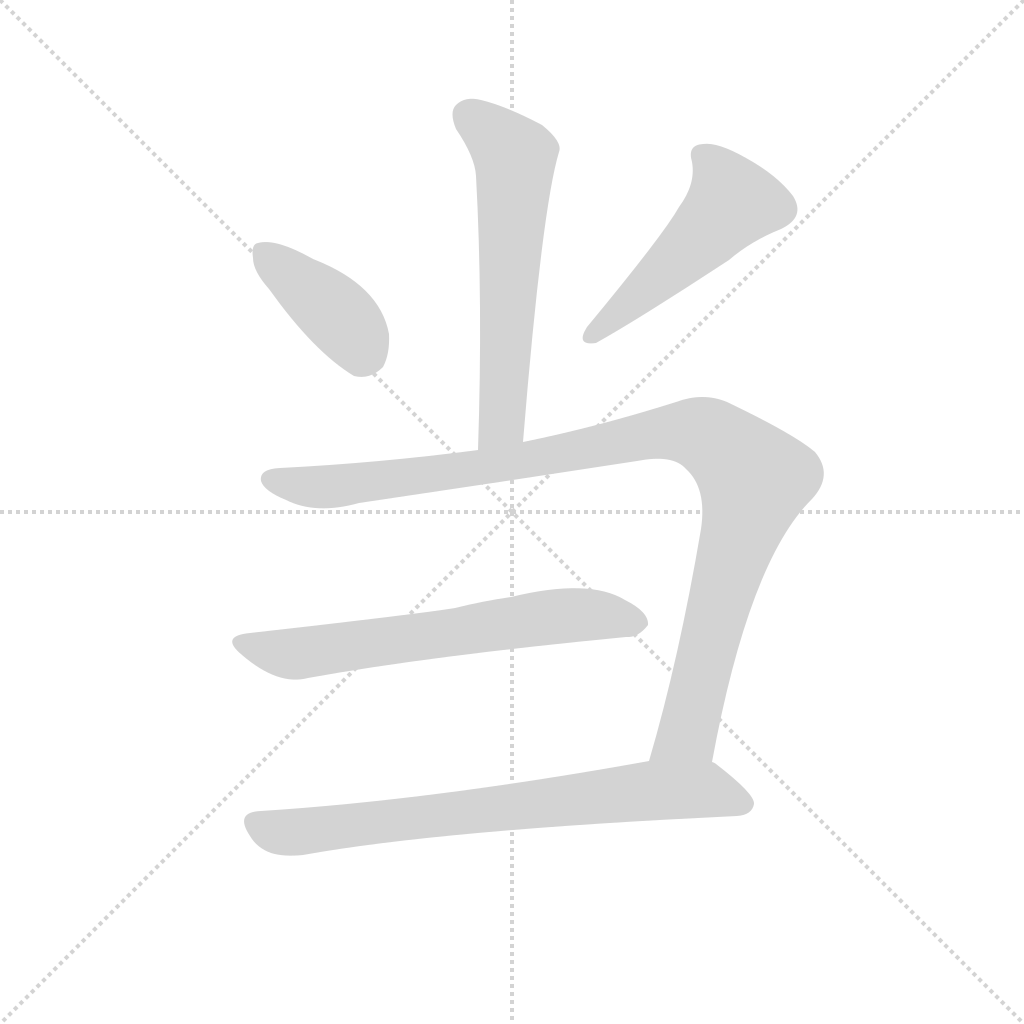
Ancient form. Tang Rhymes (Tangyun), Collection of Rhymes (Jiyun), Rhyme Compilation (Yunhui), and Correct Rhymes (Zhengyun) all record the pronunciation as dang (rising tone).
Explaining Graphs (Shuowen): Fields are equal and opposite. The graph is formed from the radical field, with shang providing the phonetic.
Jade Chapters (Yupian): To undertake or bear responsibility.
Analects of Confucius (Lunyu): When facing matters of benevolence and righteousness, one need not be overly modest even before one's teacher.
Narratives of the Jin State (Jinyu): What is termed good fortune is neither a blessing nor a result of virtue; one cannot sustain an attitude of composure without them. Commentary: Dang means to undertake or bear.
Broad Rhymes (Guangyun): To match, equal, or be equivalent to.
Book of Rites (Liji): A senior minister of a medium-sized state has a status equivalent to the middle minister of a large state; a middle minister is equivalent to their junior minister, and a junior minister is equivalent to their senior grand master.
Records of the Grand Historian (Shiji): To study military strategy and discuss warfare, believing that no one under heaven could equal him.
To encounter or be in a specific time or place.
Book of Rites (Liji): When the wife is not present, the concubines dare not wait upon the master at night.
To happen upon or meet.
Zuo Commentary (Zuozhuan): Among the sages, there are those with brilliant virtue; if they do not happen upon an appropriate era, their descendants will surely be people of prominence.
Book of Rites (Liji): Do not sigh while in the midst of eating.
Appropriate or fitting.
Book of Changes (Yijing): To make a decisive move, holding fast to what is right to guard against danger, because one's position is appropriate.
Zuo Commentary (Zuozhuan): Feng Hua walked forward facing Duke Ai directly. Commentary: Dang gong means not leaning left or right, facing directly.
Book of Rites (Liji): To provide instruction at the appropriate moment is called being timely.
Records of the Grand Historian (Shiji): Likes and dislikes have their measures; joy and anger are kept appropriate.
To preside over or manage.
Zuo Commentary (Zuozhuan): Qing Feng presided over the state government. Commentary: Dang guo means holding the power of the state.
Ceremonial and Rituals (Yili): A youth wears the coarse hemp mourning garment only when he acts as the head of the household. Commentary: Dang shi refers to one who acts as the heir of the father and bears the affairs of the family, that is, the head of the household.
To match or be a counterpart.
Book of the Former Han (Qianhan): When it came time to drink, the Zhuo family played the zither, and Wenjun peeked through the crack in the door, falling in love with him and worrying that she could not be a match for him. Commentary: Shigu says that dang means to form a marriage alliance.
To be worth or equivalent to.
Records of the Grand Historian (Shiji): Using Zhang Yi alone is worth the territory of Hanzhong; I request to be sent to the State of Chu.
Increased Rhymes (Zengyun): To block or shield.
Zuo Commentary (Zuozhuan): He ordered Zhu Gua to hide a spear in the firewood on a carriage to block the gate.
Li Bai (Libai): One man guards the pass, and ten thousand cannot get through.
To judge a criminal is called dang, meaning to make the crime correspond to the legal punishment.
Records of the Grand Historian (Shiji): The commandant of justice presented the verdict that a man who ran into the imperial carriage should be punished by a fine. Commentary: Dang refers to determining his crime.
Lu Wenshu's Letter on Promoting Virtue and Relaxing Punishment: The legal document for the verdict is complete.
Correct Rhymes (Zhengyun): Similar to he (to agree/to fit). It should be so.
Ceremonial and Rituals (Yili): When the assistant is about to perform a task, he stands outside the door facing south. Commentary: Dang shi refers to being about to handle a matter, but the matter has not yet arrived.
Records of the Grand Historian (Shiji): The inner clerk Shi Qing returned home drunk and did not descend from his carriage upon entering the outer gate. The senior master scolded him, saying: The inner clerk is a noble person; when entering the inner lane, the elders of the neighborhood all run away to hide, yet the inner clerk sits in his carriage with a calm expression; is this how he should act? Commentary: Gu dang is irony used to express that he should not have acted this way, a severe reprimand.
To exceed the corresponding amount.
Records of the Grand Historian (Shiji): The number of enemies killed and captured exceeded the losses on one's own side. Commentary: It means not merely equal.
To conduct or handle business.
Ouyang Xiu (Ouyangxiu): After Cao Bin pacified the Jiangnan region, he went to the palace gate to request an audience. His name card read: By imperial order, returning from handling official business in Jiangnan.
Record of Official Ranks (Zhiguanfenji): Petition to recommend capital officials; two people with the qualifications of a county magistrate were appointed as managing officials for this department.
Official title.
Book of the Former Han (Qianhan): An edict was issued that the Shanyu need not perform the kowtow ceremony; the officials around him, the danghu and others, all lined up to watch. Commentary: Zuo danghu is a Xiongnu official title.
Pai dang is the name for banquets held in the palace during the Song Dynasty.
State name.
Rhyme Compilation (Yunhui): Originally Qiang territory, the Tang Dynasty established Dang Prefecture, likely named after the Shaodang Qiang tribe.
Book of the Later Han (Houhan): In the autumn, the ninth month, the Shaodang Qiang invaded Longxi.
County name.
General Explanation of Characters (Zhengzitong): Feng Prefecture has Liangdang County.
Book of the Later Han (Houhan): Nanjun has Dangyang County.
Book of the Later Han (Houhan): Sent Liu Long to perform agricultural garrison duty in Wudang. Commentary: Wudang is the present-day Junzhou County.
Also Dang-dang Mountain and Wudang Mountain, which are names of mountains.
Dangkang, name of a beast.
Classic of Mountains and Seas (Shanhaijing): In Qin Mountain, there is a wild beast shaped like a pig but with tusks; its name is Dangkang. Commentary: It is a tooth-badger.
Dang-di, name of a fish.
Erya: The jiao fish is the dang-di. Commentary: It is a type of sea fish.
Also a surname.
Tang Rhymes (Tangyun), Collection of Rhymes (Jiyun), Rhyme Compilation (Yunhui), and Correct Rhymes (Zhengyun) all record the pronunciation as dang (falling tone).
Logical and fitting.
Book of Rites (Liji): In ancient times, heaven and earth were in harmony and the four seasons were appropriate.
Han's Collection of Sayings (Hanshiwaizhuan): The conduct of a gentleman is not valued for its difficulty, but only for its appropriateness.
Han Feizi: Tangxi Gong met Marquis Zhao of Han and said: If a ruler leaks the conversations of his ministers, it is like a jade cup without a bottom.
General Explanation of Characters (Zhengzitong): Anything taken to be pawned for money is colloquially called dang.
Book of the Later Han (Houhan): The rewards obtained by Liu Yu were pawned to the Hu people, and Gongsun Zan seized them. Commentary: Dang is read as dang (falling tone).