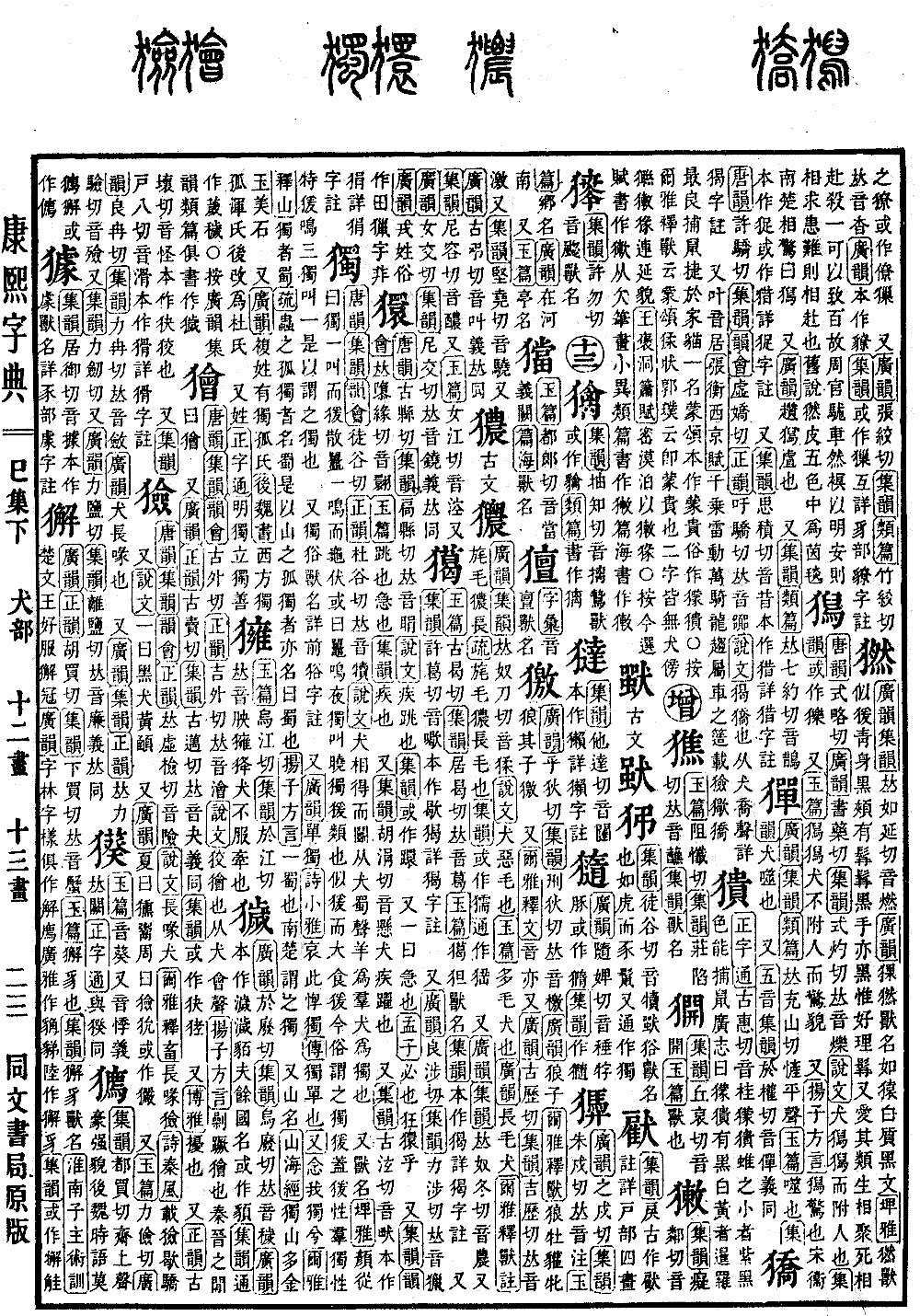
Si Collection, Lower Volume
Radical: Dog (quǎn)
17 strokes
Page 719, Entry 25
Pronounced dú.
According to the Explanation of Writing (Shuowen Jiezi), it refers to dogs encountering one another and fighting. The character is formed with Dog as the radical and Shu as the phonetic component. Sheep prefer to flock together, while the dog prefers to be alone. It is also the name of a wild beast. According to the Amplified Elegant (Piya), Yan Cong states: When the du cries once, the gibbons disperse; when the alligator (tuó) calls, the tortoise bows down. Some say the alligator calls at night, while the du calls at dawn. The du is related to the gibbon species. It resembles a gibbon but is larger, and it eats gibbons. It is commonly referred to today as the solitary gibbon. Because gibbons are gregarious and the du prefers to live alone, and because gibbons call three times while the du calls once, it is called the du.
It also denotes a type of wild beast. For a detailed explanation, see the entry for the character previously mentioned.
It also means alone or single. In the Book of Odes (Shijing), Small Odes (Xiaoya), it is written: Grieving for this solitary one. The commentary states that the character means lonely. It also expresses the feeling of being lonely. In the Erya, Explaining Mountains, it states that a solitary mountain is called a shu. The commentary notes that among insects, the solitary one is called a shu, and thus a mountain that is solitary is also called a shu. In the Dialect (Fangyan) by Yang Xiong, it states that one is called a shu, while in the southern Chu region, it is called a du.
It is also the name of a mountain. In the Classic of Mountains and Seas (Shanhaijing), it is mentioned that on Solitary Mountain (Dushan), there is an abundance of metal, jade, and beautiful stones.
It also refers to the compound surname Dugu. In the Book of Later Wei (Houweishu), it is recorded that the Duguhun clan of the West later changed their name to the Du clan. It is also a surname. According to the Correct Meaning Guide (Zhengzitong), there were individuals named Duli and Dushan during the Ming dynasty.