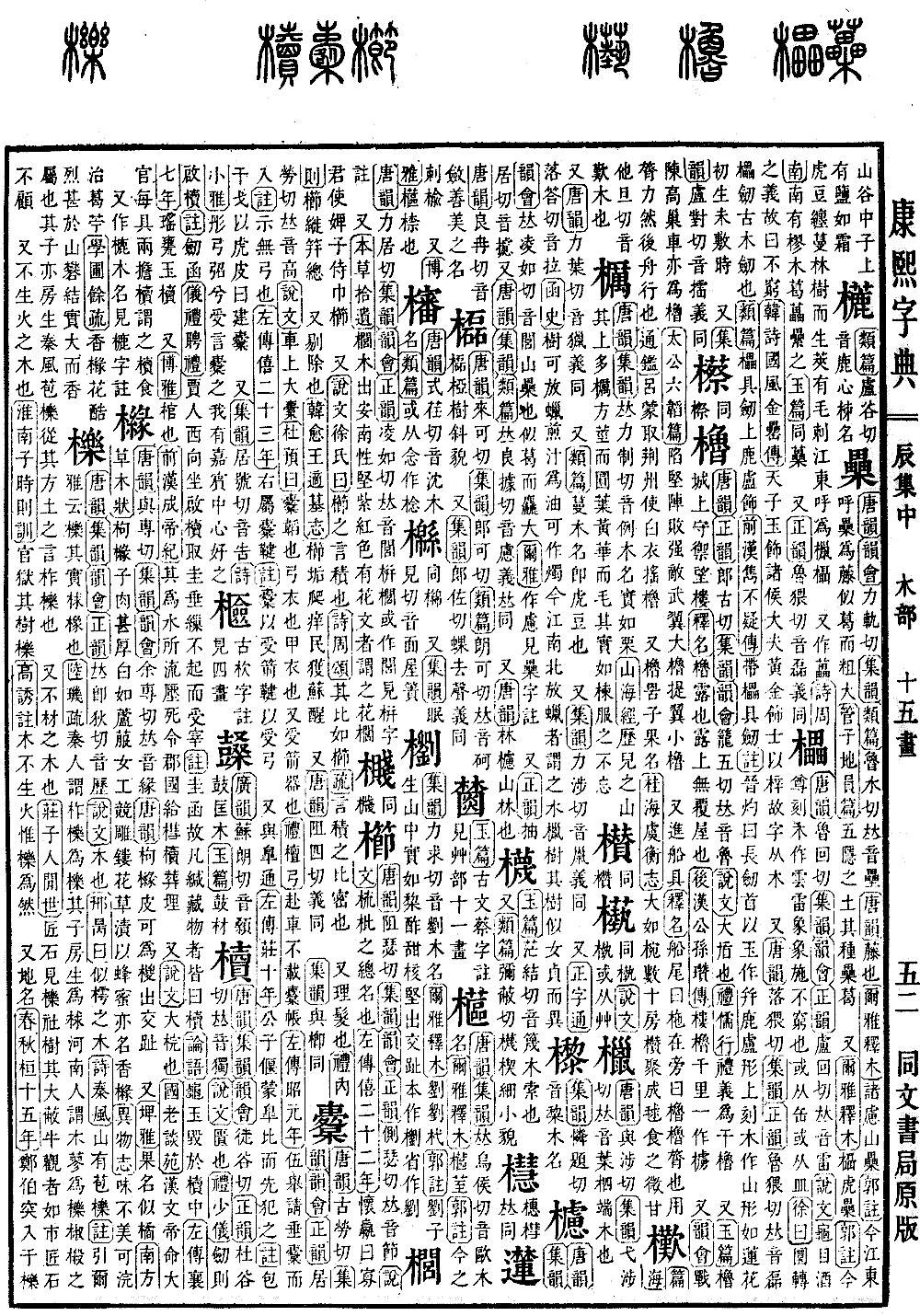
Chen Collection, Middle Volume
Radical: Wood (mù)
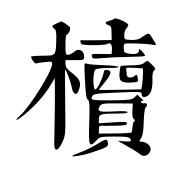
Dú
Kangxi Strokes: 19
Page 560, Entry 28
Pronounced dú.
According to the Explaining and Analyzing Characters (Shuowen Jiezi), it refers to a cabinet or chest.
According to the Record of Ceremonial Usages (Liji), specifically the Lesser Ceremonial (Shaoyi) section: When dealing with a sword, open the chest. The commentary notes this refers to a sword case.
According to the Book of Etiquette and Ceremonial (Yili), in the chapter on Guest Rituals (Pinli): The merchant sat facing west, opened the chest, and took out the jade tablet with black silk ribbons; he did not rise to receive the magistrate. The textual explanation notes this means a case. In general, anything used to seal and store objects is called a dú.
In the Analects (Lunyu): Tortoise shells and jade destroyed within their chest.
In the Zuo Tradition (Zuozhuan), under the seventh year of Duke Zhao: A jade vessel and a jade chest.
Also, according to the Guangya dictionary, it refers to a coffin.
In the History of the Former Han (Qian Hanshu), in the Annals of Emperor Cheng: Those who were carried away or crushed by water were to be provided with simple coffins by their commanderies and kingdoms for burial.
Additionally, according to the Explaining and Analyzing Characters (Shuowen Jiezi), it refers to a large serving bowl.
According to the Guolao Tanyuan, Emperor Wen of the Han Dynasty ordered the officials to prepare two loads of containers, which were referred to as chest-food.
Also written as a variant form (dú). It is a tree name. See the entry for the character dú.
Textual corrections:
In the Book of Etiquette and Ceremonial (Yili), the chapter on Guest Rituals (Pinli) originally read sitting facing west; it has been corrected to facing west to match the original text.
The commentary previously mentioned jade case, but as this note does not exist in the source, it has been changed to mean a case according to the textual explanation.
In the Zuo Tradition (Zuozhuan), the seventh year of Duke Xiang has been corrected to the seventh year of Duke Zhao to match the original text.