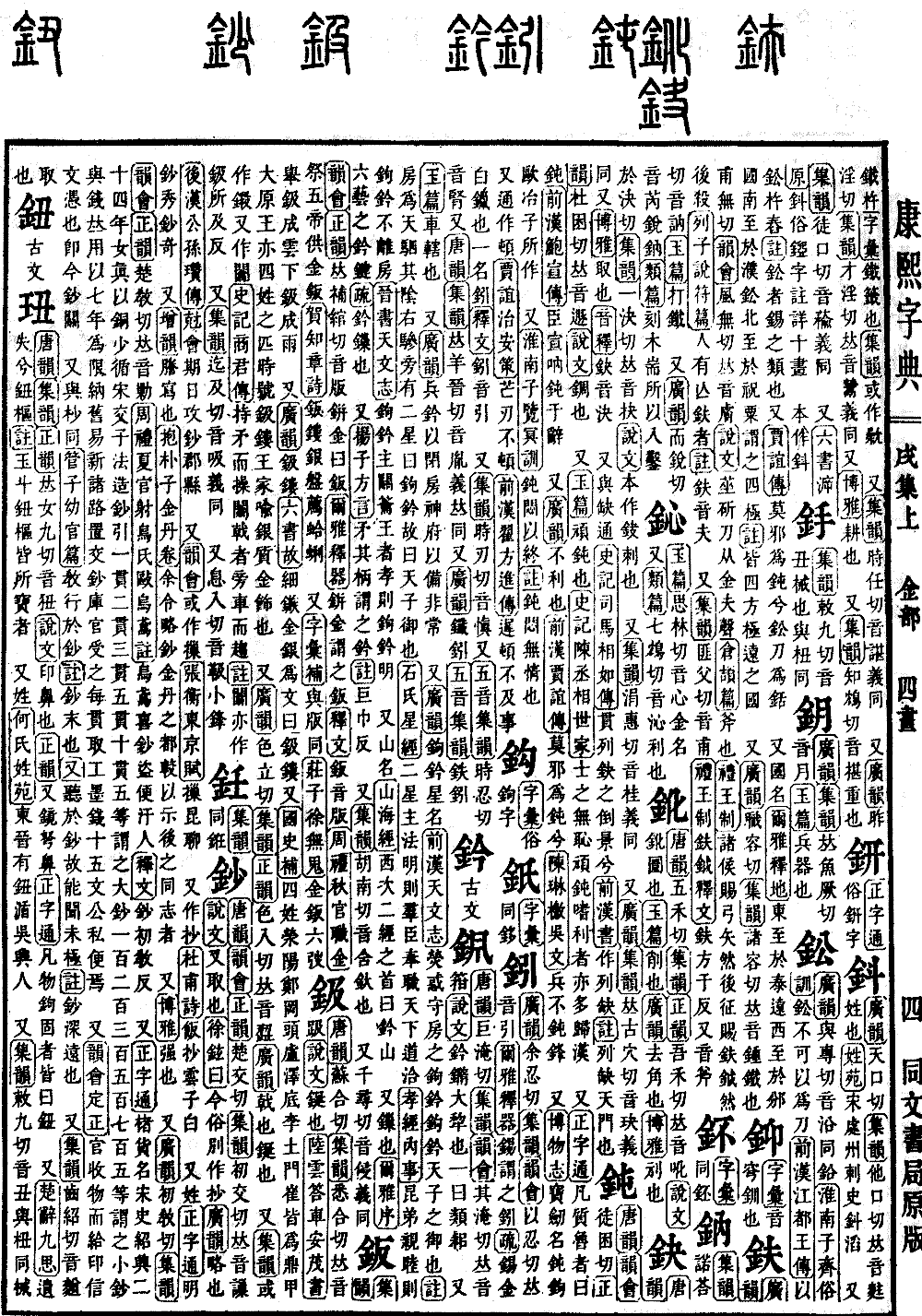
Xu Collection, Upper Volume
Radical: Metal (jīn)
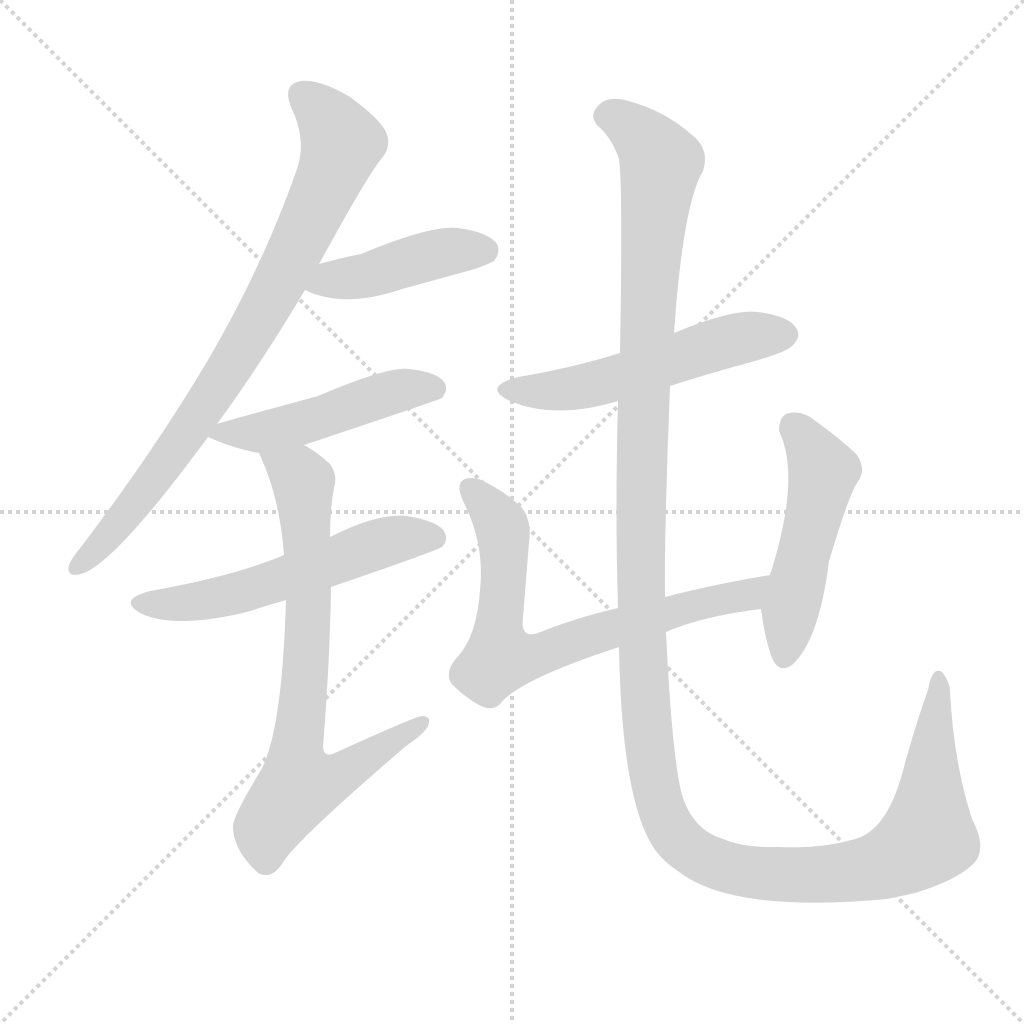
Character: Dun
Kangxi Stroke Count: 12
Page 1298, Entry 01
Pronounced dun. According to the Shuowen Jiezi (Shuowen), it means to sharpen or hone. According to the Yupian, it means stubborn and dull. In the Records of the Grand Historian (Shiji), Biography of the Chancellor, it is written: Scholars who are shameless, stubborn, dull, and greedy for profit also mostly submitted to the Han. According to the Zhengzitong, all those who are simple-minded or slow-witted are called dun. In the Book of Han (Hanshu), Biography of Bao Xuan, it is written: I, Xuan, am slow and dull in speech. According to the Guangyun, it means not sharp. In the Book of Han, Biography of Jia Yi, it is written: The Mo-Ye sword becomes dull. In the Proclamation to Wu by Lu Qin, it is written: Weapons do not dull their blades. According to the Bowuzhi, it is the name of a precious sword called the Dun-Gou, created by the master smith Ou Yezi. In the Huainanzi, Lanming Xun, it is written: To remain dull and unresponsive until the end. The commentary notes that dull and unresponsive means lacking emotion. It is also commonly written as the variant form dun. In the Security Strategy by Jia Yi, it is written: The sharp edge does not become blunt. In the Book of Han, Biography of Zhai Fangjin, it is written: Slow and blunt, unable to keep up with affairs.