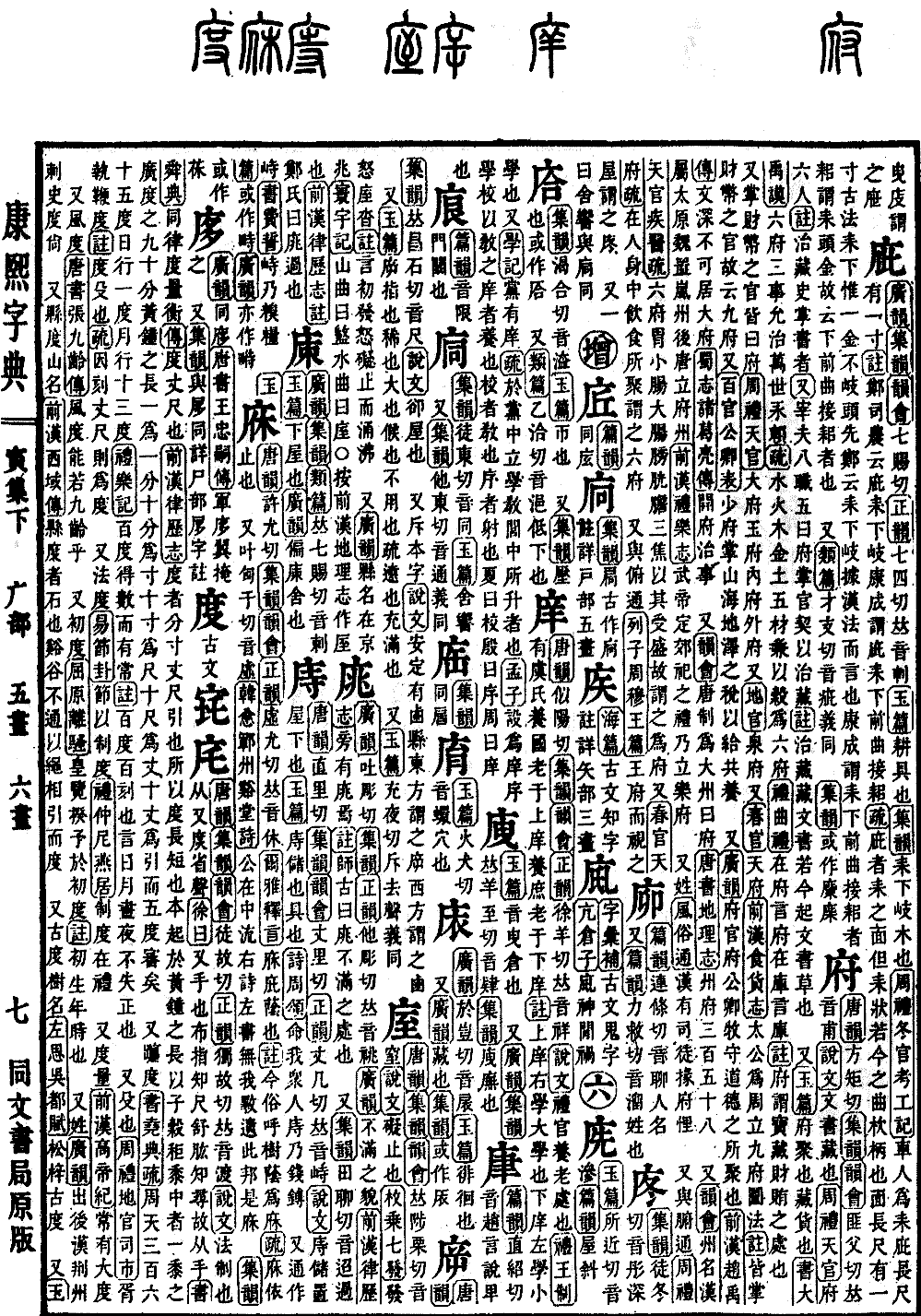
Yin Collection, Lower Volume
Radical: Broad (guǎng)
Kangxi Strokes: 9
Page 345, Entry 26
According to ancient phonological texts: Tang Rhyme (Tangyun), Collection of Rhymes (Jiyun), and Rhyme Compendium (Yunhui) record the pronunciation as tu gu reng. Orthodox Rhymes (Zhengyun) records the pronunciation as du gu, sounding similar to du. Analytical Dictionary of Chinese Characters (Shuowen Jiezi) defines it as law, regulation, or standard. The character is composed of the radical for hand (you) and a phonetic component derived from the character for all (shu). Xu Kai states that the hand component represents the palm. Spreading the fingers allows one to determine a measure of one chi (foot), and extending the arm allows one to determine the measure of one xun (fathom); thus, the character is derived from hand. Book of Documents (Shangshu), Canon of Shun (Shundian) records: Unifying the pitch pipes, measures of length, volume, and weight. The commentary explains: Du refers to units of length such as zhang and chi. History of the Former Han (Qian Hanshu), Treatise on Harmonics and Astronomy (Lulizhi) states: Du includes the units of fen, cun, chi, zhang, and yin, used for measuring length. Its standard originated from the length of the yellow bell pitch pipe, measured using medium-sized black millet grains. One grain width measured against the yellow bell pipe divides its length into ninety parts; one part of the yellow bell pipe defines one fen, ten fen make one cun, ten cun make one chi, ten chi make one zhang, and ten zhang make one yin, thereby establishing the five standard units of length.
Also refers to the degrees of celestial movement. Book of Documents (Shangshu), Canon of Yao (Yaodian) commentary states: The entire celestial sphere is divided into three hundred and sixty-five degrees; the sun moves one degree daily, and the moon moves thirteen degrees daily. Record of Rites (Liji), Record of Music (Yueji) states: All systems of measurement and standards are consistent and remain constant. The commentary notes that "hundred degrees" refers to one hundred ke (an ancient unit of time). This indicates that the movement of the sun and moon and the alternation of day and night follow a pattern without losing their regular orbits.
Also refers to a weapon, the shu (a type of polearm). Rites of Zhou (Zhouli), Offices of Earth (Diguan), Office of the Market (Sishi) records: The subordinates held whips and shu. The commentary notes: Du is the shu. The sub-commentary explains: Because it could be used to mark measurements of length, it is called du.
Also refers to regulations and systems. Book of Changes (Yijing), Articulation Hexagram (Jiegua) states: Use systems to exercise restraint. Record of Rites (Liji), Confucius at Leisure (Zhongni Yanju) states: Systems are embodied in rituals.
Also refers to breadth of mind or demeanor. History of the Former Han (Qian Hanshu), Annals of Emperor Gao (Gaodi Ji) states: (Emperor Gao) always possessed a grand breadth of mind.
Also refers to carriage or personal presence. New Book of Tang (Xin Tangshu), Biography of Zhang Jiuling records: (Emperor Xuanzong asked his attendants) Can his demeanor be compared to that of Zhang Jiuling?
Also refers to the time of birth or birthday. Qu Yuan, Encountering Sorrow (Lisao) writes: My father carefully conjectured the circumstances of my birth. The commentary notes: Initial du refers to the year of one's birth.
Also a surname. Collection of Rhymes (Guangyun) records: Descended from Du Shang, the Inspector of Jingzhou during the Later Han Dynasty.
Also the name of a mountain, Xiandu. History of the Former Han (Qian Hanshu), Western Regions (Xiyu Zhuan) records: Xiandu is a rocky mountain. The valleys are impassable, so ropes are used to pull each other across.
Also the name of a tree, Gudu. Zuo Si, Rhapsody on the Capital of Wu (Wudu Fu) mentions: Pine trees, catalpa trees, and gudu trees.
Also, Jade Chapter (Yupian) records: Interchangeable with the character for cross (du), meaning to cross over or pass through. History of the Former Han (Qian Hanshu), Biography of Jia Yi states: Like crossing a river without oars.
Also, Collection of Rhymes (Guangyun) records the pronunciation as tu luo, sounding similar to duo. Er Ya, Explanation of Terms (Shigu) defines it as to plan or consider. Book of Odes (Shijing), Lesser Odes (Xiaoya) states: Seeking advice and planning everywhere. Zuo Tradition (Zuozhuan), Fourth Year of Duke Xiang states: Consulting with relatives is called xun, while consulting on matters of ritual is called du.
Also, Canon of Posthumous Titles (Shifa) states: Being able to follow morality internally is called du.
Also refers to using a pestle to tamp earth for walls. Book of Odes (Shijing), Greater Odes (Daya) writes: The sound of filling earth and tamping walls is booming. Zheng Xuan's note explains: Du is like throwing earth and tamping it.
Also refers to an official title, Duzhi. New Book of Tang (Xin Tangshu), Treatise on Officialdom (Baiguanzhi) records: Duzhi (the bureau) managed the national taxation, the regulation of the abundance or scarcity of goods, the benefits and disadvantages of water and land transport, and the calculation and allocation of annual fiscal income and expenditures.
Textual research: The original text in History of the Former Han (Qian Hanshu), Treatise on Harmonics and Astronomy (Lulizhi) reading fen cun zhang chi yin should be corrected to fen cun chi zhang yin. The original text in History of the Former Han (Qian Hanshu), Western Regions (Xiyu Zhuan) reading Xiandu, stone mountain should be Xiandu is a stone mountain.