You Collection, Upper Volume
Radical: See (jiàn)
Kangxi Strokes: 22
Page 1138, Entry 08
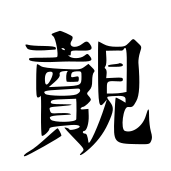
Pronounced di.
Shuowen Jiezi (Shuowen) states it means to see.
Book of Changes (Yijing), Hexagram of Oppression (Kun): For three years one does not see.
Spring and Autumn Annals (Chunqiu), 24th Year of Duke Zhuang: The grand masters and the wives of the clan members presented gifts upon being granted an audience.
Gongyang Commentary (Gongyang Zhuan) asks: What does it mean to have an audience? It means to see.
Book of Rites (Liji), Suburban Sacrifice and the Special Victim (Jiao Tesheng): One dares not have a private audience.
Rites of Zhou (Zhouli), Ministry of Autumn, Annotations for the Master of Ceremonies: A private audience is a private meeting.
Collection of Rhymes (Yunhui), Minor Supplement: An audience with a ruler is called di, while an audience with a high official is called mian. Di and mian are distinct. In prose, mian can also be referred to as di.
Also pronounced ti.
Also pronounced ji. Equivalent. See the note for the previous character.
Also pronounced du.
Poem presented to Cavalry General Gu by Lu Yun: The profound mechanisms echo and startle, the hidden and the manifest are broadly revealed. Harmonized by those who share the same path, all things return to flourish in their time. Di rhymes with yu.
According to the Collection of Rhymes (Jiyun), it is sometimes written in variant forms.