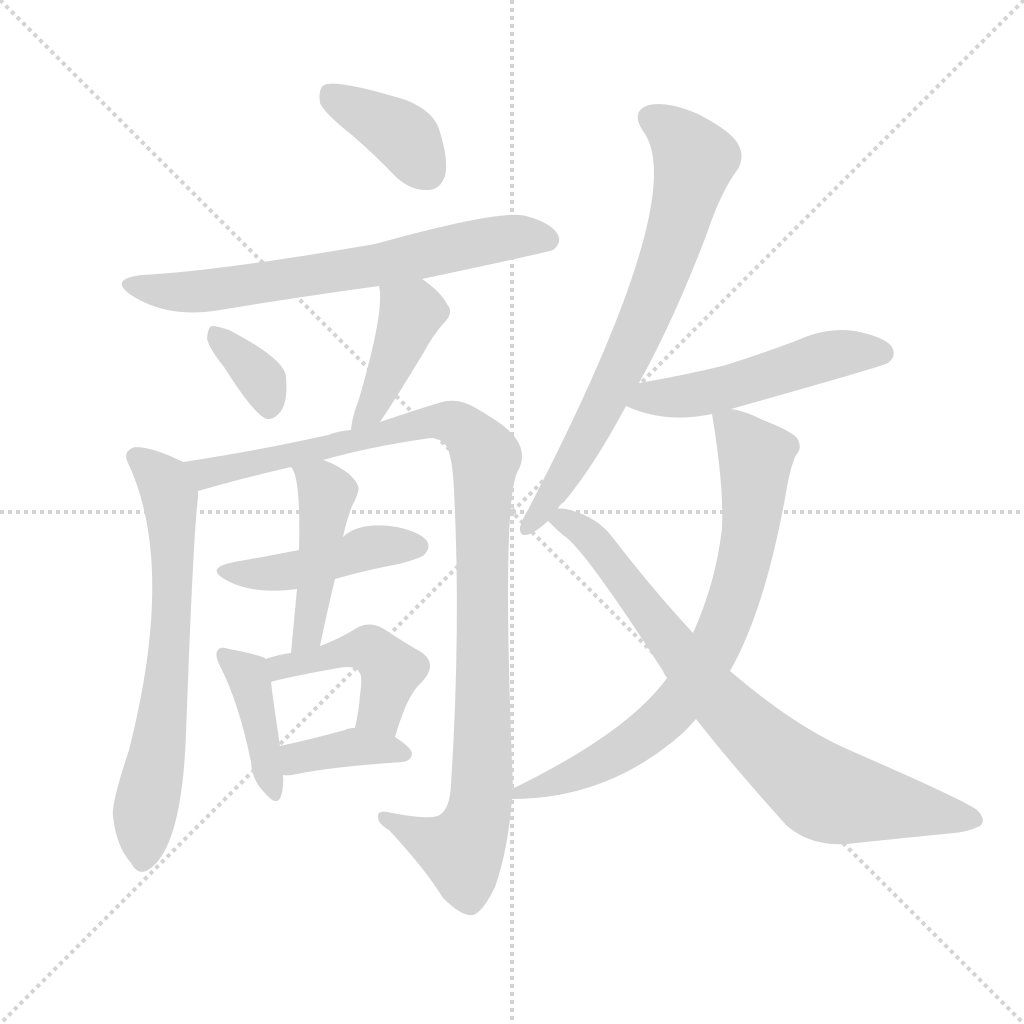
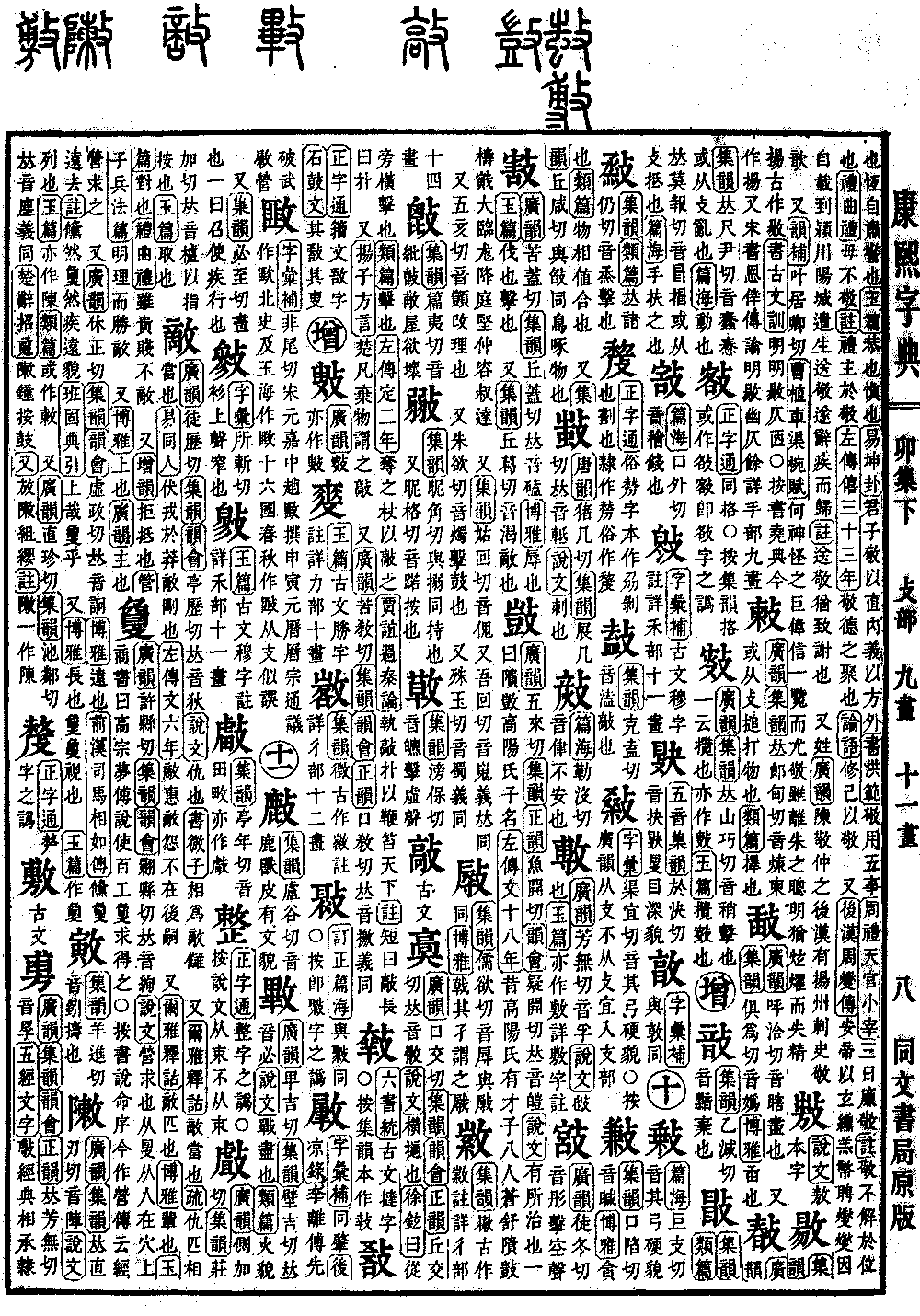
Mao Collection, Lower Volume
Radical: Tapping (pū)
Kangxi Strokes: 15
Page 474, Entry 48
Pronounced di.
Explanatory Notes:
According to the Expanded Dictionary of Sounds and Meanings (Guangyun), it denotes an enemy. According to the Collected Dictionary of Sounds (Jiyun) and the Dictionary of Rhymes (Yunhui), it is pronounced di.
Per the Explanation of Writing (Shuowen), it means an enemy or opponent. In the Book of Documents (Shujing), specifically the section concerning the Viscount of Wei (Weizi), it is written: treat each other as enemies.
In the Literary Expositor (Erya), in the chapter interpreting ancient terms, it is noted that this term signifies equivalence. The commentary explains that this refers to equals or counterparts corresponding to one another.
In the Book of Changes (Yijing), in the section on fellowship with men, the text mentions lying in ambush in the wilderness, which signifies opposing strength.
In the Zuo Commentary (Zuozhuan), in the sixth year of the reign of Duke Wen, it is written: to equate favor and equate resentment is not for one's descendants to manage.
According to the Literary Expositor (Erya), it also signifies a peer. According to the Comprehensive Dictionary (Boya), it means a generation or equal. According to the Jade Chapter (Yupian), it denotes a match or counterpart.
In the Book of Rites (Liji), in the section on summary of rules of propriety, it is stated that even though status may differ, one is not necessarily an equal.
According to the Augmented Dictionary (Zengyun), it also means to resist or repel.
In the Book of Guanzi (Guanzi), in the chapter on the Art of War, it is written: understand the principles to overcome the enemy.
According to the Comprehensive Dictionary (Boya), it also means to ascend or surpass.
According to the Expanded Dictionary of Sounds and Meanings (Guangyun), it also means a master or lord.