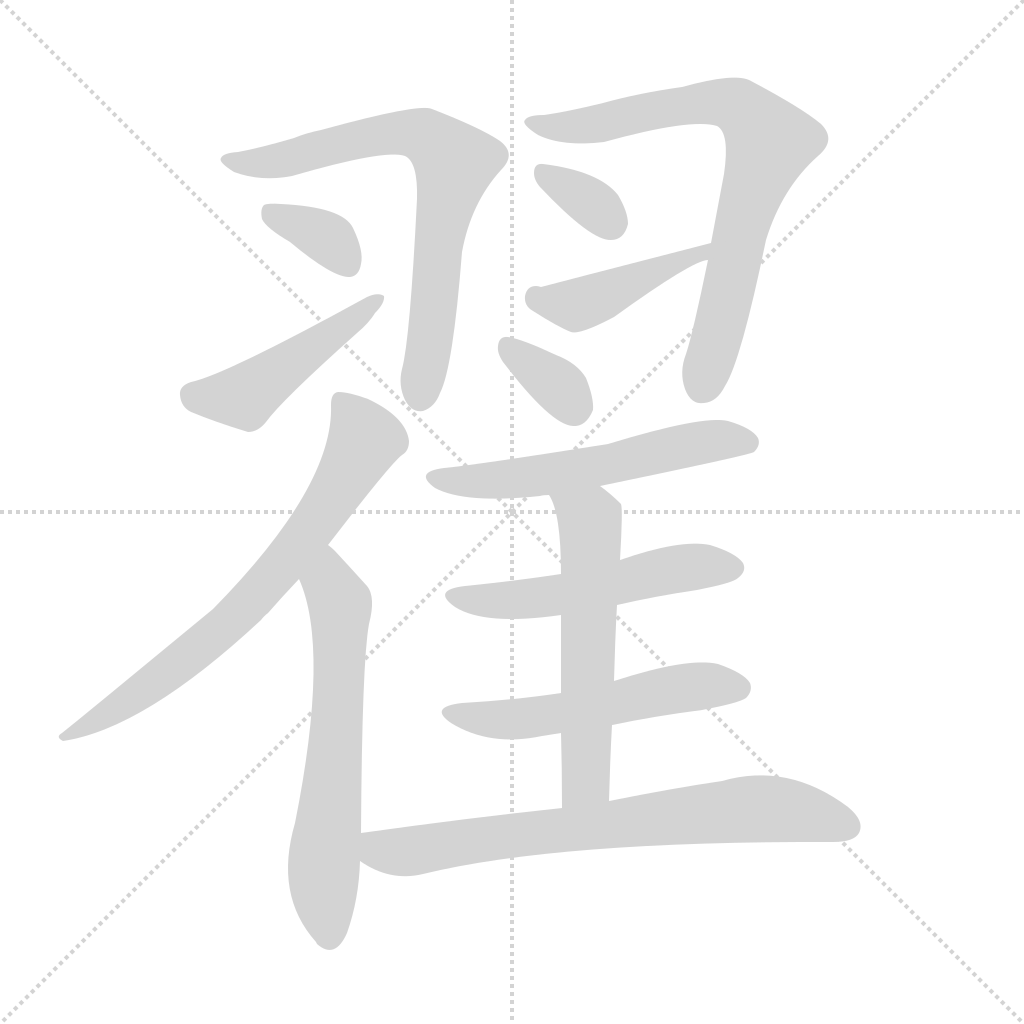
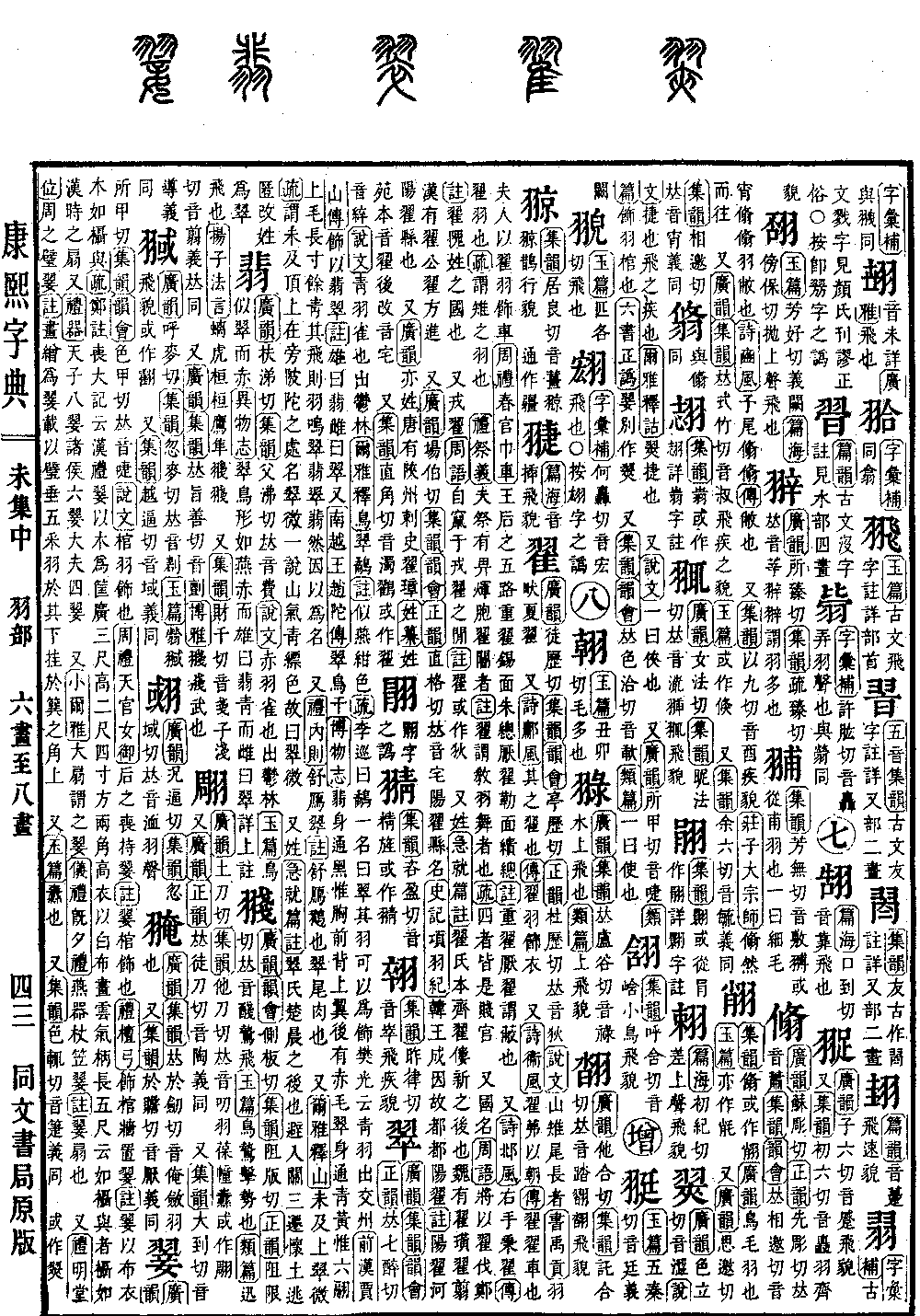
Wei Collection, Middle Volume. Radical: Feather (yǔ). Kangxi stroke count: 14. Page 957, Entry 32.
Pronounced di.
According to the Shuowen Jiezi (Explaining Graphs and Analyzing Characters), it refers to a mountain pheasant with a long tail. In the Book of Documents (Shujing), specifically the Tribute of Yu chapter, it mentions the summer pheasant feathers of Yuquan.
Also, in the Book of Odes (Shijing), in the Odes of Yong, it says, "Wearing the pheasant-feather robes." The commentary states that the term refers to garments decorated with feathers.
In the Book of Odes (Shijing), in the Odes of Wei, it says, "Arriving at court in a pheasant-adorned carriage." The commentary explains that this refers to a carriage decorated with pheasant feathers, used by the wife of a ruler.
In the Rites of Zhou (Zhouli), within the Office of Spring and the Carriage Keeper, it mentions the five types of carriages for the queen, including the heavy-pheasant and the covered-pheasant models. The commentary notes that these terms refer to the screens of the carriage.
Also, in the Book of Odes (Shijing), in the Odes of Bei, it says, "Holding the pheasant feathers in the right hand." The commentary notes that this refers to the feathers of a pheasant. The sub-commentary explains that this denotes the plumage of the bird.
In the Book of Rites (Liji), in the Meaning of Sacrifices chapter, it mentions the officials responsible for ritual duties. The commentary explains that the term refers to those who teach feather-dances. The sub-commentary states that these four roles are all specific minor offices.
Also, the name of a state. In the Discourses of the States (Guoyu), it mentions using the Di people to attack the Zheng state. The commentary notes that this was a state with the surname Kui.
Also, Rong-Di tribes. In the Discourses of the States (Guoyu), it mentions hiding among the Rong and Di tribes. The commentary notes that the character is sometimes written as a variant form (dí).
Also, a surname. According to the commentary on the Jijiupian (Emergency Handbook), the Zhai clan originated from the descendants of Zhai Louxin of the Qi state. During the Wei state, there were Zhai Huang and Zhai Jian; in the Han dynasty, there were Zhai Gong and Zhai Fangjin.
Pronounced zhai.
Yangzhai, the name of a county. In the Records of the Grand Historian (Shiji), in the Annals of Xiang Yu, it states that King Cheng of Han established his capital at Yangzhai based on the old capital. The commentary notes that Yangzhai is a county in the Heyang region.
Also, a surname. During the Tang dynasty, there was a governor of Shanzhou named Zhai Zhang. According to the Xingzuan (Compilation of Surnames) and the Xingyuan (Garden of Surnames), the surname was originally pronounced zhai and later changed to the pronunciation zhai.
Pronounced zhuo. The character di (a type of pheasant) is sometimes written as this character.