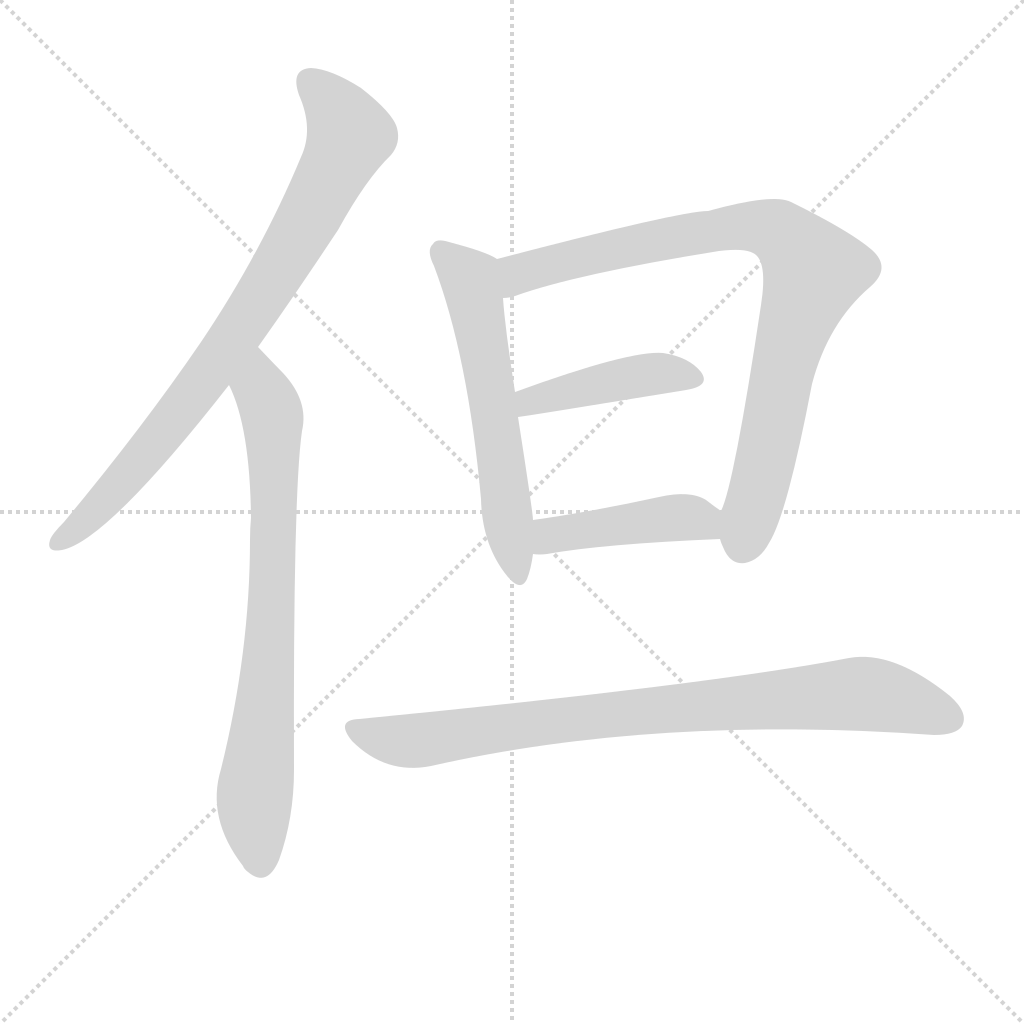
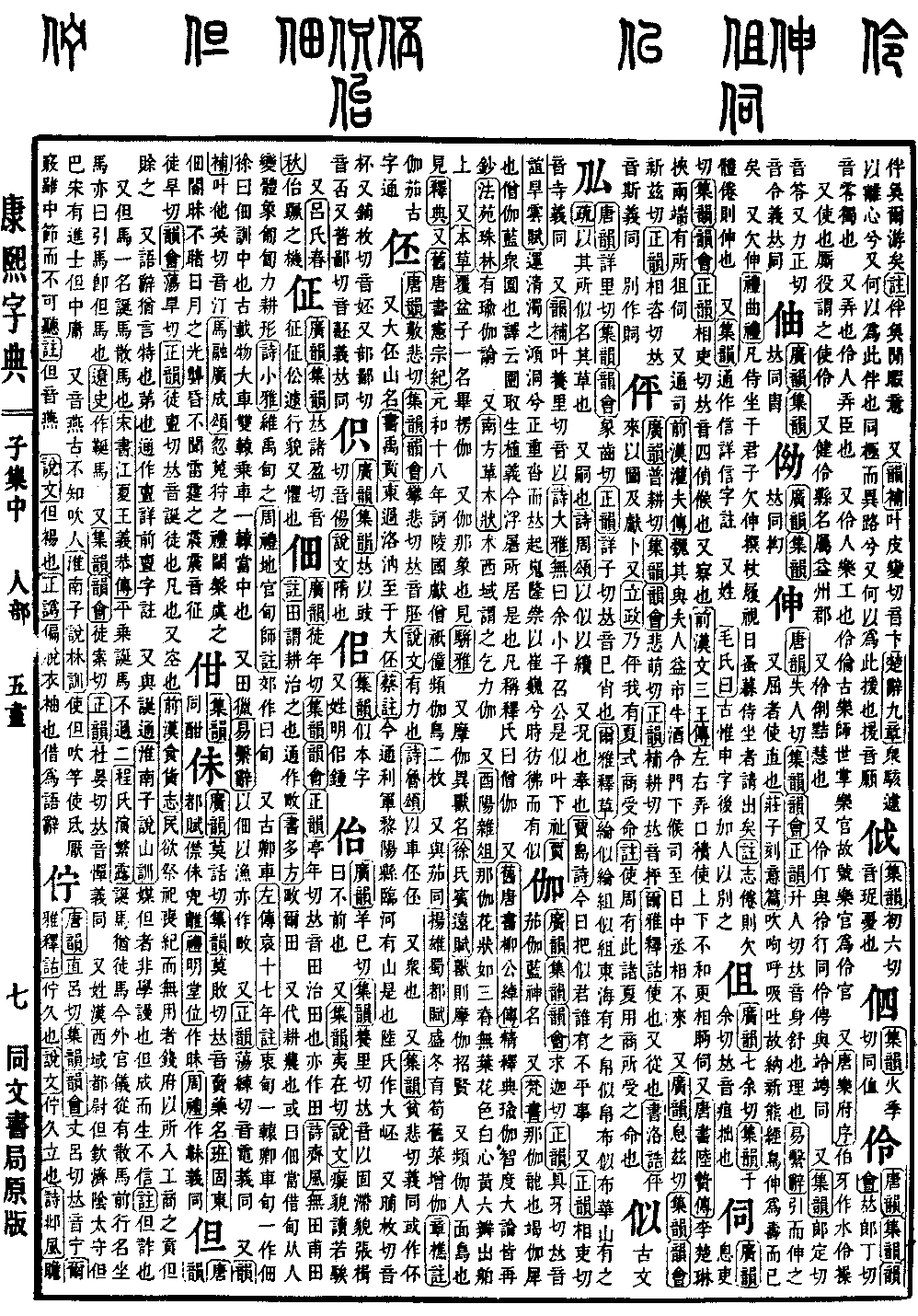
Zi Collection, Middle Volume. Radical: Person (rén). Character: dàn. Kangxi stroke count: 7. Page 97, Number 21. Tang Rhymes (Tangyun): Pronounced with the initial of tú and the final of hǎn. Rhyme Collection (Yunhui): Pronounced with the initial of dàng and the final of hǎn. Correct Rhymes (Zhengyun): Pronounced with the initial of tú and the final of dǎn. The sound is dàn. It means in vain or simply. It also refers to having nothing or being empty. In the Book of the Former Han (Qian Han Shu), Treatise on Food and Money: If the common people wish to perform sacrifices or funerals but lack the funds, the treasury may use collected taxes to provide them with temporary loans. It is also used as a grammatical particle, equivalent to the particles tè or yě. It is interchangeable with the character dǎn. For details, see the previous entry for the character dǎn. It is also interchangeable with the character dàn. In the Master of Huainan (Huainanzi), Lessons on Mountains: A matchmaker’s deceit is not something learned as a craft, but once deceit is formed, it results in a lack of integrity. The commentary notes that dàn means deceit. It is also used in the term dàn mǎ, also called dàn mǎ, which refers to a spare horse. In the Book of Song (Song Shu), Biography of Liu Yigong, Prince of Jiangxia: The spare horses used for ordinary carriages did not exceed two. In Cheng's Elaborations on the Luxuriant Dew (Yanfanlu): The dàn mǎ is a spare horse. Today, in the ceremonial guards of local officials, there are spare horses led in front called zuò mǎ. They are also called yǐn mǎ, which is the dàn mǎ. In the History of Liao (Liaoshi), it is written as dàn mǎ. Also in the Collected Rhymes (Jiyun) and Rhyme Collection (Yunhui): Pronounced with the initial of tú and the final of àn. In the Correct Rhymes (Zhengyun): Pronounced with the initial of dù and the final of yàn. The sound is dàn. The meaning is the same. It is also a surname. During the Han dynasty, there were Dan Qin, a military official of the Western Regions, and Dan Ba, the Governor of Jiyin. In the Song dynasty, there was Dan Zhongyong, a successful candidate of the imperial examinations. It is also pronounced chú. It refers to a person in ancient times who could not play the yú flute. In the Master of Huainan (Huainanzi), Lessons from the Forest of Sayings: If you make Dan blow the flute and make Di finger the holes, even if they are in rhythm, it will not be pleasant to hear. The commentary notes that dàn is read as chú. In the Explanation of Simple Graphs and Analysis of Compound Characters (Shuowen Jiezi): Dàn means to be exposed or bare. In the Correction of Errors (Zheng’e): It refers to taking sides or removing one's sleeves. It is borrowed for use as a grammatical particle. Textual Research: Also pronounced yàn. It refers to a person in ancient times who could not play the yú flute. In the Master of Huainan (Huainanzi), Lessons from the Forest of Sayings: If you make Dan blow the flute and make Di finger the holes, even if they are in rhythm, it will not be pleasant to hear. The commentary says dàn is pronounced yàn. Upon careful examination of the commentary in the Master of Huainan (Huainanzi), the phrase dàn is read as yàn means it shares the same sound as chú. It implies that the pronunciation follows the dialect of the people of the Yan region, but the character chú is not actually pronounced as yàn. Therefore, the earlier mention of the sound yàn is corrected to the sound chú, and the later mention of reading it as yàn is corrected to reading it as chú.