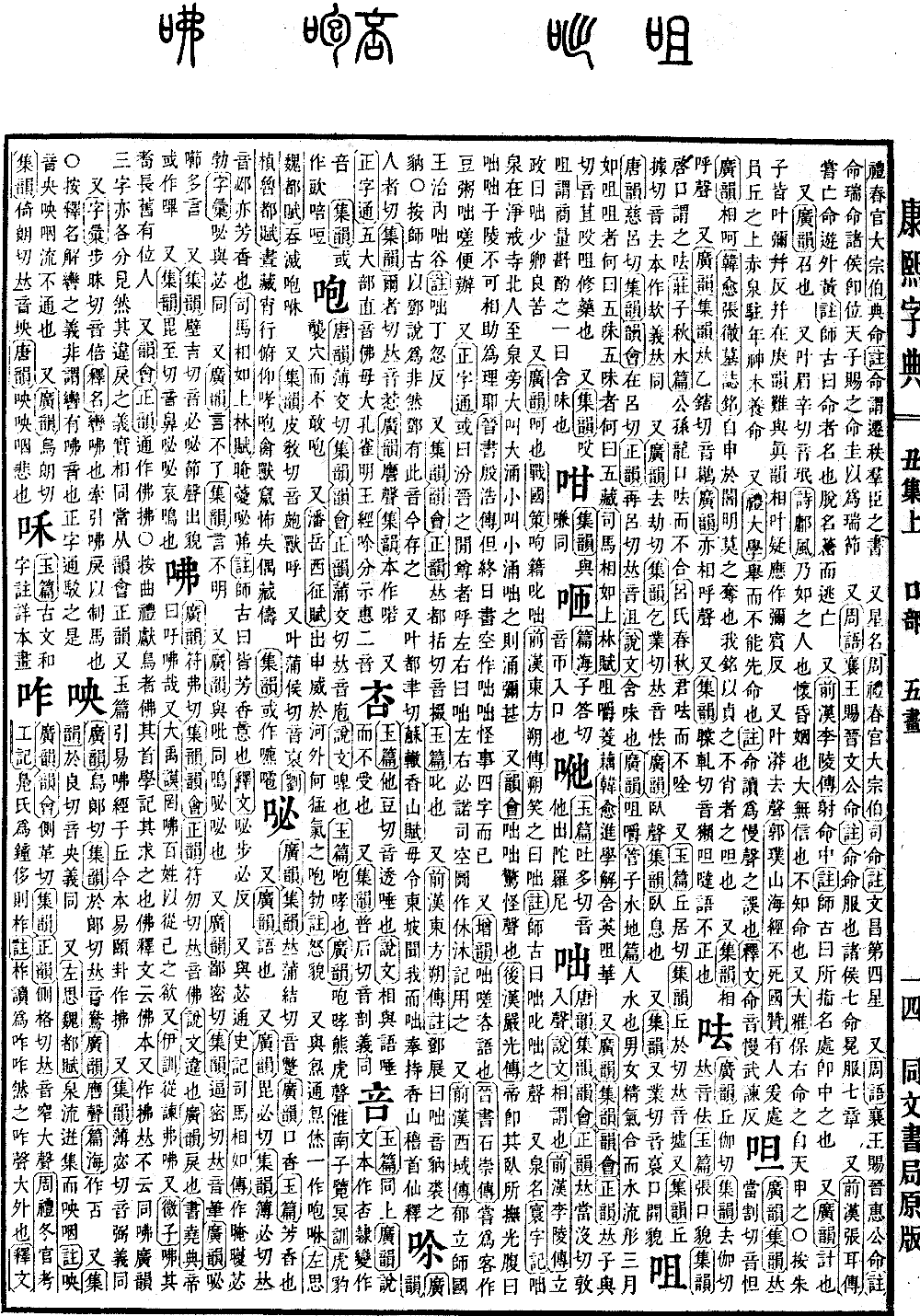
Chou Collection, Upper Volume. Radical: Mouth (kǒu). Kangxi strokes: 8. Page 184, Entry 07.
According to Tang Rhymes (Tangyun), Collection Rhymes (Jiyun), Rhyme Meetings (Yunhui), and Orthodox Rhymes (Zhengyun), it is pronounced du. According to the Explaining Graphs and Analyzing Characters (Shuowen), it refers to the meaning of calling to or speaking with one another. In the History of the Former Han (Qianhan Shu), Biography of Li Ling, it is recorded: Standing for the government, I say: Alas, Shaoqing, you have truly suffered.
According to the Extensive Rhymes (Guangyun), it refers to the meaning of scolding or berating. In the Strategies of the Warring States (Zhanguo Ce), it refers to shouting or berating loudly. In the History of the Former Han (Qianhan Shu), Biography of Dongfang Shuo, Dongfang Shuo said laughingly: Tsk. The commentary by Yan Shigu states: Duo is a sound used for berating.
It is also the name of a spring. According to the Record of the World (Huanyu Ji), Duo Spring is located north of Jingjie Temple. If a person walks to the side of the spring and shouts loudly, the spring surges forth in a large amount; if one shouts softly, it surges in a small amount; if one scolds it, it surges even more violently.
According to the Rhyme Meetings (Yunhui), duo-duo is a sound expressing astonishment or strangeness. In the History of the Later Han (Houhan Shu), Biography of Yan Guang, the emperor went to where he was lying, rubbed Yan Guang’s belly, and said: Alas, Ziling, can you not assist me in governing the state? In the Book of Jin (Jin Shu), Biography of Yin Hao, it is said that he spent his days writing in the air, only writing the four characters for strange and astonishing affairs.
According to the Added Rhymes (Zengyun), duo-jie is an expression of sighing or exclamation. In the Book of Jin (Jin Shu), Biography of Shi Chong, it is noted that he once prepared bean porridge for a guest, which was completed very quickly.
According to the Mastery of Characters (Zhengzitong), some say that in the Fen River and Jin regions, when superiors call for attendants, they say "duo," and the attendants must respond. Siku Tu used this account in his Record of Leisure and Bathing (Xiumu Ji).
In the History of the Former Han (Qianhan Shu), Record of the Western Regions, there is the State of Yulishi, where the seat of government is located in Neiduo Valley. The commentary notes that Duo is pronounced ding-hu.
According to the Collection Rhymes (Jiyun), Rhyme Meetings (Yunhui), and Orthodox Rhymes (Zhengyun), it is also pronounced duo, similar to the sound of duo. According to the Jade Chapters (Yupian), it carries the meaning of scolding or berating.
According to the commentary on the History of the Former Han (Qianhan Shu), Biography of Dongfang Shuo, Deng Zhan stated: Duo is pronounced like the duo in duo-qiu. Note: Yan Shigu considered Deng Zhan’s explanation to be incorrect, but since Deng Zhan proposed this pronunciation, it is preserved here.
It is also rhymed as du-yu. In Su Zhe’s Rhapsody on Fragrant Mountain (Xiangshan Fu), it reads: Do not let Dongpo hear my voice and be astonished. Respectfully holding Fragrant Mountain, I kowtow to the immortals and the Buddhas.