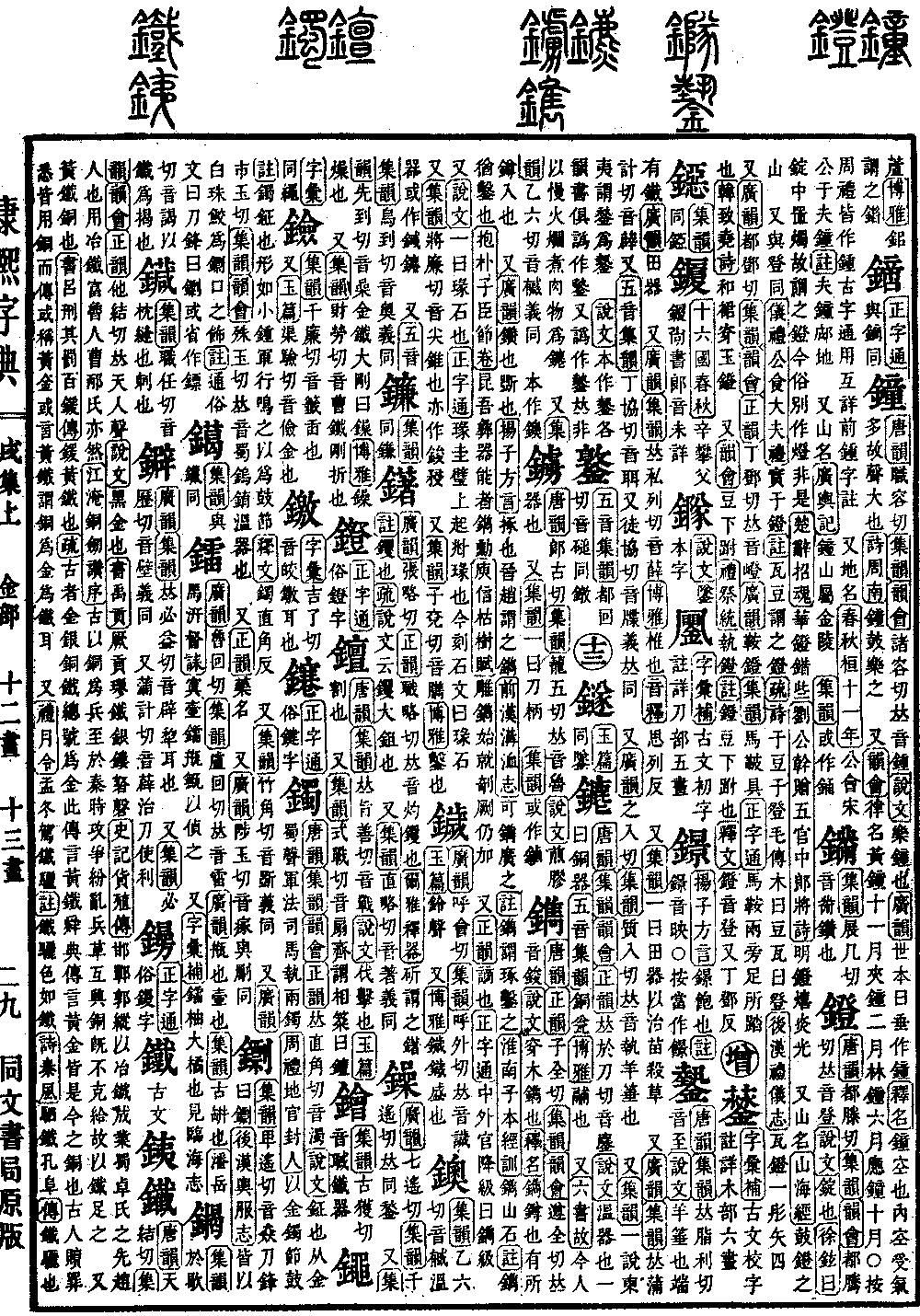
Xu Collection, Upper Volume
Radical: Metal (jīn)
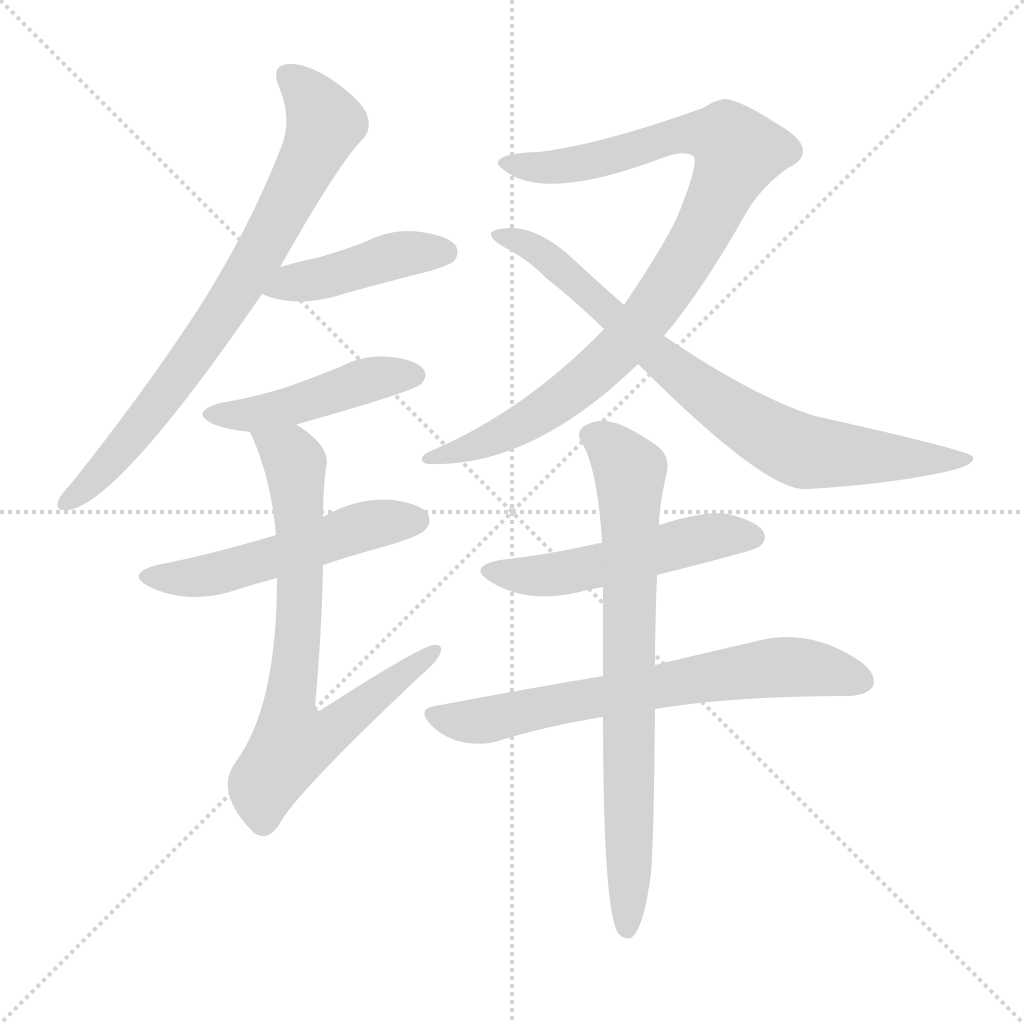
鐸
Kangxi strokes: 21
Page 1323, Entry 01
Pronounced duó
Shuowen Jiezi (Shuowen): A large bell. According to military regulations, five men form a squad, and five squads form a unit; the unit commander carries a duó.
Yupian: Used to proclaim government orders.
Shiming: The duó is a measure; it is the measure of commands and orders.
Book of Documents (Shangshu), Yin Zheng: The official in charge of information collection traveled the roads with a wooden-tongued bell.
Commentary: The wooden-tongued bell, or mu duó, has a metal bell body and a wooden tongue, used to spread literary teachings.
Rites of Zhou (Zhouli), Heaven Officials: Proclaim using the wooden-tongued bell.
Commentary: In ancient times, whenever there was a new order, the wooden-tongued bell was shaken to alert the crowd. The wooden-tongued bell has a wooden tongue. For literary affairs, the wooden-tongued bell is used; for military affairs, the metal-tongued bell is used.
Also, Rites of Zhou, Earth Officials, Drum Master: Use the metal bell to coordinate the drums.
Commentary: The duó is a large bell. It is shaken to coordinate the sound of the drums.
Also, ox bell.
A New Account of Tales of the World (Shishuo Xinyu): Jin dynasty official Xun Xu encountered a merchant from Zhao whose ox bell was ringing; he recognized its tone. When he was later in charge of music and the tones were not harmonious, he said that if he could obtain the merchant's ox bell, the music would be harmonious. He sent orders to the prefectures and states to send all ox bells; when they were obtained, the music was indeed harmonious.
Also, Kaiyuan Yishi: In the palace, small pieces of jade were hung between the eaves; when the wind blew, they sounded like jade pendants, and they were called wind-bells (zhanfeng duó).
Also, a place name.
Zuo Tradition (Zuo Zhuan), 16th year of Duke Xi: The Di people invaded Jin and took Hu and Shouduó.
Commentary: Shouduó is a place in Jin, located north of the Fen River.
Also, a country name.
Zuo Tradition, 16th year of Duke Xuan: The Jin official Shi Hui led an army and destroyed the Red Di clan of Jia, as well as Liuxu and Duochen.
Commentary: Duochen belongs to the Liuxu region.
Also, a palace name.
Zuo Tradition, 3rd year of Duke Ai: The Si Palace caught fire.
Commentary: Si Palace is the name of a palace.
Also, a surname.
Zuo Tradition, 18th year of Duke Cheng: Duó E was the commander of the Upper Army.
History of the Former Han (Qian Hanshu), Treatise on Literature: Three chapters of the Duó lineage.
Commentary: Refers to the Chu dynasty Grand Tutor, Duó Jiao.
Also, a person's name.
Zuo Tradition, 28th year of Duke Xi: Cao Shu Zhenduó.
Also, 13th year of Duke Zhao: Si Duó She.
Commentary: An official of the State of Lu.
Textual Corrections:
Rites of Zhou, Earth Officials, Feng Ren: Use the metal bell to coordinate the drums. Corrected to Drum Master according to the original text.
Zuo Tradition, 16th year of Duke Xuan: Jin official Shi Hui led an army to destroy the Red Jia Di clan, as well as Liuxu and Duochen. Corrected to the Red Di clan of Jia according to the original text.