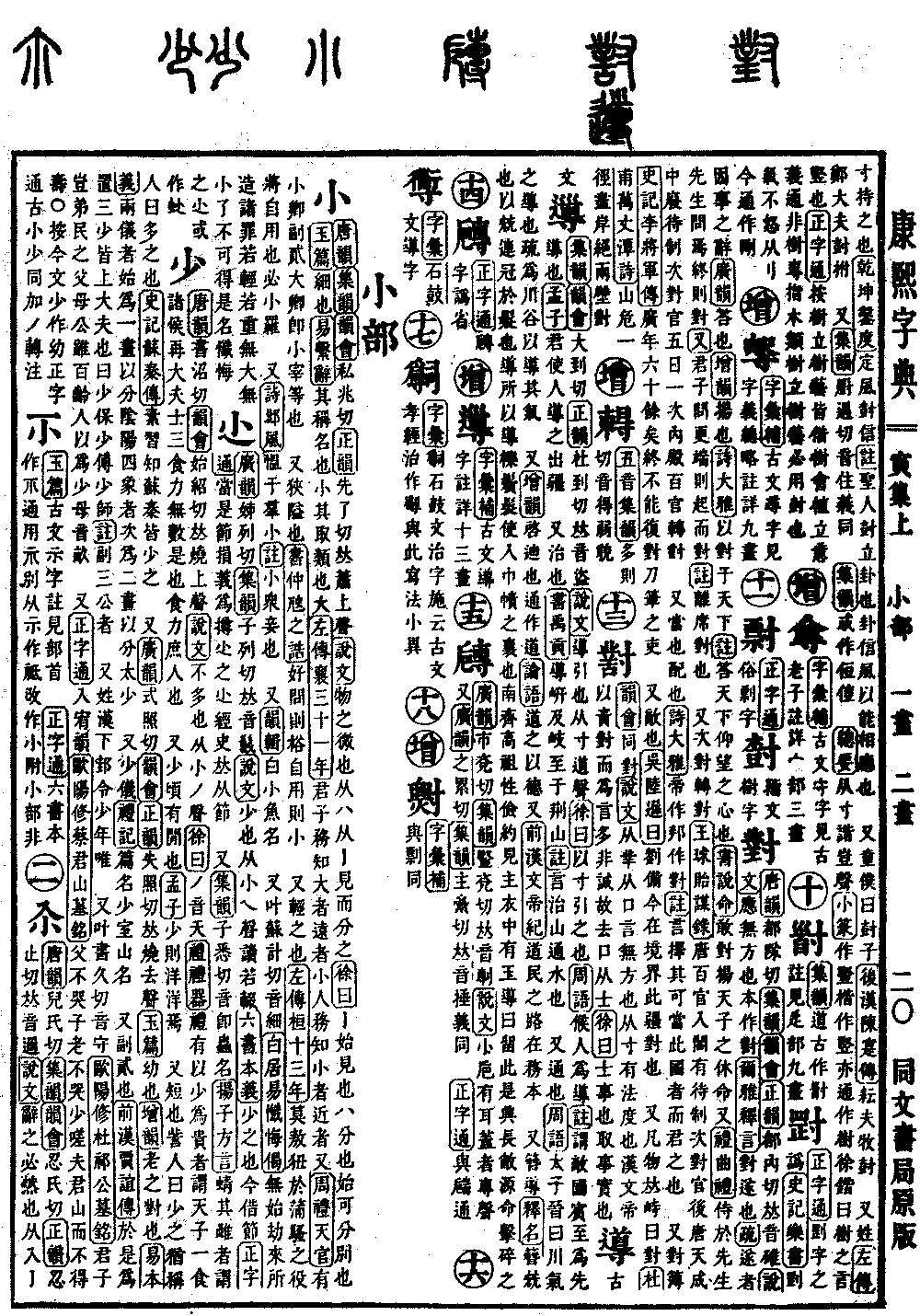
Yin Collection, Upper Volume. Radical: Inch (cùn). Kangxi stroke count: 14. Page 296, Entry 07.
Pronounced duì.
According to the Explaining Graphs and Analyzing Characters (Shuowen Jiezi), it means to respond without a predetermined method. Originally written in a variant form.
According to the Approaching Standard (Erya), in the section explaining words, it means to follow or succeed. The commentary states that following refers to a term used in response to circumstances.
According to the Extended Rhymes (Guangyun), it means to answer. According to the Augmented Rhymes (Zengyun), it means to praise.
In the Book of Odes (Shijing), in the section on Major Odes (Daya), it says: To respond to the world. The commentary explains this as responding to the hearts of the people who look up to the world.
In the Book of Documents (Shujing), in the section on The Charge to Yue (Shuoyue), it says: Daring to praise the glorious mandate of the Son of Heaven.
Also, in the Book of Rites (Liji), in the section on Summary of the Rules of Proprietary Behavior (Quli), it says: When sitting in attendance upon a master, if the master asks a question, wait until he finishes, then respond. Also, if a superior changes the topic, stand up and respond. The commentary notes this means leaving one's mat to respond.
Also, there are terms like secondary response and rotating response. According to the Records of Inherited Strategies (Wangqiu Yimou Lu), during the Tang dynasty, officials entering the court had officials tasked with secondary responses. During the Tiancheng period of the Later Tang, the secondary response positions were abolished, and every five days, officials in the inner palace would participate in rotating responses.
Also, it means to correspond or to match. In the Book of Odes (Shijing), in the section on Major Odes (Daya), it says: God created the state and created its match. The commentary explains this as choosing one who can fulfill the requirements of the state to rule it.
Also, it refers to responding to legal records. According to the Records of the Grand Historian (Shiji), in the biography of General Li, it says: Guang was over sixty years old and could no longer face the officials of the brush and knife.
Also, it means to be an enemy. Lu Xun of Wu said: Liu Bei is now within our borders; he is our current adversary.
Also, when things stand facing each other, it is called being opposite. In a poem by Du Fu regarding the Ten Thousand Zhang Pool, it says: The mountain is perilous and the path ends, the banks are sheer and the two walls stand opposite.
Textual research: In the Book of Rites (Liji), in the section on Summary of the Rules of Proprietary Behavior (Quli), it says: Sitting in attendance upon a master. In accordance with the original text, the word sitting has been added after attendance.