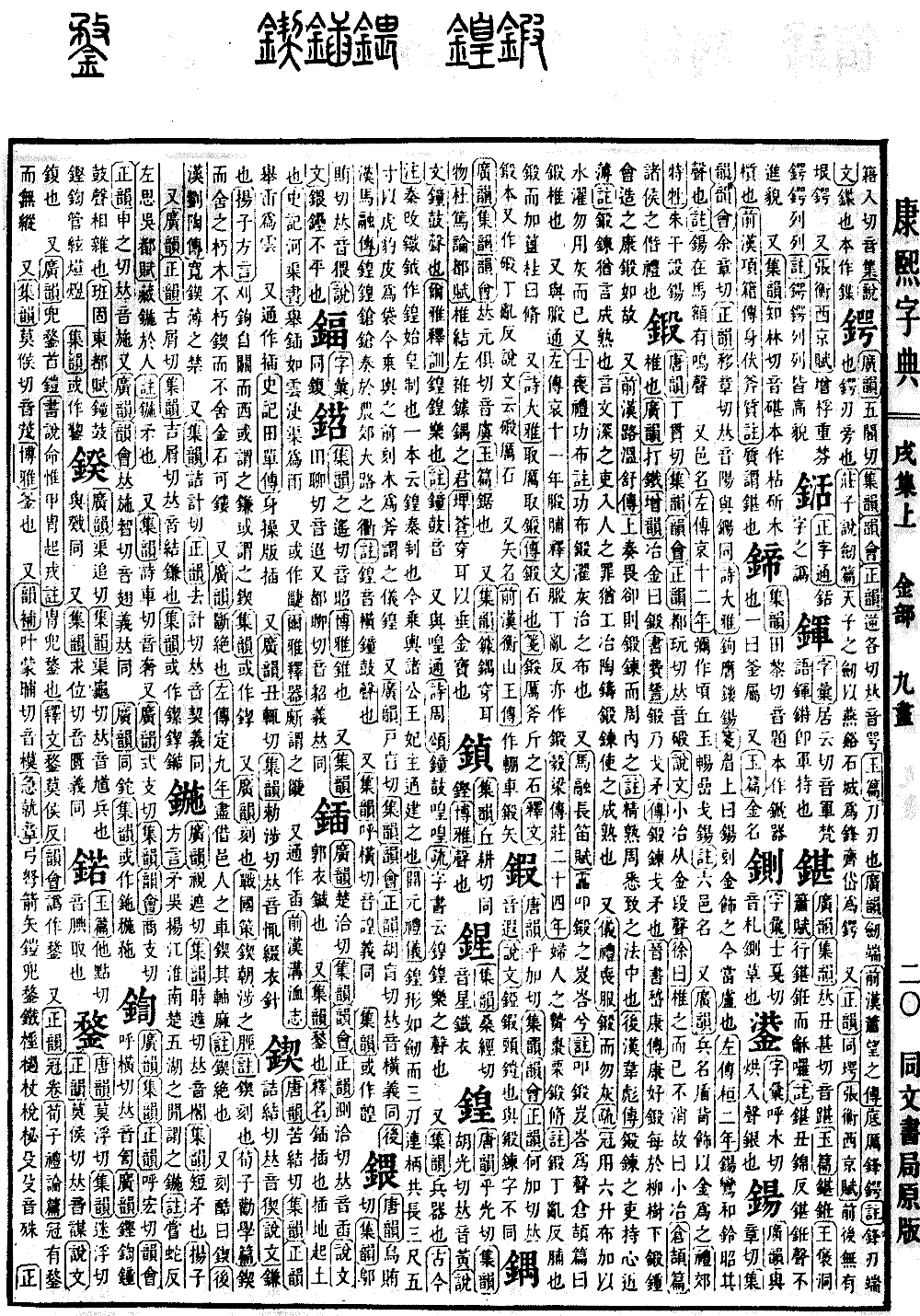
Xu Collection, Upper Volume
Radical: Metal (jīn)
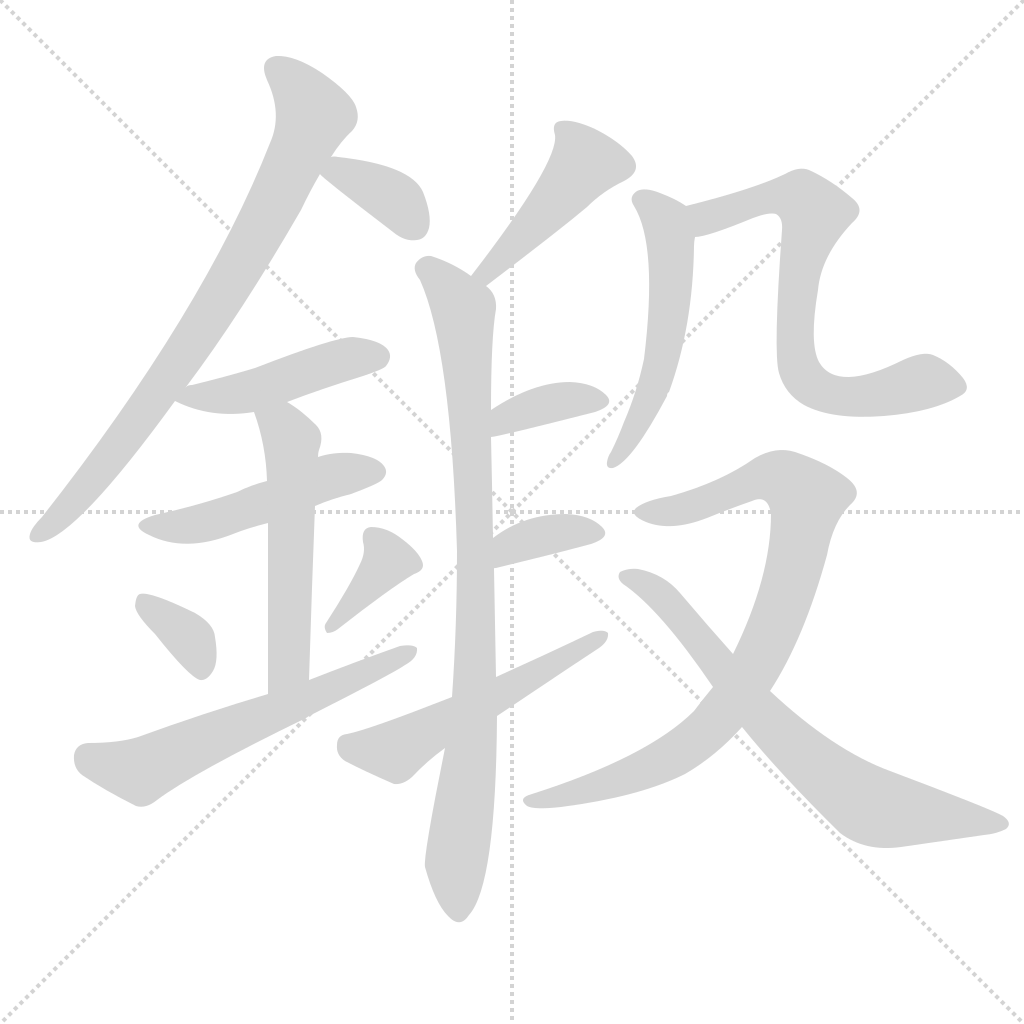
鍛; Kangxi strokes: 17; Page 1314, Entry 09
Pronounced duàn. According to the Explaining and Analyzing Characters (Shuowen Jiezi), it refers to minor metalworking. It is composed of the metal radical with a phonetic element indicating segment. Xu Kai states that it refers specifically to hammering without melting the metal, hence it is called minor metalworking. The Cangjie Pian dictionary defines it as hammering. The Guangyun dictionary defines it as smithing. The Zengyun dictionary states that the smelting of metal is called forging.
Book of Documents (Shujing), Oath of Fei: Forge your spears and lances. Commentary: Tempering spears and lances.
Book of Jin (Jinshu), Biography of Ji Kang: Ji Kang enjoyed smithing and would often forge beneath a willow tree. When Zhong Hui went to visit him, Ji Kang continued his work without stopping.
Also in the Book of Han (Hanshu), Biography of Lu Wenshu: When submitting a memorial, one fears it will be rejected, so one repeatedly refines and polishes the argument, weaving together charges to make them rigorous and unassailable. Annotation: To be refined and detailed, ensuring it fits the legal framework.
Book of the Later Han (Houhanshu), Biography of Wei Biao: Those officials skilled at framing others have a heart that is near to being cruel. Annotation: To temper or forge, as if to bring to maturity. This means that officials who are overly critical of legal texts and who interpret laws with malicious depth to convict others are like craftsmen smelting, casting, or forging, bringing the charges to a state of maturity.
Book of Etiquette and Ceremonial (Yili), Mourning Attire: Wash but do not use ash. Commentary: The mourning cap uses six-sheng cloth; it is only washed with water and not treated with ash.
Book of Etiquette and Ceremonial, Funeral Rites: Gongbu, which refers to cloth that has been pounded, washed, and treated with ash.
Ma Rong, Ode to the Long Flute: The thunderous striking and forging is precipitous. Annotation: Striking and forging, precipitous, are terms describing the sound. The Cangjie Pian says: Forging means to hammer.
Also used interchangeably with the character for dried meat (zhuàn). Left Commentary (Zuo Zhuan), Year 11 of Duke Ai, Commentary on Dried Meat: The character for dried meat is pronounced luàn (rising tone). Also written as the character for forging.
Gongyang Commentary (Gongyang Zhuan), Year 24 of Duke Zhuang: The gifts for a woman’s initial meeting include dates, chestnuts, and dried meat. Commentary: The character for forging is pronounced luàn (rising tone), meaning dried meat. Dried meat pounded with ginger and cinnamon is called dried venison (xiū).
Book of Odes (Shijing), Greater Odes: Obtain grindstones, obtain forging stones. Commentary: Forging stones are stones. Note: Forging stones are stones for sharpening axes and hatchets. Annotation: The original text is also written with the character for whetstone, pronounced luàn (rising tone). The Explaining and Analyzing Characters (Shuowen Jiezi) states that it is a whetstone. It also refers to arrowheads.
Book of Han (Hanshu), Biography of the Prince of Hengshan: Manufacturing war chariots and sharp arrows.