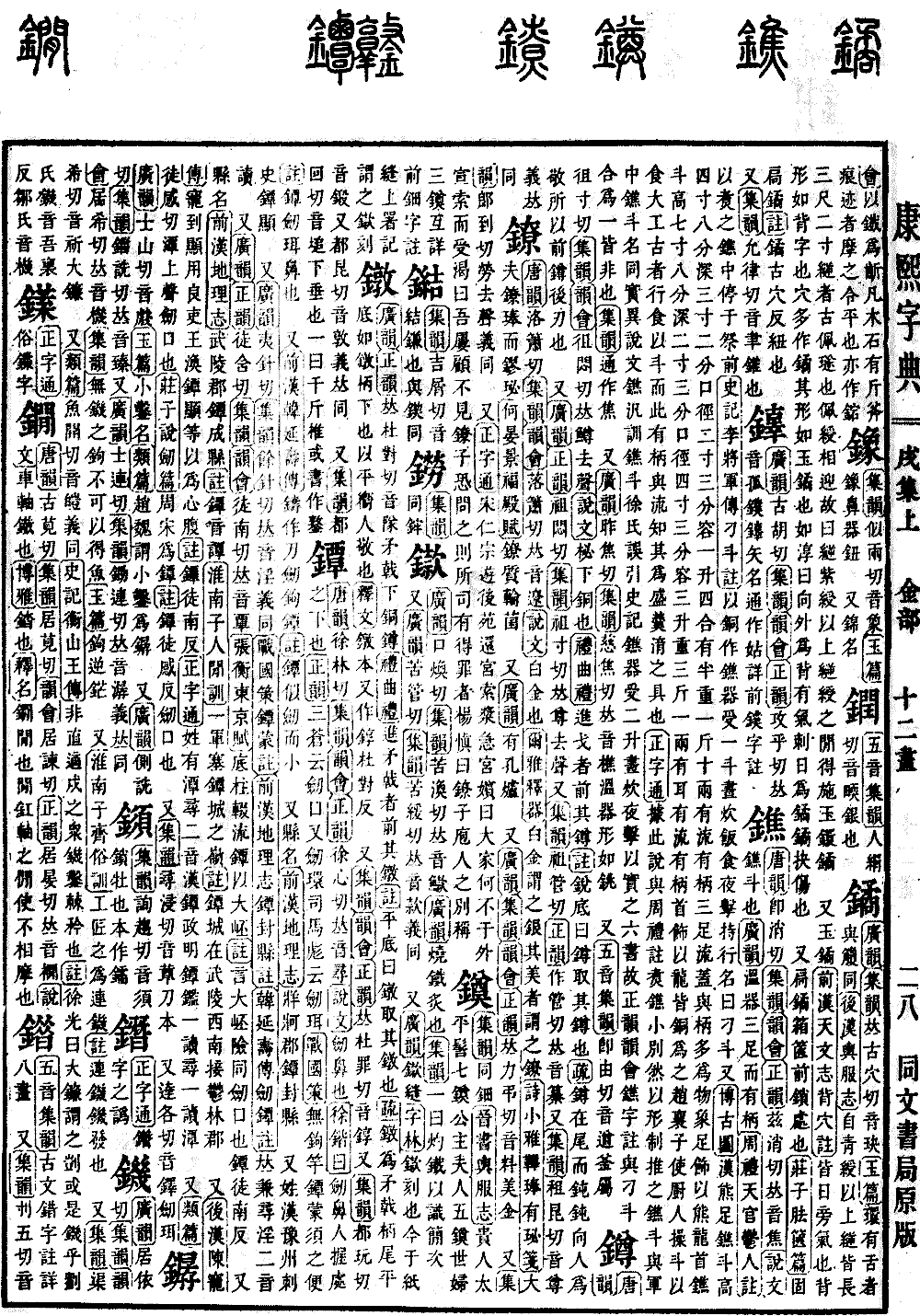
Xu Collection, Upper Volume
Radical: Metal (jīn)
Dui
Kangxi Strokes: 20
Page 1322, Entry 10
Guangyun and Zhengyun: Pronounced dui (falling tone). The copper cap at the end of a spear or halberd handle.
Book of Rites (Liji), Section on Customary Etiquette (Quli): When presenting a spear or halberd, one must face the dui end forward.
Commentary: The flat-bottomed part is called the dui. It is named for its stable nature.
Sub-commentary: The dui is the tail end of a spear or halberd handle; its flat bottom resembles a scale weight, located at the end of the handle. Keeping the flat bottom facing the other person is a sign of respect.
Explication of Texts (Shiwen): The word dui is also written in a variant form (chun). Pronounced chun (rising tone).
Also Jiyun, Yunhui, and Zhengyun: Pronounced chun (rising tone).
Also Jiyun: Pronounced duan (falling tone).
Also Pronounced dun (first tone). The meaning remains the same.
Also Jiyun: Pronounced tui (level tone). Meaning to hang down. Another theory states it is a thousand-jin iron hammer. Sometimes also written in a variant form (dui).