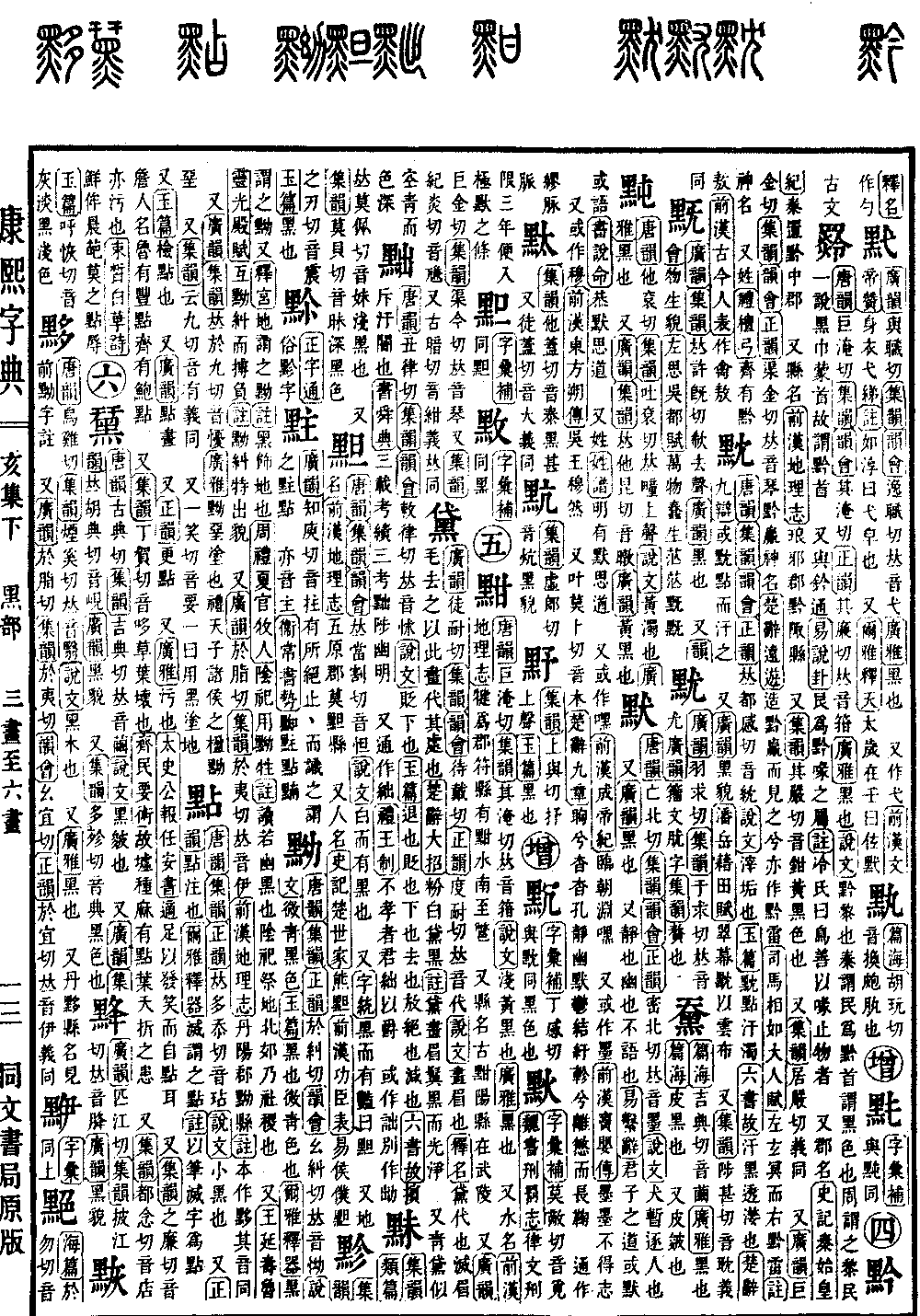
Hai Collection, Lower Volume
Radical: Black (hēi)
Kangxi Strokes: 17
Page 1519, Entry 01
Pronounced dian.
In the Shuowen Jiezi (Shuowen), it means a small black mark. According to the Zheng Yun (Zheng Yun), it also means to add a dot or mark. According to the Er Ya (Erya), "to extinguish" is called a dot; the commentary explains this as using a brush to blot out a character.
According to the Yu Pian (Yupian), it means to inspect or check. According to the Guang Yun (Guangyun), it refers to a stroke or mark. According to the Zheng Yun, it refers to the beating of a watchman's gong. According to the Guang Ya (Guangya), it means to stain or defile. In the Letter to Ren An (Bao Ren An Shu) by the Grand Historian, it says, "It is merely sufficient to be laughed at and to stain oneself."
Pronounced zhan. Used in personal names. In the state of Lu there was Feng Dian, and in the state of Qi there was Bao Dian.
Pronounced duo. Refers to the withering or damage of plant leaves. In the Essential Techniques for the Welfare of the People (Qimin Yaoshu), it notes the hazard of withered leaves and stunted growth when planting hemp in old ruins.
Pronounced dian. Also means to stain or defile. In the Poem of the White Flower (Baihua Shi) by Shu Xi, it says, "Fresh, matching the morning blossoms, nothing to stain or disgrace them."
Textual Research: In the Letter to Ren An by the Grand Historian, the original text reads "to be laughed at," whereas the current text was previously listed as "to trigger laughter." The original text has been consulted and corrected to "to be laughed at."