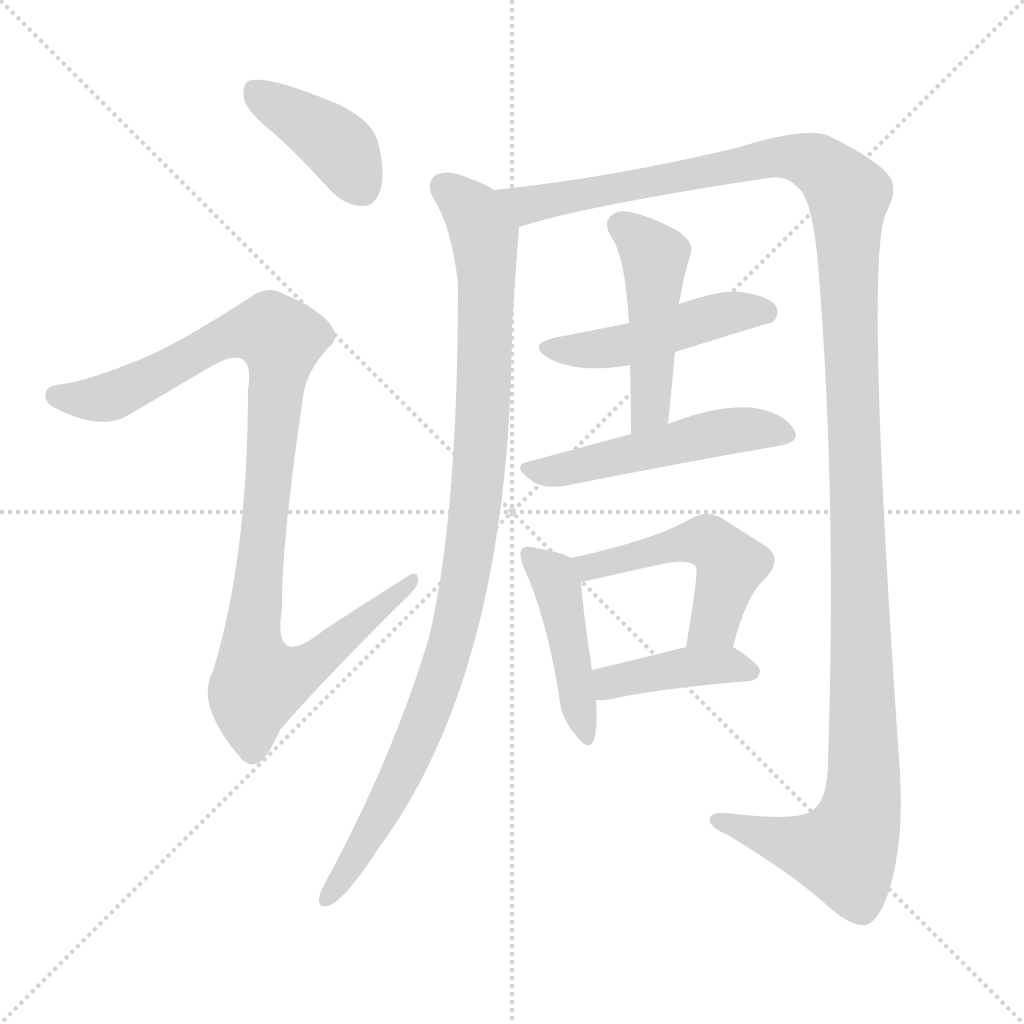
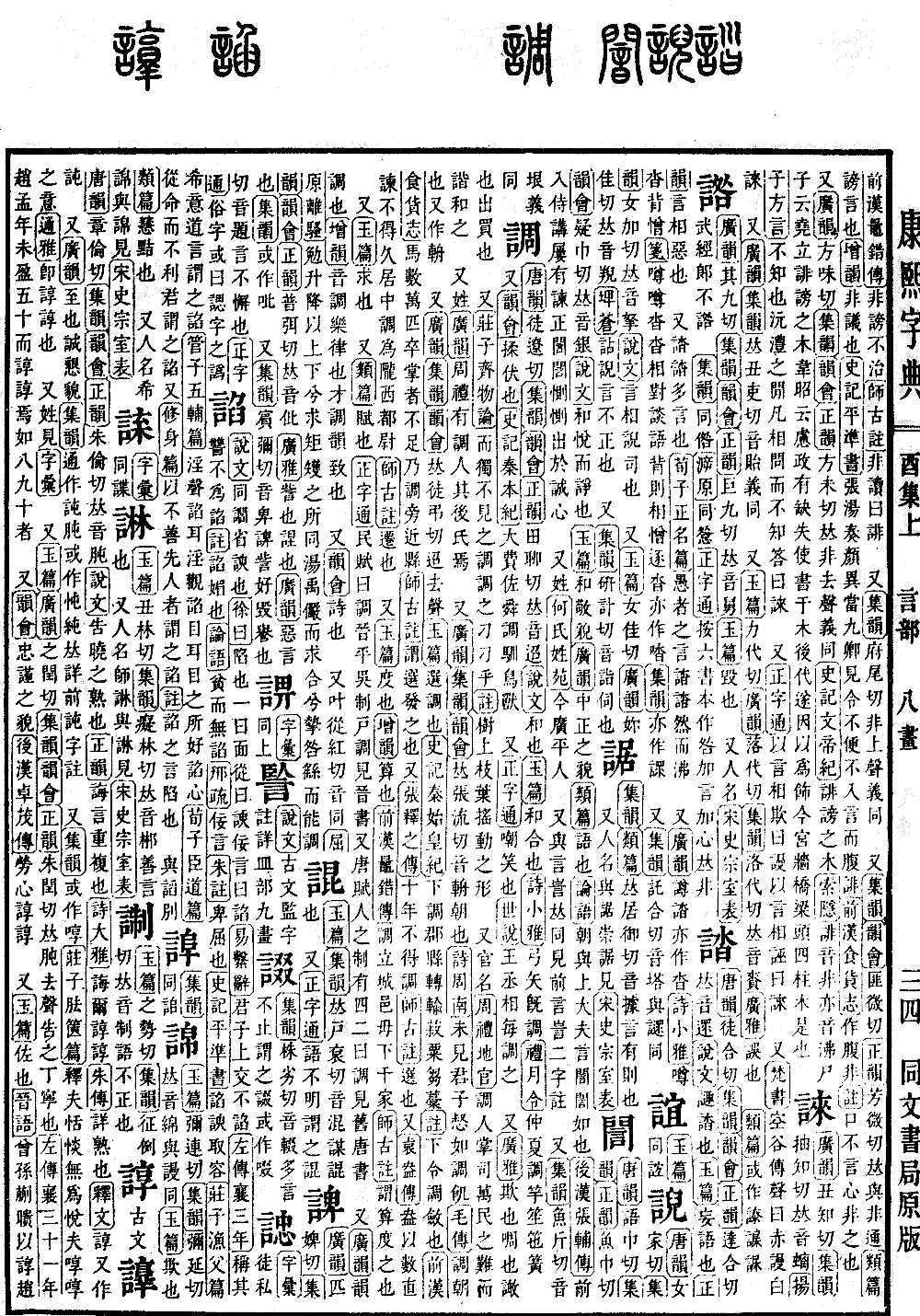
You Collection, Upper Volume. Radical: Speech (yán); Kangxi stroke count: 15; Page 1166, Entry 00.
Pronounced tiao.
According to the Shuo Wen Jiezi (Shuowen), it means harmonious.
According to the Yu Pian, it means harmonious or coordinated.
Book of Odes (Shijing), Xiao Ya: The bow and arrows have already been adjusted and prepared.
Book of Rites (Liji), Yue Ling: In the mid-summer season, tune and test musical instruments such as the yu, sheng, chi, and huang.
Furthermore, according to the Yun Hui, it means to tame or to train.
Records of the Grand Historian (Shiji), Annals of Qin: Dafei assisted Shun in taming and training birds and beasts.
Furthermore, according to the Zheng Zi Tong, it means to mock or to tease.
A New Account of Tales of the World (Shishuo): Chancellor Wang frequently teased him.
Furthermore, according to the Guang Ya, it means to deceive, mock, exaggerate, or sell out.
Furthermore, Zhuangzi, Discussion on Making All Things Equal (Qiwulun): Have you not seen the way the tree branches sway?
Commentary: Describes the appearance of tree branches and leaves swaying.
Also refers to a title of an official.
Rites of Zhou (Zhouli), Earth Office: The official known as the Tiaoren (Adjuster) is responsible for handling the disputes of the people and bringing them into harmony.
Also refers to a surname.
Guang Yun: There was an official title Tiaoren in the Rites of Zhou; his descendants took Tiao as a surname.
Pronounced zhou. Means morning.
Book of Odes (Shijing), Zhou Nan: Not having seen the gentleman, I am as worried as if I were starving in the morning.
Mao Commentary: Tiao means morning. Sometimes also written in a variant form (zhou).
Pronounced tiao (falling tone).
Yu Pian: Means to select or to conscript.
Records of the Grand Historian (Shiji), Annals of Qin Shi Huang: Issued an order to conscript from the commanderies and counties to transport beans, millet, and fodder.
Commentary: Means to issue an order to collect and mobilize.
Book of Han (Qianhan), Treatise on Food and Money: There were tens of thousands of horses; the soldiers responsible for feeding them were insufficient, so they conscripted people from nearby counties.
Yan Shigu Commentary: Means to select and dispatch.
Furthermore, Biography of Zhang Shizhi: For ten years, he did not receive a promotion or transfer.
Yan Shigu Commentary: Means to select.
Furthermore, Biography of Yuan Ang: Because Yuan Ang frequently offered direct admonitions, he could not remain at court for long and was transferred to be the Commandant of Longxi.
Yan Shigu Commentary: Means to transfer or reassign.
Yu Pian: Means to estimate or to calculate.
Zeng Yun: Means to calculate.
Book of Han (Qianhan), Biography of Chao Cuo: Plan and establish cities, with no fewer than one thousand households each.
Yan Shigu Commentary: Means to calculate and plan.
Yu Pian: Means to seek.
Lei Pian: Means taxation.
Zheng Zi Tong: The taxes of the people are called tiao; after the Jin dynasty pacified the Wu state, they established the household taxation system. See Book of Jin (Jinshu).
Also, the tax system of the Tang dynasty had four types of levies on people, the second of which was called tiao. See Old Book of Tang (Jiu Tangshu).
Guang Yun: Refers to vocal tone or musical melody.
Zeng Yun: Refers to musical pitch, specifically the pitches of the musical system. Also refers to talent or refined style.
Yun Hui: Refers to poetry.
Also rhyming as tong.
Qu Yuan, Li Sao: I seek diligently above and below, solely to find where the laws are the same. Tang of Shang and Yu of Xia searched solemnly for those who shared their ideals, and thus obtained Yi Yin and Gao Yao, thereby achieving harmony.