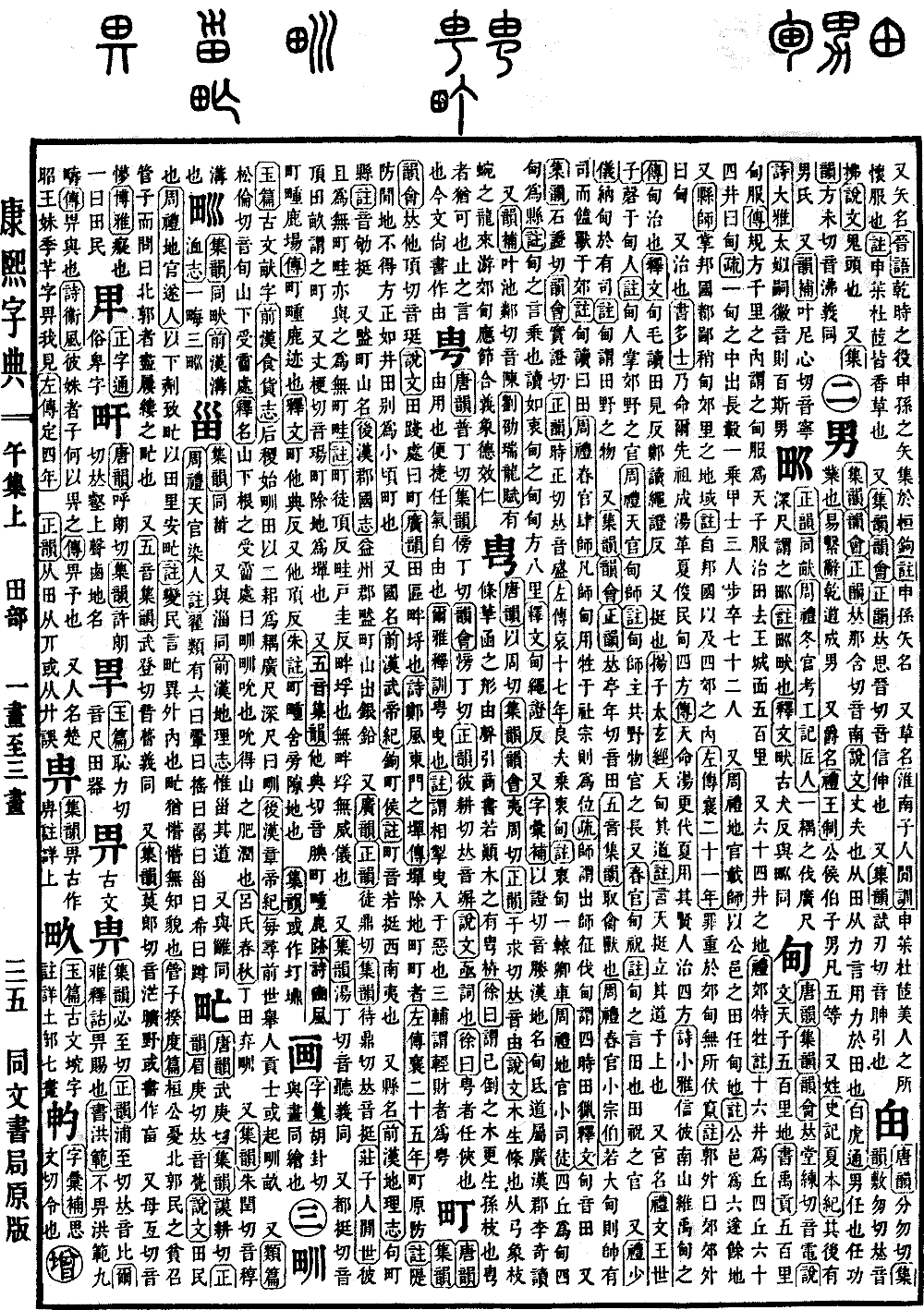
Wu Collection, Upper Volume
Radical: Field (tián)
Kangxi Strokes: 7
Page 759, Entry 04
Pronounced diàn. According to the Shuowen Jiezi (Explanation of Writing and Analysis of Characters), this refers to the five-hundred-li territory of the Son of Heaven. In the Book of Documents (Shujing), the chapter Tribute of Yu (Yu Gong) mentions the five-hundred-li imperial domain (diànfú). Commentary explains this as the designated area within a thousand-li radius reserved for the service of the Son of Heaven, where lands are managed within five hundred li of the royal city. It also refers to a unit of land comprising sixty-four wells. The notes to the Rites of Zhou (Zhouli), chapter Suburban Special Sacrifices (Jiao Te Sheng), state that sixteen wells make one qiu, and four qiu, totaling sixty-four wells, are called a dian. The commentary explains that for every dian, one war chariot, three armored soldiers, and seventy-two infantrymen must be provided. In the Rites of Zhou (Zhouli), chapter Bureau of Earth, it mentions arranging public land within the dian territory. The notes state that public land refers to the remainder outside the six settlements (sui). In the chapter Prefectural Master (Xianshi), it mentions managing the regions of states, capitals, suburbs, and rural districts; the notes interpret this as ranging from the capital states to the area within the four suburban borders. In the Zuo Tradition (Zuo Zhuan), the twenty-first year of Duke Xiang, it is said that a crime is more severe than one committed in the suburban fields, leaving no place to hide; the notes state that the area outside the outer wall is called suburban (jiao), and the area beyond that is called dian. It also means to govern. In the Book of Documents (Shujing), the chapter Many Officers (Duo Shi), it says to command your ancestors, as King Tang of Shang replaced the Xia dynasty and employed wise men to govern the four quarters. Commentary explains that heaven ordained Tang to change the dynasty, and the Xia dynasty employed wise men to govern the four directions. In the Book of Odes (Shijing), the chapter Lesser Odes (Xiao Ya), it says that Mount Nan is vast, governed by the Great Yu. Commentary defines dian here as governance. The explanatory notes state that Mao Heng reads it as tian jian, while Zheng Xuan reads it as sheng zheng. It also means to stand upright. In the Tai Xuan Jing (Great Mystery), it is written that heaven stands upright in its way; the notes interpret this as heaven standing upright in its way above. It also refers to an official title. In the Book of Rites (Liji), chapter Legacy of King Wen (Wen Wang Shi Zi), it mentions striking the chime stone for the dian official; the notes explain that the dian official is the officer in charge of suburban lands. In the Rites of Zhou (Zhouli), chapter Bureau of Heaven, there is a master of the fields (dianshi); the notes state that the master of the fields is the chief official in charge of supplying products from the wild. In the chapter Spring Offices (Chunguan), there is a sacrificial dian official; the notes state that dian means field, referring to the official in charge of sacrifices related to field hunting. In the Book of Rites (Liji), chapter Minor Ceremonial (Shaoyi), it mentions delivering the products of the fields to the relevant officials; the notes define dian as products produced from the fields.
Pronounced tián. According to the Collected Rhymes (Jiyun), the Rhyme Compendium (Yunhui), and the Correct Rhymes (Zhengyun), it refers to hunting birds and beasts. In the Rites of Zhou (Zhouli), chapter Spring Offices, it is stated that if a large-scale hunt is held, the relevant officials are led to perform sacrifices for captured wild beasts in the suburbs. The notes state that dian is read as tian. In the Rites of Zhou (Zhouli), chapter Spring Offices, concerning the Arranger of Sacrifices (Sishi), it mentions arranging positions when the army goes on an expedition or holds a hunt. Commentary explains that the army refers to military expeditions, while dian refers to the seasonal hunts. The explanatory notes state that dian is pronounced tian.
Pronounced shèng. According to the Collected Rhymes (Jiyun), the Rhyme Compendium (Yunhui), and the Correct Rhymes (Zhengyun), it refers to a type of single-shaft carriage used by high ministers. In the Zuo Tradition (Zuo Zhuan), the seventeenth year of Duke Ai, it is mentioned that Liangfu rode in a zhongdian carriage; the notes define zhongdian as a type of single-shaft carriage used by a minister. In the Rites of Zhou (Zhouli), chapter Bureau of Earth, it states that four qiu make one dian, and four dian make one xian. The notes explain that dian here means a carriage, read as the dian in zhongdian. A dian is a square of eight li. The explanatory notes read it as sheng zheng.
Pronounced yì. A place name from the Han dynasty. The Dian Di Road belonged to Guanghan Commandery, according to Li Qi.
Pronounced yì. In the Rhapsody on the Auspicious Dragon (Rui Long Fu) by Liu Shao, it refers to the winding dragon coming to roam in the fields, conforming to the season and the way, symbolizing virtue following a benevolent heart.