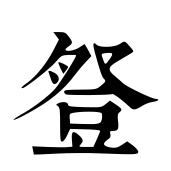
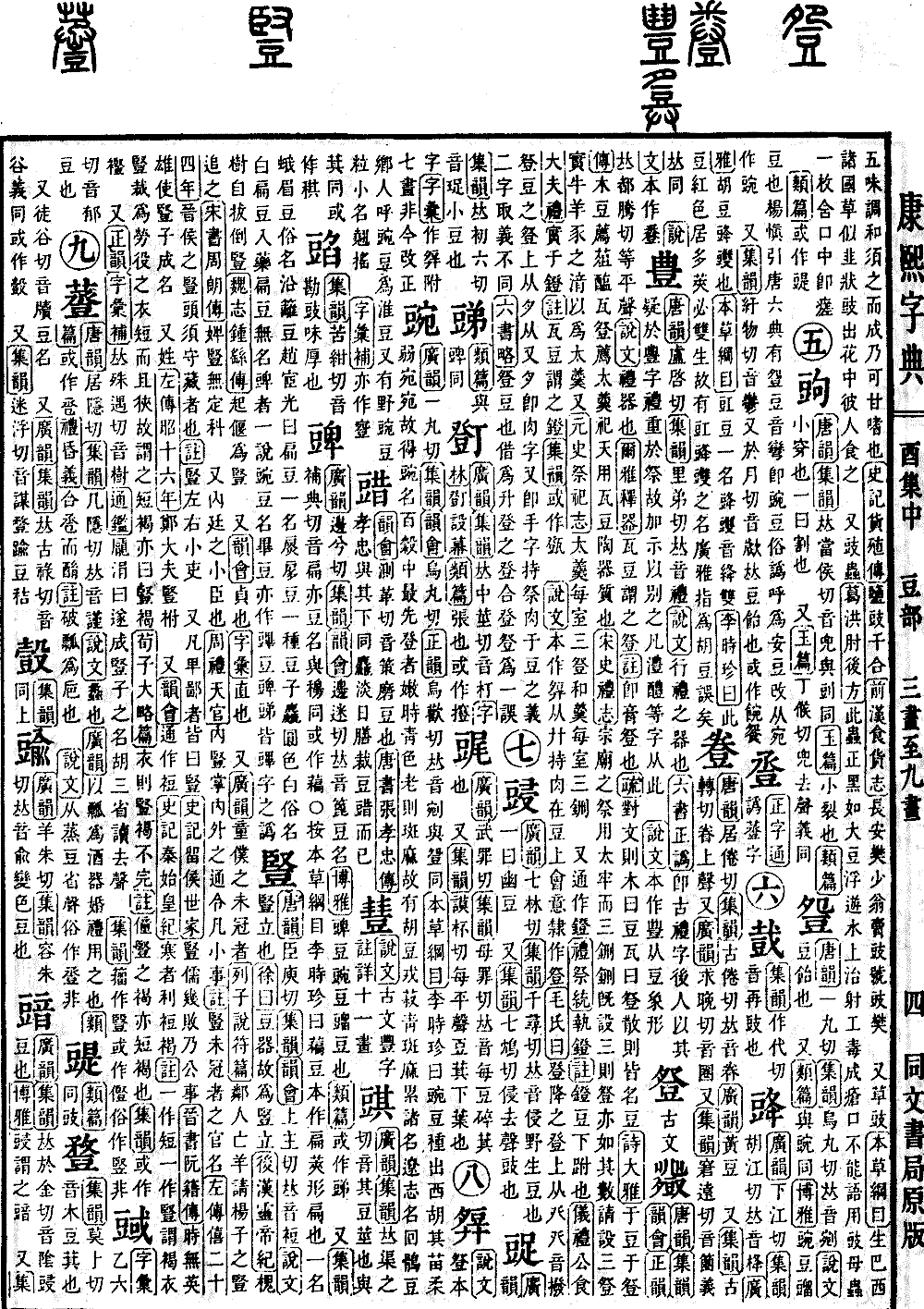
You Collection, Middle Volume
Radical: Bean (dòu)
Kangxi Strokes: 13
Page 1192, Entry 08
Ancient texts record: Tang Rhyme (Tangyun), Collection Rhyme (Jiyun), Rhyme Compendium (Yunhui), and Correct Rhymes (Zhengyun) all state it is pronounced deng (level tone). Explaining Characters and Writing (Shuowen Jiezi) interprets it as a ritual vessel. Er'ya: Explanation of Vessels states that an earthenware bean vessel is called a deng. The commentary explains this refers to a lamp-deng. The sub-commentary explains that strictly speaking, wooden ones are called bean, and earthenware ones are called deng, though generally speaking both can be called bean. Book of Odes (Shijing): In the bean, in the deng. The commentary states wooden bean vessels are used to hold salted vegetables and meat pastes, while earthenware deng vessels are used to hold meat juices without seasoning; earthenware is used for sacrifices to Heaven because of its simple, unadorned nature. History of Song (Songshi): Ritual Records states that in ancestral temple sacrifices, the great offering (tailao) is used accompanied by three xing vessels. Since three xing are provided, three deng should also be provided according to this number, with a request to establish three deng to hold meat juices of cattle, sheep, and pigs as the great broth (taigeng). History of Yuan (Yuanshi): Records of Sacrifices states that for the great broth, each room uses three deng, and for the mixed broth, each room uses three xing.
It is also written as a variant form deng. Book of Rites (Liji): Holding the deng. The commentary states that deng refers to the base under a bean vessel. Book of Etiquette and Ceremonial (Yili): Filled in the deng. The commentary states that an earthenware bean is called a deng. Collection Rhyme (Jiyun) also records it as written as a variant form.
Explaining Characters and Writing (Shuowen Jiezi) states the original character was written as a combination of the radical for two hands holding meat above a bean, which is an ideographic character. In clerical script, it changed to the current form. Mr. Mao says: The deng meaning to ascend has the radical bo at the top. The deng referring to a vessel has the radical for meat and the radical for hand at the top, signifying hands placing ritual meat onto a bean vessel. The two characters derive their meanings from different sources. Six Writings Outline (Liushu Lue) states that deng is a bean vessel. It is erroneously borrowed to mean to ascend. To merge deng (vessel) and deng (ascend) into one character is incorrect.