Hai Collection, Middle Volume
Radical: Fish (yú)
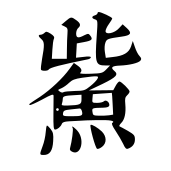
Character: 鮆
Kangxi Dictionary strokes: 16
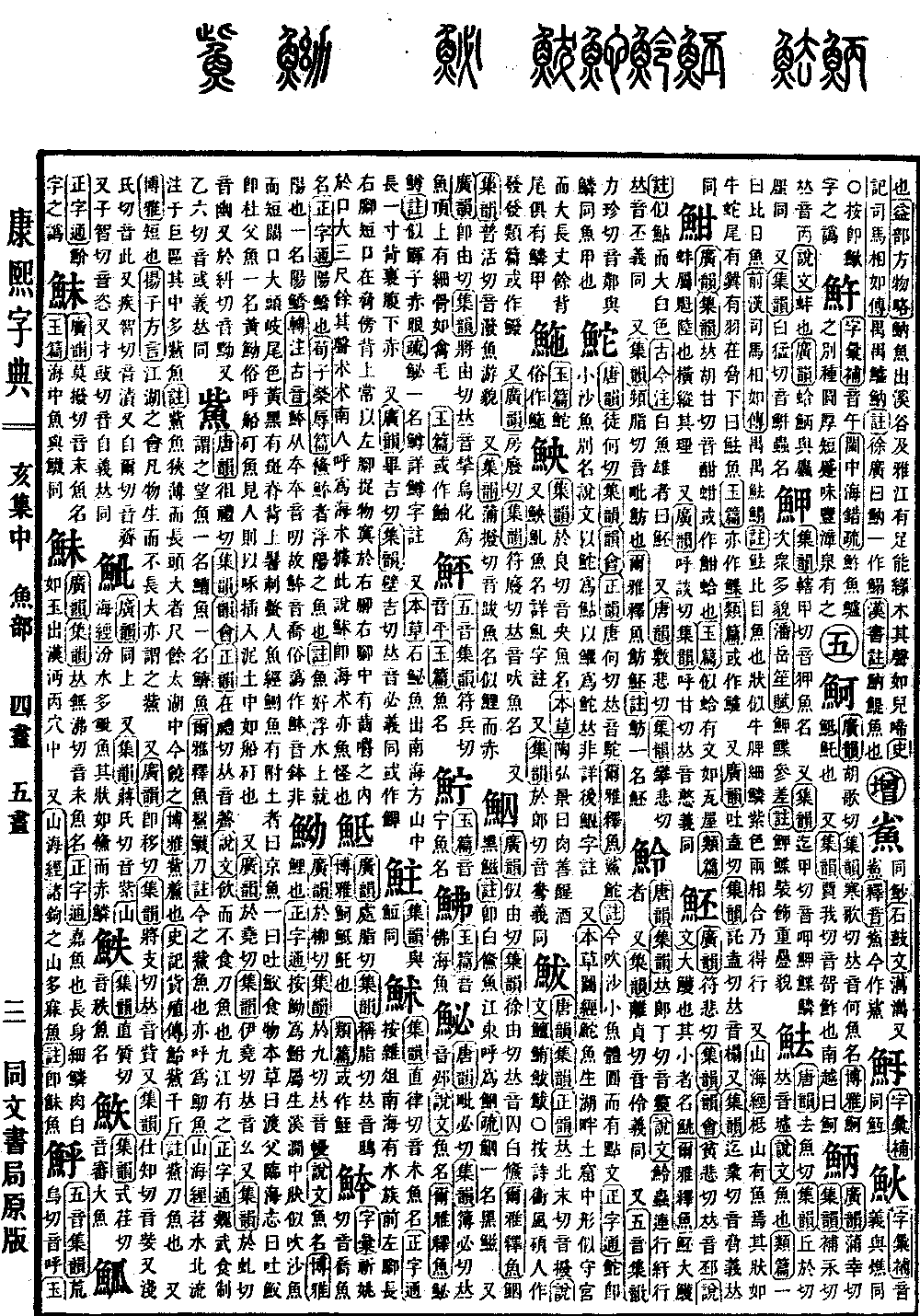
Page 1467, Entry 26
Pronounced qi.
According to the Explaining Graphs and Analyzing Characters (Shuowen Jiezi), it refers to a fish that drinks but does not eat, known as the knife fish. It is found in the Nine Rivers.
According to the Correct Meaning of Characters (Zhengzitong), in the Dietary Regulations of Emperor Wu of Wei, it is called the longing fish. It is also known as the qiu fish and the ji fish.
According to the Er Ya (Dictionary of Classical Chinese), in the commentary on the fish section, it is identified as the modern ji fish. It is also called the dao fish.
According to the Classic of Mountains and Seas (Shanhai Jing), the Tiao River flows north and empties into the Ju District, which abounds with ji fish. The commentary notes that the ji fish is narrow, thin, and has a long head, with large ones reaching over a foot in length; they are currently abundant in Lake Tai.
According to the Bo Ya (Three Kingdoms-era dictionary), the term also refers to pickled fish.
According to the Records of the Grand Historian (Shiji), Biography of Merchants, it is mentioned as a thousand catties of mackerel and ji fish. The commentary states that the ji fish is the knife fish.
It also means short.
According to the Dialect (Fangyan) by Yang Xiong, at the confluence of rivers and lakes, anything that grows without reaching full size is also called ji.
It is also pronounced zi.
It is also pronounced zhi.
It is also pronounced ci.
It is also pronounced zi.
It is also pronounced qi.
It is also pronounced zi.
It is also pronounced zi.
The meanings are the same.