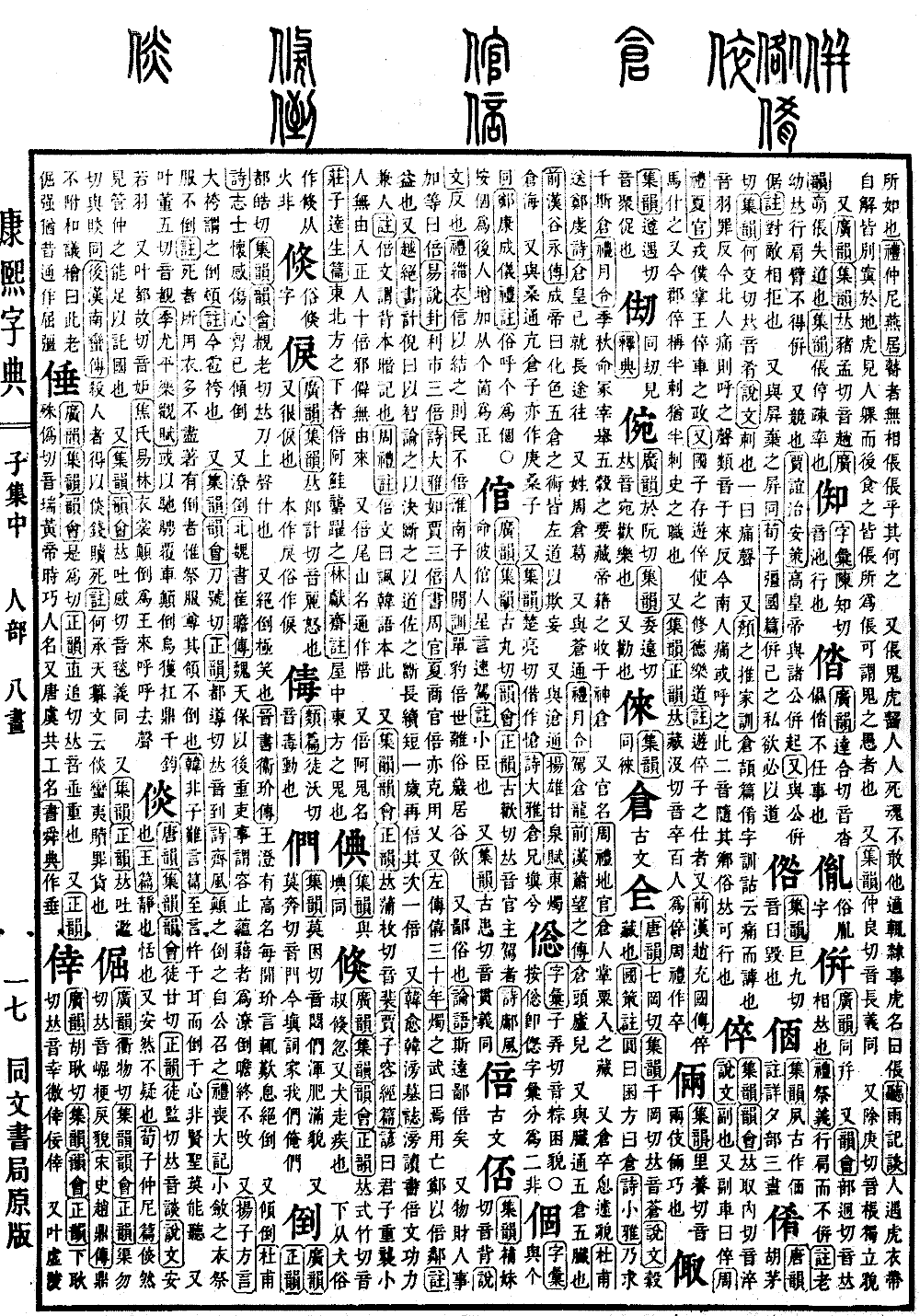
Zi Collection, Middle Volume. Radical: Person (rén). Character: cāng. Kangxi Stroke Count: 10. Page 107, Number 14.
The ancient script form is written as cāng.
Tang Rhymes (Tangyun) provides the fanqiè (phonetic notation) as qī combined with gāng. Collected Rhymes (Jiyun) provides the fanqiè as qiān combined with gāng. It is pronounced the same as the word for azure.
Explaining Graphs and Analyzing Characters (Shuowen Jiezi) defines this as a place for storing grain.
The Commentary on the Strategies of the Warring States (Zhan Guo Ce Zhu) explains that circular structures are called qūn, while square ones are called cāng.
The Book of Odes (Shijing) in the Minor Odes section contains the line: Thus a thousand granaries are sought and obtained.
The Book of Rites (Liji) in the Monthly Ordinances section records: In late autumn, the Grand Steward is ordered to report the total amount of the five grains harvested and stored; the grain produced from the ritual field of the Son of Heaven is then stored in the sacred granary.
It also refers to an official title. The Rites of Zhou (Zhouli) in the Ministry of the Earth section records: The granary official oversees the storage of grain.
There is also the term cāngzù, which describes a hurried or urgent manner. Du Fu wrote in the poem Sending off Zheng Qian: In a flurry, he has already departed for the long journey.
It is also a surname. During the Zhou Dynasty, there was a person named Cang Ge.
It is also used interchangeably with the word for azure or dark green. The Book of Rites in the Monthly Ordinances records: Riding an azure dragon. The Book of Han (Hanshu) in the Biography of Xiao Wangzhi mentions servants with dark green headbands.
It is also used interchangeably with the word for internal organs. The term five cāng refers to the five viscera. The Book of Han in the Biography of Gu Yong records that Emperor Cheng of Han said: Those arts for changing facial complexion and refining the five viscera are all heterodox ways used to deceive people.
It is also used interchangeably with the word for the blue ocean. Yang Xiong wrote in the Rhapsody on the Ganquan Palace (Ganquan Fu): To the east, it illuminates the blue ocean.
It is also used interchangeably with the name sāng. The name of the philosopher Kangcangzi is also written as Gengsangzi.
Additionally, the Collected Rhymes provides the fanqiè pronunciation as chǔ combined with liàng, used as a loanword for the character meaning sorrowful. The Book of Odes in the Major Odes section contains the line: The sorrow is long-lasting and pervasive.