Zi Collection, Page Position: Lower
Radical: Knife (dāo)
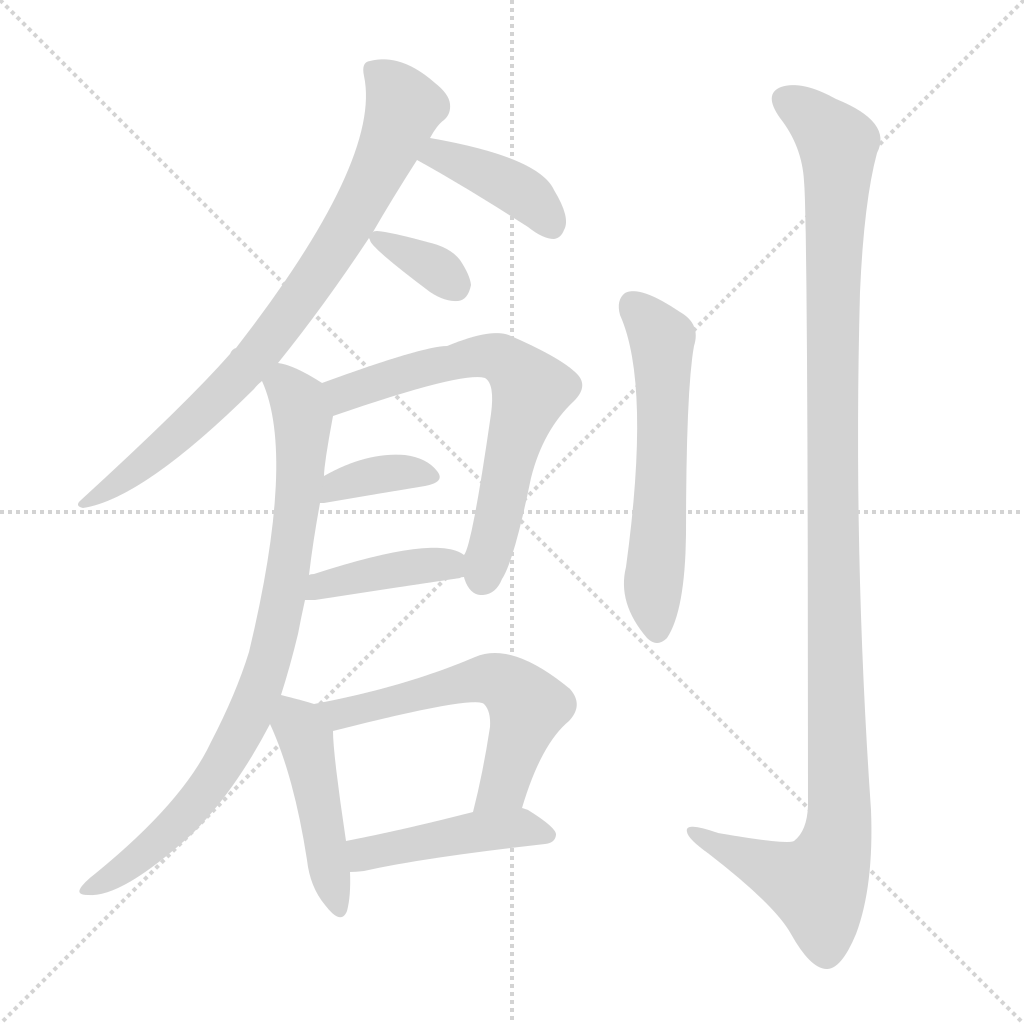
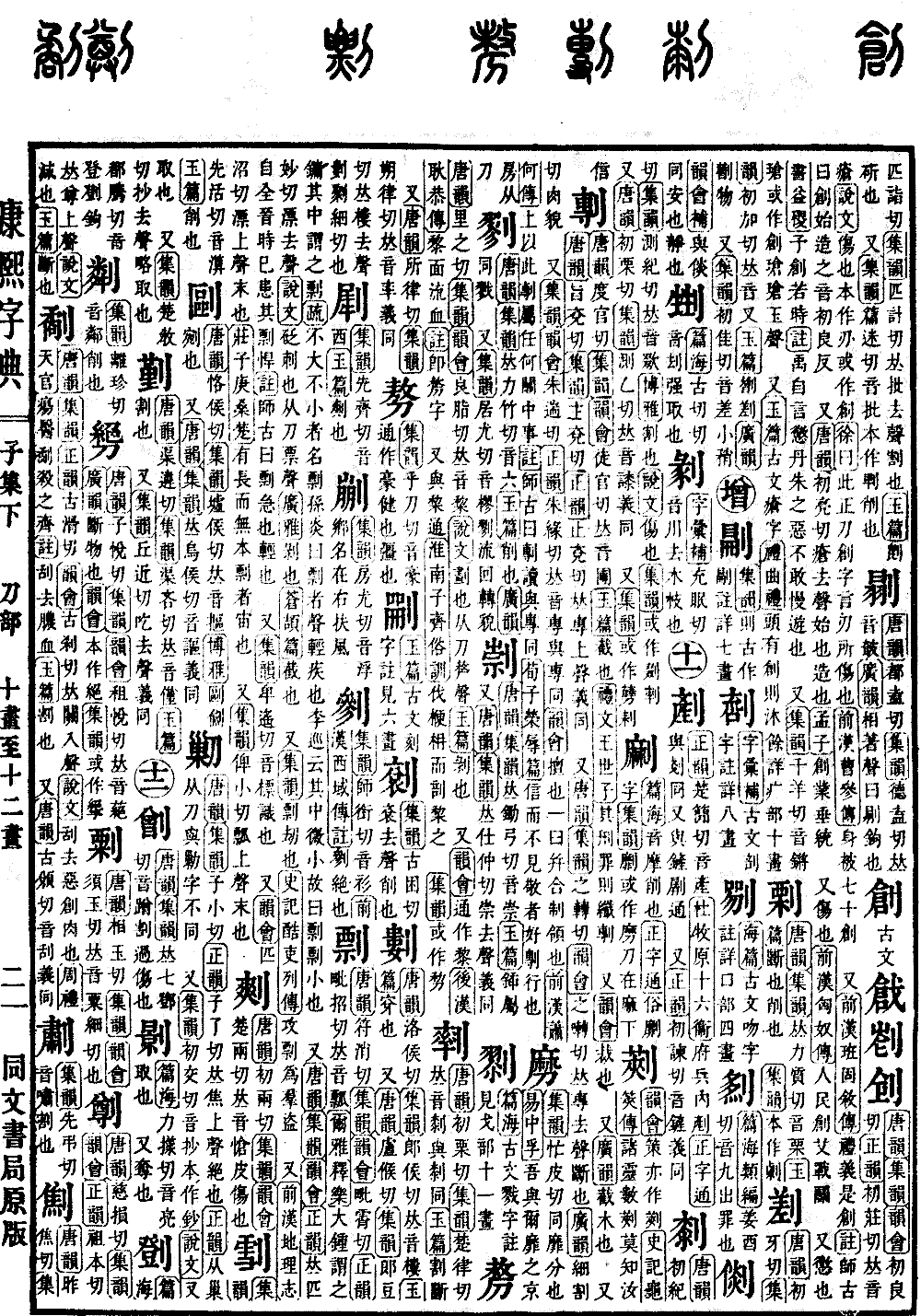
Character: 创
Kangxi Stroke Count: 12
Page: Page 143, Entry 02
Ancient writing: "戧".
Pronunciation: In "Tang Yun" (Tang Yun), "Ji Yun" (Ji Yun), and "Yun Hui" (Yun Hui), it is pronounced "chu liang qie". In "Zheng Yun" (Zheng Yun), it is pronounced "chu zhuang qie". The pronunciation is the same as "chuang" (chuāng).
"Shuowen Jiezi" (Shuowen Jiezi) explains it as "wound". Originally written as "刅", or as "创".
Xu Xuan states: This is precisely the character "chuang" in "dao chuang" (knife wound), referring to injuries caused by a blade.
In the "Book of Han - Biography of Cao Can" (Hanshu - Caocan Zhuan), it says "shen bei qi shi chuang" (the body received seventy wounds).
Also, in the "Book of Han - Narrative of Ban Gu" (Hanshu - Bengu Xuzhuan), it says "li yi shi chuang" (rites and righteousness are established).
Note: Yan Shigu states: "Chuang" means to establish initially, pronounced "chu liang fan".
Also, in "Tang Yun" (Tang Yun), it is pronounced "chu liang qie", sounding like the departing tone of "chuang" (chuāng). It means to begin or establish.
In "Mencius" (Mengzi), there is "chuang ye chui tong" (establish a foundation and pass it down to later generations).
Also means to injure.
In the "Book of Han - Biography of the Xiongnu" (Hanshu - Xiongnu Zhuan), it says "ren min chuang ai zhan" (the people were injured by war).
Also means to admonish.
In the "Book of Documents - Yi Ji" (Shangshu - Yiji), it says "yu chuang ruo shi" (I take this as an admonishment).
Note: Yu spoke of taking the misdeeds of Dan Zhu as a warning, not daring to be negligent or indulge in pleasure.
Also, in "Ji Yun" (Ji Yun), it is pronounced "qian yang qie", with the same pronunciation as "qiang" (qiāng). "Qiang" (qiāng) is sometimes written as "chuang" (chuāng). "Qiang qiang" (qiāng qiāng) is the sound of jade striking together.
Also, "Yupian" (Yupian) records it as an ancient character for "chuang" (chuāng).
In the "Book of Rites - Qu Li" (Liji - Qu Li), it says "tou you chuang, ze mu" (if there is a wound on the head, then wash the hair). For further details, see the "Illness" (nè) radical, stroke count 10.