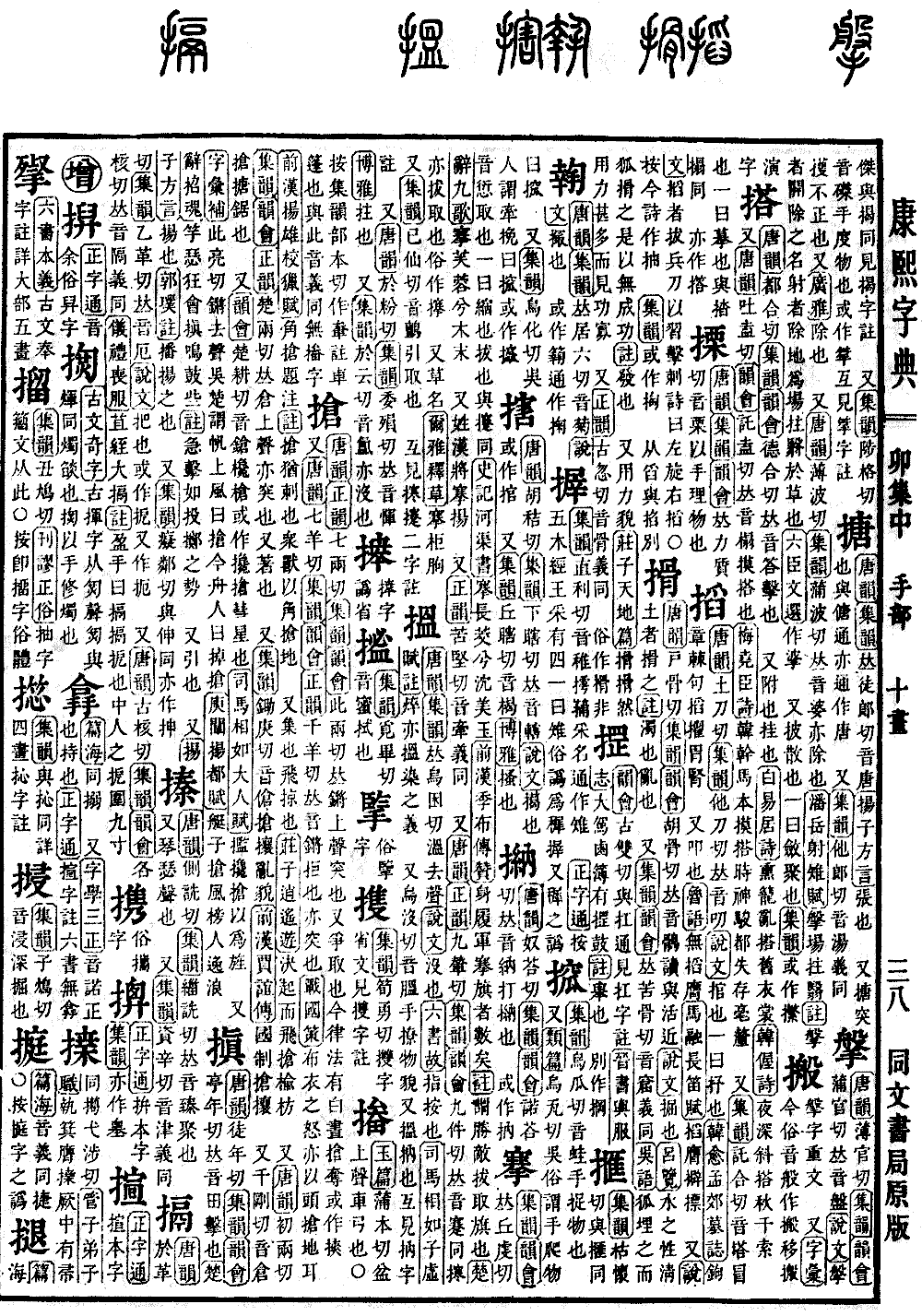
Mao Collection, Middle Volume
Radical: Hand (shǒu)
抢
Kangxi strokes: 14
Page 448, Entry 22
Pronounced qiǎng (rising tone). To collide. Also, to seize or snatch. Modern legal code uses the term for daylight robbery. Sometimes also written in a variant form (xiá).
Pronounced qiāng. To resist. Also, to collide. From Strategies of the Warring States (Zhanguo Ce): The anger of a common man is merely to strike his head against the ground. From History of the Former Han (Qianhan Shu), Yang Xiong’s Hunting Rhapsody: Horns colliding and striking (zhù). The commentary states: To collide is to pierce; many animals pierce the ground with their horns.
Also, to gather; to fly in a skimming motion. From Zhuangzi, Free and Easy Wandering: Suddenly rising to fly, skimming the elm and the sandalwood trees.
Pronounced chuǎng (rising tone). Also, to collide. Also, to attach.
Pronounced cāng. The appearance of chaos or disorder. From History of the Former Han (Qianhan Shu), Biography of Jia Yi: The state institutions were in disorder (qiāng rǎng).
Pronounced cāng. A saw.
Pronounced qiāng. A comet, sometimes written in a variant form (chān qiāng). From Sima Xiangru, Rhapsody on the Great Master: Using the comet as a banner.
Pronounced qiàng (falling tone). In the Wu and Chu regions, the wind blowing onto a sail is called qiàng; modern boatmen call it the maneuver of qiàng. From Yu Chan, Rhapsody on the Capital of Yang: The small boat catches the wind (qiàng fēng), the oarsmen leave the waves behind.