Zi Collection, Page Position: Lower
Radical: Receptacle (kan)
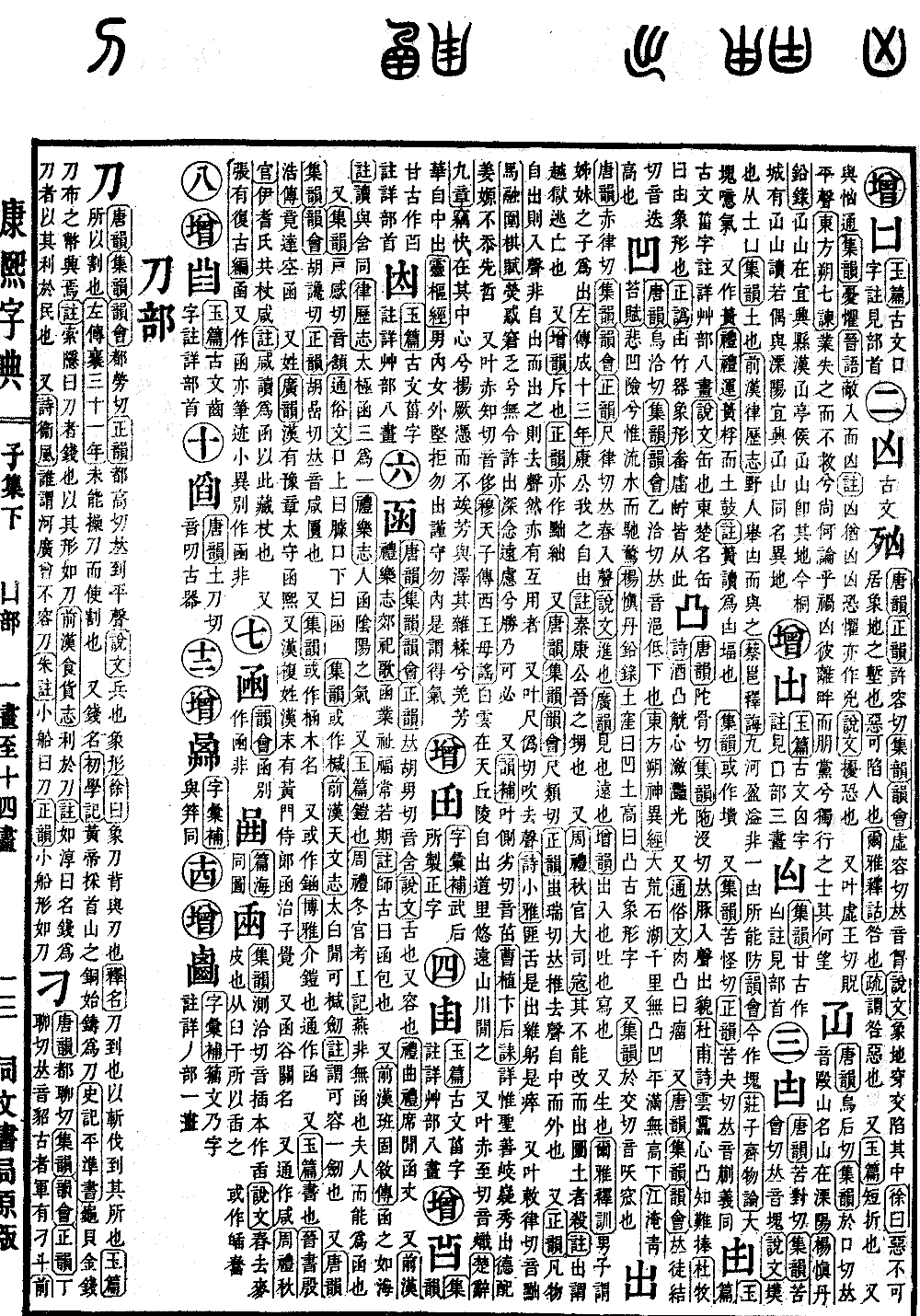
Character: chu
Kangxi Stroke Count: 5
Page 135, Number 11
In the Tang Rhyme (Tangyun), it is pronounced with the fanqie romanization chiyu. In the Collected Rhymes (Jiyun), Rhyme Assembly (Yunhui), and Correct Rhymes (Zhengyun), it is pronounced with the fanqie romanization chilyu, which is the entering tone (rusheng) of the character chun.
The Explaining Graphs and Analyzing Characters (Shuowen Jiezi) defines it as to advance or go forth (jin). The Expanded Rhymes (Guangyun) defines it as to appear (jian) or to be far (yuan). The Augmented Rhymes (Zengyun) defines it as to exit or enter (churu), to spit out (tu), or to write (xie). It is also defined as to be born (sheng). Approaching the Correct (Erya), in the section Explaining Instruction (Shixun), states that a man refers to his sister's son as chu.
The Commentary of Zuo (Zuo Zhuan), in the thirteenth year of Duke Cheng, states: Duke Kang was born of our house. The commentary notes that Duke Kang of Qin was a nephew to the state of Jin. Also, in the Rites of Zhou (Zhouli), under the section Ministry of Justice, Grand Minister of Justice (Dashikou), it says that execution is carried out for those who do not repent and escape from prison. The commentary notes that chu refers to breaking out of prison and fleeing.
Augmented Rhymes defines it as to dismiss or repel (chitui). Correct Rhymes notes it is also written in a variant form pronounced chu (to dismiss) or chu (insufficient).
In Tang Rhyme, Collected Rhymes, and Rhyme Assembly, it is also pronounced with the fanqie romanization chilei. In Correct Rhymes, it is pronounced with the fanqie romanization chirui, which is the departing tone (qusheng) of the character tui. It means going from the inside to the outside. Correct Rhymes also notes that generally, when a thing comes out of its own accord, it is pronounced in the entering tone. When it is made to come out by something else, it is pronounced in the departing tone. However, these uses are sometimes interchangeable.
It is also used as a rhyming word (xieyun) pronounced with the fanqie romanization chiwei, the departing tone of the character chui. In the Book of Odes (Shijing), Minor Odes (Xiaoya), it says: It is not that the tongue is talkative, but that the person himself is weary and worn out. It is also used as a rhyming word pronounced with the fanqie romanization chilyu, sounding the same as chu (to dismiss). In the Rhapsody on Weiqi (Weiqi Fu) by Ma Rong: Make the opponent distressed and lacking in means, not allowing him to use deceptive tactics; only through deep thought and far-reaching consideration can victory be certain.
In the Rhyme Supplement (Yunbu), it is used as a rhyming word pronounced with the fanqie romanization zelie, sounding the same as zhuo (to sprout). In the Eulogy for Empress Bian (Bian Hou Lei) by Cao Zhi: Carefully considering the sagacious and virtuous, she showed exceptional intelligence since childhood. Her virtue matched that of Jiang Yuan, bringing no shame to the wise ones of former generations.
It is also used as a rhyming word pronounced with the fanqie romanization chizhi, sounding the same as chi (extravagant). In the Ballad of the Queen Mother of the West in the Tale of King Mu (Mu Tianzi Zhuan): White clouds drift in the sky, and the hills appear of their own accord. The road is long and distant, with mountains and rivers separating the way.
It is also used as a rhyming word pronounced with the fanqie romanization chizhi, sounding the same as chi (blazing). In the Nine Cantos (Jiuzhang) of the Songs of the South (Chuci): Feeling a secret joy within, casting aside resentment and waiting no longer. Fragrance and filth are mixed together, yet the fragrance alone emanates from within. In the Spiritual Pivot (Lingshu Jing): The male belongs to the internal and the female to the external; resolutely refuse to let the essential qi leak out. Guard it carefully so that no intrusion occurs; this is called obtaining the qi.